

A “Letter To Airline For Complaint About Noise Level” is a formal way to express dissatisfaction. It addresses excessive noise experienced during a flight. Passengers write it after suffering discomfort. This discomfort is due to loud engines, disruptive passengers, or malfunctioning equipment.
Are you struggling to draft such a letter? We understand it can be tricky. That’s why we’ve created helpful resources.
In this article, you’ll find templates and examples. These samples will simplify writing your noise complaint letter. You can easily adapt them to your specific situation.
Letter To Airline For Complaint About Noise Level
[Your Name]
[Your Address]
[Your Phone Number]
[Your Email Address]
[Date]
[Airline Customer Service Department]
[Airline Address]
Subject: Complaint Regarding Excessive Noise Levels on Flight [Flight Number]
Dear Airline Customer Service,
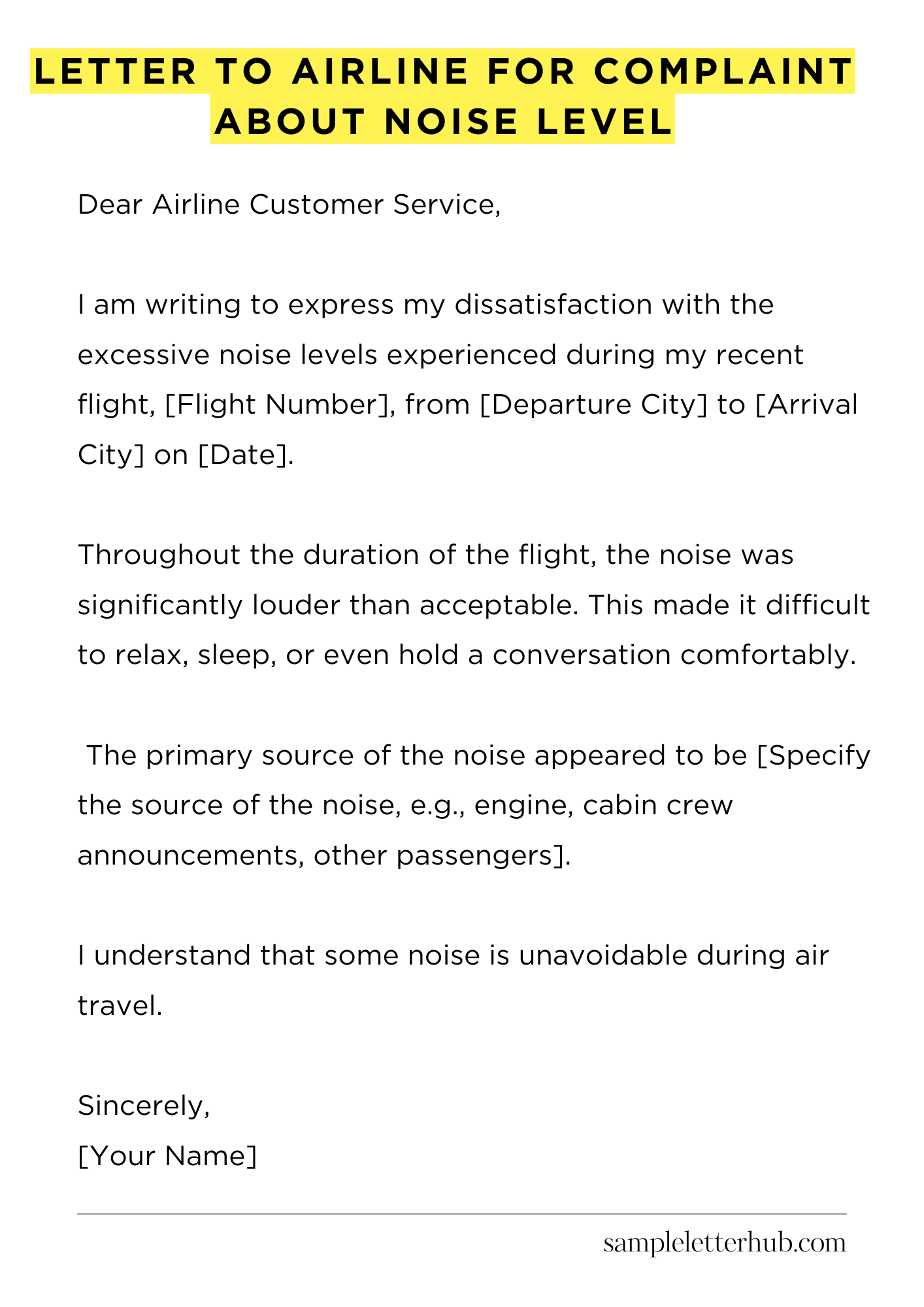
I am writing to express my dissatisfaction with the excessive noise levels experienced during my recent flight, [Flight Number], from [Departure City] to [Arrival City] on [Date].
Throughout the duration of the flight, the noise was significantly louder than acceptable. This made it difficult to relax, sleep, or even hold a conversation comfortably. The primary source of the noise appeared to be [Specify the source of the noise, e.g., engine, cabin crew announcements, other passengers].
I understand that some noise is unavoidable during air travel. However, the level of noise on this particular flight was disruptive and negatively impacted my overall travel experience.
I request that you investigate this matter and take appropriate measures to address the noise levels on future flights. I would appreciate a response outlining the steps you will take to prevent similar issues from occurring again.
Thank you for your time and attention to this matter.
Sincerely,
[Your Name]
How to Write Letter To Airline For Complaint About Noise Level
Subject Line: Capture Attention Immediately
- Be succinct and explicit. Instead of “Complaint,” try “Excessive Noise Complaint – Flight [Flight Number] – [Date]”.
- Include key identifiers: flight number, date, and a brief descriptor of the issue.
- A well-crafted subject line ensures your missive doesn’t languish unread.
Salutation: Initiate with Professionalism
- Avoid overly casual greetings. “Dear Customer Relations Department,” or “To Whom It May Concern,” are acceptable starting points.
- If you know a specific individual’s name, by all means, use it. This demonstrates you’ve done your due diligence.
- Maintain a respectful tone; civility is paramount, even when lodging a grievance.
Introduction: Set the Stage
- Clearly state the purpose of your correspondence in the opening paragraph. For instance: “I am writing to express my profound dissatisfaction with the inordinate noise levels experienced during flight [Flight Number] from [Departure City] to [Arrival City] on [Date].”
- Provide context. Briefly mention your seat number or section of the aircraft.
- This initial salvo should be direct and unambiguous.
Body Paragraphs: Detail the Auditory Agony
- Elaborate on the specific noises that perturbed you. Was it engine drone, incessant chatter, or malfunctioning equipment?
- Quantify the disturbance. Instead of “very loud,” try “decibel levels that consistently exceeded acceptable thresholds.”
- Describe the impact this had on your flight experience. Did it induce anxiety, prevent sleep, or exacerbate a pre-existing condition?
- Avoid hyperbole. Stick to verifiable facts and demonstrable effects.
Supporting Evidence: Bolster Your Claim
- If possible, include any supporting evidence. Did you record the noise levels (discreetly, of course)? Did other passengers corroborate your experience?
- Photographs or videos, if applicable, can lend credence to your complaint.
- Even anecdotal evidence from fellow travelers can fortify your position.
Desired Resolution: Articulate Your Expectations
- Clearly state what you expect from the airline. Are you seeking a partial refund, frequent flyer miles, or an apology?
- Be reasonable in your demands. A measured request is more likely to elicit a favorable response.
- Frame your request in terms of customer satisfaction and future patronage.
Closing: End on a Courteous Note
- Express your hope for a prompt and satisfactory resolution.
- Thank the airline for their time and consideration.
- Use a formal closing such as “Sincerely,” or “Respectfully,” followed by your full name and contact information.
- Proofread meticulously before dispatching your letter. Grammatical errors undermine your credibility.
Frequently Asked Questions: Airline Noise Complaint Letters
This section addresses common inquiries regarding lodging a formal complaint with an airline concerning excessive noise levels experienced during a flight.
Understanding the process can help ensure your complaint is effectively communicated and addressed.
1. What information should I include in my noise complaint letter?
Your letter should detail the flight number, date, time, and specific location (seat number) where you experienced the excessive noise. Describe the nature of the noise and its impact on your comfort.
2. To whom should I address my noise complaint letter?
Address your letter to the airline’s Customer Relations or Customer Service department. Contact information can typically be found on the airline’s website.
3. What kind of noise issues warrant a formal complaint?
Substantial and unusual noise disturbances, such as consistently loud engine noise, malfunctioning equipment, or disruptive passenger behavior that the crew did not address, are valid reasons for complaint.
4. What outcome can I expect from filing a noise complaint?
While there’s no guarantee of compensation, airlines may offer an apology, a partial refund, or travel vouchers as a gesture of goodwill, depending on the severity and validity of the complaint.
5. How long should I wait for a response from the airline?
Allow the airline approximately 4-6 weeks to respond to your complaint. If you haven’t received a reply within this timeframe, consider sending a follow-up email or letter.
Related:
Resignation letter due to rude boss
Resignation letter moving to another state
Resignation letter due to illness of family member
Resignation letter due to study