


Need to update your insurance policy? You may need a “Letter to Add Beneficiary to Insurance Policy.” This letter officially adds a new beneficiary to your existing insurance. It ensures your policy benefits go to the right person after you’re gone.
Don’t worry about starting from scratch. We’ve got you covered. We’re sharing easy-to-use templates. You’ll find several Letter to Add Beneficiary to Insurance Policy examples here. They can help with various scenarios.
These sample letters simplify the process. They make it easy to write your own. Just customize the provided examples to suit your needs. You can add a beneficiary to your insurance policy confidently.
[Your Name]
[Your Address]
[Your Phone Number]
[Your Email Address]
[Date]
[Insurance Company Name]
[Insurance Company Address]
Subject: Request to Add Beneficiary to Insurance Policy – Policy Number [Your Policy Number]
Dear Sir/Madam,
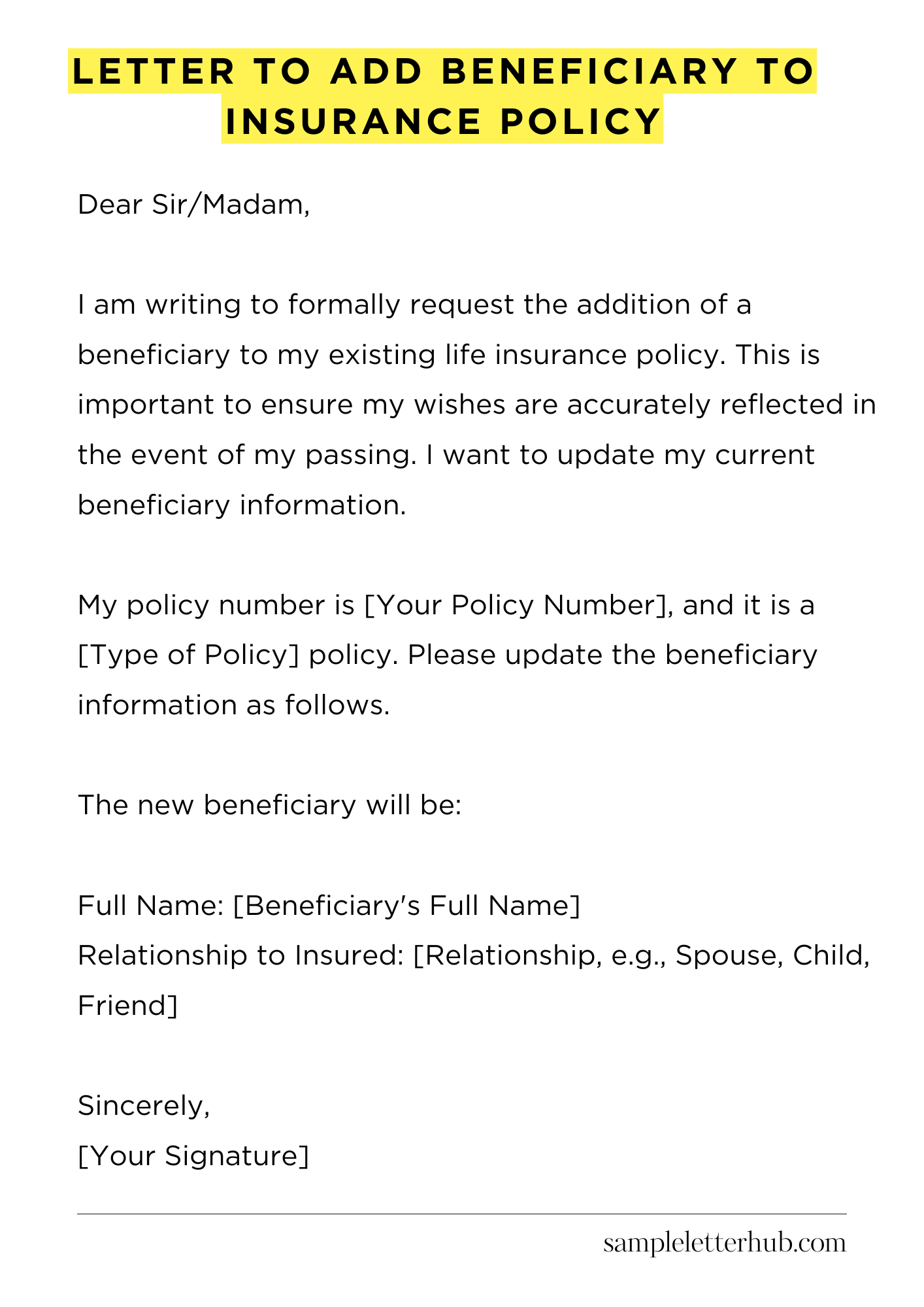
I am writing to formally request the addition of a beneficiary to my existing life insurance policy. This is important to ensure my wishes are accurately reflected in the event of my passing. I want to update my current beneficiary information.
My policy number is [Your Policy Number], and it is a [Type of Policy] policy. Please update the beneficiary information as follows.
The new beneficiary will be:
Full Name: [Beneficiary’s Full Name]
Relationship to Insured: [Relationship, e.g., Spouse, Child, Friend]
Date of Birth: [Beneficiary’s Date of Birth]
Social Security Number (if applicable): [Beneficiary’s Social Security Number – optional, but helpful]
Address: [Beneficiary’s Full Address]
Percentage of Benefit: [Percentage, e.g., 100%, 50%, 25% – if multiple beneficiaries, specify each percentage]
I have included this information for your convenience. Please note that I understand the importance of keeping my beneficiary information current. If there is a need for additional documentation from my end, please inform me right away.
I would also appreciate confirmation once this change has been processed. A quick note confirming the changes would be appreciated.
Thank you for your time and attention to this matter. I look forward to your prompt response and confirmation of this change.
Sincerely,
[Your Signature]
How to Write Letter to Add Beneficiary to Insurance Policy
Designating a beneficiary is a crucial step in ensuring your insurance policy fulfills its intended purpose. It guarantees that your chosen individuals receive the financial benefits you’ve meticulously planned for. Adding a beneficiary can feel daunting, but the process is surprisingly straightforward. This guide will walk you through crafting a precise and impactful letter.
1. Initiate the Process: Preliminary Steps
Before you even begin to ink your missive, you need some preliminary groundwork. First, identify your insurance provider; find their contact information, including the mailing address for policy changes.
Secondly, locate your policy document – it contains vital details, such as your policy number and the specific provisions for beneficiary modifications. This information is sacrosanct for a smooth process.
2. Header: The Formal Salutation
The header sets the tone. Start with the current date, followed by the insurance company’s name and address. Then, address the letter to the appropriate department, usually the “Policyholder Services” or “Beneficiary Department”. Clarity and accuracy here avert potential confusion and expedite processing. Remember, a well-formatted header lends credibility.
3. Subject Line: Explicit Declaration
A concise and unambiguous subject line is paramount. It immediately informs the recipient of the letter’s purpose. Consider using phrases like: “Request to Add Beneficiary to Insurance Policy – [Your Policy Number]” or “Beneficiary Designation Amendment – Policy Number [Your Policy Number]”. Keep it succinct, and put it on the focus.
4. Body: The Core of Your Communication
This is where the meat of your request resides. Start with a polite opening, clearly stating your intention. Provide your full name, policy number, and the names, addresses, and relationship to you of the beneficiary(ies) you wish to add.
You might also want to mention their date of birth and Social Security number, though this is dependent on the company’s requirements. Specify the percentage or portion each beneficiary should receive. Be precise; ambiguity can lead to complications.
5. Supporting Documentation: Augmenting Your Assertion
Some insurance companies may require supporting documentation. This could include copies of birth certificates or other identification. This ensures verification and protection. Review the specific instructions provided by your insurance provider. Attach any required documentation securely to avoid loss.
6. Closing: Courtesy and Confirmation
End the letter with a professional closing, such as “Sincerely” or “Respectfully”. Reiterate your policy number for clarity. Include your printed name, your signature (handwritten), and your contact information. Request a written confirmation of the beneficiary change. This offers you peace of mind and tangible proof of the update. It’s a crucial step.
7. Delivery and Follow-Up: Ensuring Receipt
Send the letter via certified mail with return receipt requested. This provides proof of delivery and ensures that your letter has reached its destination.
Keep a copy of the letter and all supporting documentation for your records. Follow up with the insurance company within a reasonable timeframe (usually 2-4 weeks) if you haven’t received confirmation. Vigilance is key to guaranteeing your wishes are actualized.
FAQs about Letter to Add Beneficiary to Insurance Policy
What is the primary purpose of a letter to add a beneficiary to an insurance policy?
The primary purpose of a letter to add a beneficiary is to formally update the insurance policy documentation to reflect a change in the individuals or entities designated to receive the death benefit upon the policyholder’s passing.
This letter serves as legal notification to the insurance company and ensures that the proceeds are distributed according to the policyholder’s wishes.
What specific information is typically required in a letter to add a beneficiary?
A letter to add a beneficiary typically requires the policyholder’s full name, policy number, and the full legal name, date of birth, and relationship to the policyholder of the new beneficiary.
It’s often necessary to include the beneficiary’s address, and social security number. The letter should clearly state the percentage or specific amount of the death benefit the new beneficiary is entitled to receive, as well as the signature of the policyholder and date.
How does the process of submitting a letter to add a beneficiary work?
The process typically involves writing a formal letter that includes all required information, or using a form provided by the insurance company. The letter or form needs to be signed by the policyholder and sometimes witnessed or notarized, depending on the insurance company’s requirements.
This documentation is then submitted to the insurance company, typically via mail or online portal. The insurance company then processes the request and sends confirmation.
Are there any limitations or restrictions on who can be named as a beneficiary?
While policyholders generally have broad discretion, there might be certain limitations. For instance, some states have laws regarding how much of the death benefit can be left to a minor child or if they require a guardian.
Also, the beneficiary must be a living person or a legally recognized entity (e.g., a trust, a business). In some cases, there might be restrictions if the policy is part of a divorce settlement or other legal arrangement.
What happens if I don’t update my beneficiary information and need to make changes?
If beneficiary information is not updated and a change is needed, the proceeds will be distributed based on the existing beneficiary designation.
This could mean the proceeds go to someone the policyholder no longer wishes to receive them. In the absence of a designated beneficiary, the proceeds are typically paid to the policyholder’s estate, which is subject to the probate process and may not align with the policyholder’s intent. Therefore, regular reviews and updates of beneficiary designations are vital.
Related:
Resignation letter due to rude boss
Resignation letter moving to another state
Resignation letter due to illness of family member
Resignation letter due to study
Resignation letter due to long commute