

Sometimes, you need to ask your travel insurance provider for information. This is where a “Letter Requesting Travel Insurance Policy Information” comes in. The letter’s purpose is simple: to formally request specifics about your travel insurance policy. You might need this for a claim, clarification, or simply to understand your coverage better.
We understand writing such letters can be a hassle. That’s why we’re sharing ready-to-use templates! We have prepared several Letter Requesting Travel Insurance Policy Information samples. These examples cover various situations. Using these will make the writing process simple for you.
Our travel insurance letter examples are easy to adapt. You can easily modify them to fit your specific needs. Accessing your policy details has never been simpler. Just copy and paste, and make it your own!
[Your Name/Company Name]
[Your Address]
[Your Phone Number]
[Your Email Address]
[Date]
[Insurance Company Name]
[Insurance Company Address]
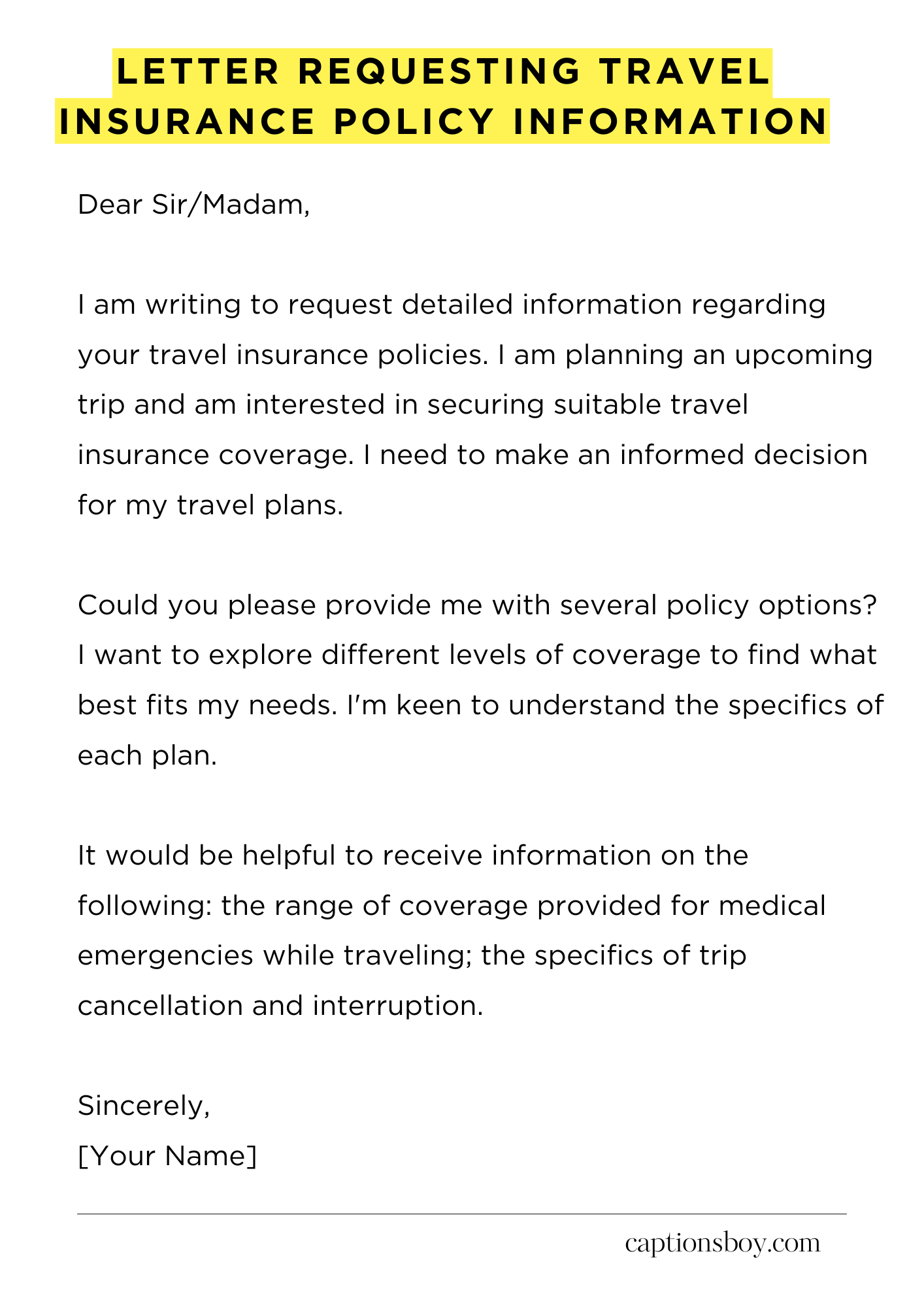
Dear Sir/Madam,
I am writing to request detailed information regarding your travel insurance policies. I am planning an upcoming trip and am interested in securing suitable travel insurance coverage. I need to make an informed decision for my travel plans.
Could you please provide me with several policy options? I want to explore different levels of coverage to find what best fits my needs. I’m keen to understand the specifics of each plan, focusing on things like medical expenses and trip cancellation.
It would be helpful to receive information on the following: the range of coverage provided for medical emergencies while traveling; the specifics of trip cancellation and interruption coverage; the process for filing a claim if something goes wrong; and the associated costs and any deductibles. Please provide details on the exclusions that apply to each policy.
I would also appreciate receiving details of any add-on options available, like coverage for lost luggage or specific activities. I would like the information in a clear and easy to understand format.
Please send the requested information to the address above. Alternatively, you may send it via email. I look forward to receiving your response and carefully reviewing the options.
Thank you for your time and assistance.
Sincerely,
[Your Name]
How to Write Letter Requesting Travel Insurance Policy Information
Securing travel insurance is a savvy move before you embark on any globetrotting adventure. However, there might be times when you require specific details about your existing policy. Perhaps you need clarification on coverage limits or wish to initiate a claim. This guide will navigate you through composing a letter requesting travel insurance policy information, ensuring a clear and concise communication.
1. Commence with Proper Salutations
Your letter’s commencement sets the tone, therefore, begin with a professional salutation. Address the letter to the appropriate department or individual at your insurance provider. If you have a specific contact person, use their name; otherwise, a general greeting like “To Whom It May Concern” is acceptable. Remember, maintaining a polished demeanor from the outset matters.
2. Explicitly State Your Purpose
The core of your communication must be transparent. Open with a statement that directly articulates the reason for your letter. State unequivocally that you are seeking specific policy information, the reason being you want to understand your coverage better, file a claim, or any other pertinent details. Precision is key in this context; this ensures prompt attention.
3. Furnish Pertinent Identification Details
To facilitate the identification process, provide all necessary details related to your travel insurance policy. Include your policy number, the effective dates of your coverage, and your full name. Including your address, phone number, and email address will ensure that the insurer can easily locate your records and respond promptly. Thoroughness prevents unnecessary delays.
4. Detail the Specific Information You Require
Clarity is your ally. Outline the specific information you need from your insurer. Are you looking to understand your policy’s stipulations regarding trip cancellation? Do you need a breakdown of the covered medical expenses? Perhaps you require information on the claims process. Be unambiguous, detailing each requirement. The more explicit you are, the more efficiently your request will be handled.
5. Enclose Supporting Documentation
To support your request and expedite the process, consider including relevant supporting documentation. If you are inquiring about a specific incident, provide copies of any related documentation, such as medical reports, police reports, or travel itineraries. These papers offer substantive verification and boost the insurer’s understanding.
6. Express a Concluding Plea and Contact Information
End your letter on a courteous note. Politely request a timely response and reiterate the best way to reach you. Specify your preferred method of communication – email, phone, or postal mail. Thank the recipient for their time and consideration. A polite closure reinforces your professionalism and encourages a positive response.
7. Finalize and Proofread Meticulously
Before dispatching your letter, proofread it with scrupulous attention. Check for grammatical errors, spelling mistakes, and ensure the tone is professional and respectful. Double-check all the information you provided to guarantee accuracy. A well-crafted and error-free letter signifies your professionalism and heightens the likelihood of a positive and prompt response.
FAQs about Letter Requesting Travel Insurance Policy Information
What information should I include in a letter requesting travel insurance policy information?
A well-crafted letter should include your full name, address, contact information (phone number and email), and the policy number. Clearly state the specific information you are seeking (e.g., a copy of the policy, details about coverage for a specific medical condition, claim procedures). If the request relates to a specific incident, provide dates, locations, and a brief description. Be sure to include the date the policy was active.
Where should I send a letter requesting travel insurance policy information?
The letter should be sent to the insurance provider or the relevant department specified in your policy documentation or on their website. If unsure, check the policy documents for a customer service or claims address. Consider sending the letter via certified mail with return receipt requested to ensure proof of delivery.
How long does it typically take to receive a response to my letter?
Response times vary depending on the insurance company and the complexity of your request. Generally, you can expect a response within 10-30 business days. However, for time-sensitive matters, such as a claim, it’s advisable to follow up if you haven’t heard back within a reasonable timeframe (e.g., 2 weeks). Include a deadline in your letter if appropriate and the matter is urgent.
What if I don’t know my travel insurance policy number?
If you have lost or misplaced your policy number, you can still request information. Provide as much identifying information as possible, such as your full name, date of birth, travel dates, and the name of the insurance provider. If you purchased the policy through a travel agent or online platform, you might contact them for assistance in locating the policy information. A copy of your travel itinerary will also help in identifying the correct policy.
Can I request policy information on behalf of someone else?
Yes, but you will likely need to provide proof of authorization. This may involve providing a Power of Attorney or a written consent letter from the policyholder, along with copies of their identification. The specific requirements depend on the insurance company’s policies, so it’s best to check with them beforehand to determine what is needed. Note that the insurance provider may request verification of identity from the policyholder to prevent fraud.
Related:
Resignation letter due to rude boss
Resignation letter moving to another state
Resignation letter due to illness of family member
Resignation letter due to study
Resignation letter due to long commute