


Dealing with health insurance can be tricky. Sometimes, you might face temporary financial hardship. A “Letter Requesting Temporary Waiver of Medical Insurance Premium” is a crucial tool. It’s a formal request. You’re asking your insurance provider to temporarily excuse you from paying your premium. The goal? To keep your health coverage active during tough times.
Are you struggling to write the right words? We have you covered. This article offers several letter requesting temporary waiver of medical insurance premium templates. These sample letters provide a framework. We will give you examples to guide you. You’ll find it easier to draft your own letter now.
Need help crafting your own waiver request? We’ve compiled some helpful resources for you. Our goal is simple. We aim to empower you with medical insurance premium waiver letter templates. Let our samples assist you. They will guide you through the process of writing letters easily.
[Your Name]
[Your Address]
[Your Phone Number]
[Your Email Address]
[Date]
[Insurance Company Name]
[Insurance Company Address]
Dear [Insurance Company Representative or Department],
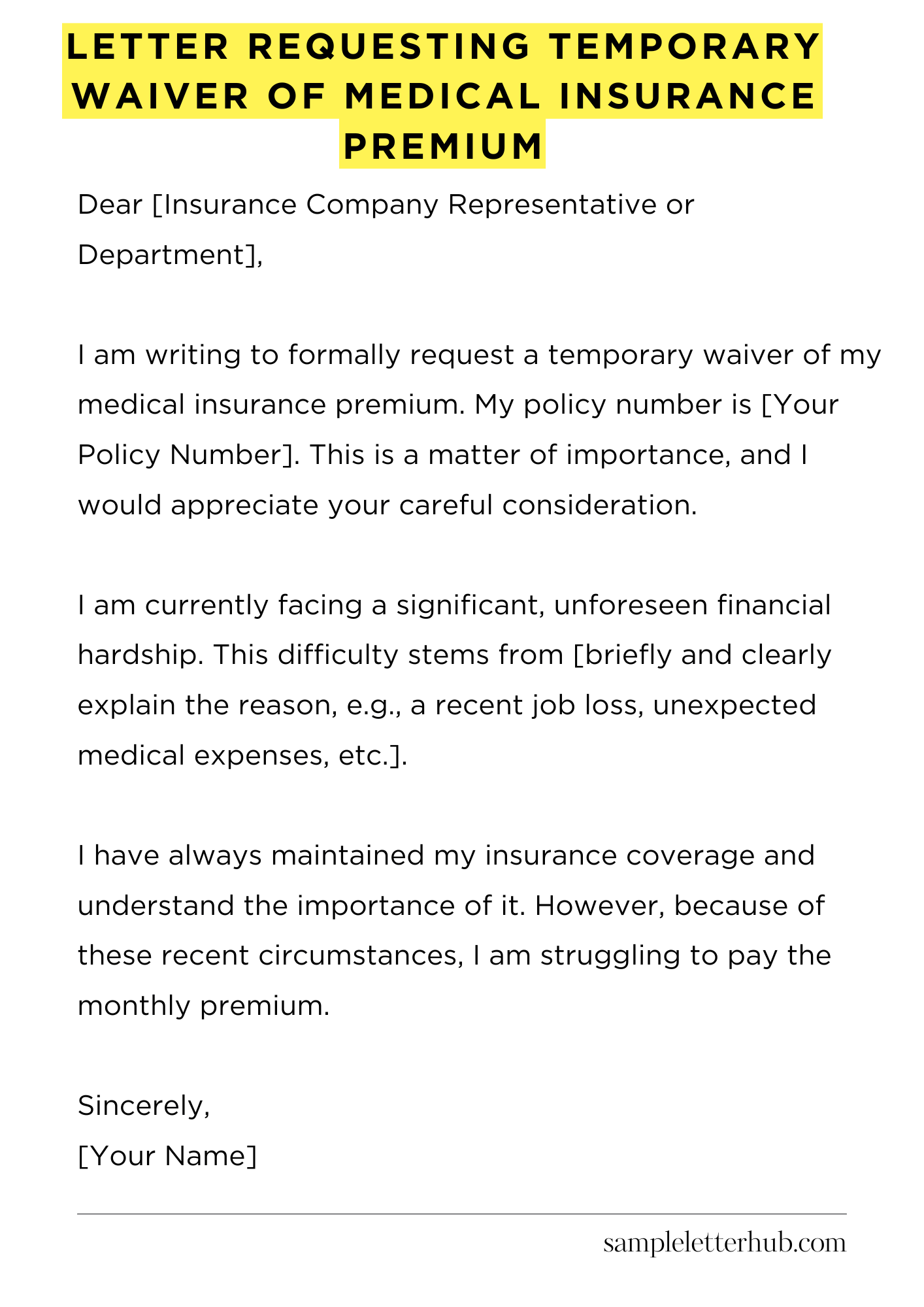
I am writing to formally request a temporary waiver of my medical insurance premium. My policy number is [Your Policy Number]. This is a matter of importance, and I would appreciate your careful consideration.
I am currently facing a significant, unforeseen financial hardship. This difficulty stems from [briefly and clearly explain the reason, e.g., a recent job loss, unexpected medical expenses, etc.]. The situation has created a strain on my ability to meet my financial obligations.
I have always maintained my insurance coverage and understand the importance of it. However, because of these recent circumstances, I am struggling to pay the monthly premium. I would be grateful if you could temporarily waive the premium payment for a specific period. I propose [State the proposed time frame, e.g., three months, six months].
During this time, I intend to focus on resolving my current financial challenges. I believe that after this period, I will be in a much better position to resume my regular premium payments. I am committed to maintaining my health insurance coverage. I value the security it provides.
I am happy to provide any supporting documentation that you may require to support my request. This includes [List any documents you can provide, e.g., proof of unemployment, medical bills, etc.]. Please let me know what is needed to process this request.
Thank you for your time, consideration, and understanding in this matter. I look forward to your positive response. I hope for a swift resolution to this situation.
Sincerely,
[Your Name]
How to Write Letter Requesting Temporary Waiver of Medical Insurance Premium
1. Commence with Proper Salutation
Begin by addressing the recipient with appropriate formality. Use the correct title and the full name of the individual you’re contacting, if possible. “Dear Mr./Ms./Mx. [Surname]” is a sound starting point.
If the specific recipient is unknown, opt for a general, yet respectful, salutation like “To Whom It May Concern.” Make sure to spell the name correctly; a simple typographical error can detract from your credibility.
2. Articulate Your Precise Intent
The first paragraph should succinctly state the purpose of your missive. Clearly and unequivocally state that you are requesting a temporary waiver of your medical insurance premium.
Immediately declare the policy number associated with the insurance coverage. This initial declaration establishes the context and allows the reader to quickly understand the nature of your correspondence.
3. Furnish a Cogent Rationale
This is the pivotal section. Detail the reasons necessitating the waiver. Offer a meticulous, verifiable account of the circumstances. Be explicit, supplying crucial dates, events, and relevant details, all substantiated by supporting documents.
Explain the financial strain you are currently experiencing, such as a temporary loss of income or unexpected medical expenses that make premium payment difficult.
4. Assemble Supporting Documentation
Include copies of any documents that buttress your claim. Attach these documents as evidence that corroborates your account. For example, if you are experiencing a temporary loss of income, include a termination notice, pay stubs, or a letter from your previous employer.
If you are struggling with medical expenses, provide medical bills, invoices, and any pertinent records illustrating the financial impact.
5. Present an Explicit Timeline and Terms
Specify the exact timeframe for which you are requesting the waiver. State the duration for which you anticipate needing this concession. Be precise, indicating the months or the period during which you are unable to fulfill your payment obligations. Consider offering a plan for reinstatement of payments once the temporary financial difficulties are resolved.
6. Conclude with a Courteous Affirmation
Politely close the letter, restating your request. Express gratitude for the recipient’s consideration and time. Include a polite statement of your willingness to provide further information if necessary. Reiterate the urgency of your matter if required. This demonstration of courtesy and cooperation will enhance your appeal.
7. Finalize with Appropriate Signatory
Conclude with a professional closing, such as “Sincerely” or “Respectfully.” Sign the letter by hand in ink. Beneath your signature, type your full name. Provide your contact details, including your phone number and email address, for expeditious communication. Consider including your postal address, too, for a complete and comprehensive letter.
FAQs about Letter Requesting Temporary Waiver of Medical Insurance Premium
What is a letter requesting a temporary waiver of a medical insurance premium?
A letter requesting a temporary waiver of a medical insurance premium is a formal written document submitted to a health insurance provider. This letter formally asks the insurance company to temporarily excuse the policyholder from paying their regular premium payments.
This request is typically made due to unforeseen circumstances, such as a temporary loss of income, job change, a natural disaster, or a serious medical event. The aim is to prevent the policy from lapsing while the policyholder experiences financial hardship.
What information should I include in the letter?
The letter should clearly state your intention, including your policy number and the dates for which you are requesting the waiver. It should provide a clear and concise explanation of the reason for your request, providing supporting documentation if possible.
Examples of supporting documentation can include a recent layoff notice, a medical bill, a disaster damage assessment, or other documents demonstrating financial hardship. Include your contact information in the letter, and sign and date the letter.
What are the chances of my request being approved?
The chances of approval vary greatly and depend on your insurance provider’s specific policies, the stated reason for the request, and the supporting documentation provided. Insurance companies evaluate each request on a case-by-case basis.
Strong supporting documentation, clear explanations, and adherence to the policy’s guidelines will significantly improve your chances. It is best to review your insurance policy documentation and/or contacting your insurance provider for specific requirements.
What happens if my request is approved?
If your request is approved, the insurance company will typically inform you in writing of the terms of the waiver. This will specify the period for which the premium payments are waived.
You might be required to resume your payments after the waiver period, or you might be offered a payment plan to catch up on the missed premiums. Understanding the terms of the approval is vital to avoid policy cancellation or additional penalties.
What happens if my request is denied?
If your request is denied, the insurance provider will typically inform you of the decision in writing, providing the reason for the denial.
If you disagree with the decision, you can explore options like appealing the decision by contacting the insurance company, asking for reconsideration, or seeking assistance from a regulatory agency or consumer protection group. It’s crucial to understand your insurance policy’s dispute resolution processes in case of a denial.
Related:
Resignation letter due to rude boss
Resignation letter moving to another state
Resignation letter due to illness of family member
Resignation letter due to study