

Need help paying those insurance premiums? A “Letter Requesting Temporary Relief for Premium Payments” is a formal way to ask your insurance company for a break. It’s a lifeline when you’re facing financial hardship. The goal? To temporarily reduce or delay your premium payments.
Writing this kind of letter can be tricky. Don’t worry! We’ve got you covered. This article offers helpful letter templates. We’ll share samples and examples of “Letter Requesting Temporary Relief for Premium Payments.” Using these, you can craft a clear and effective letter.
Our user-friendly examples make it simple. Adapt the samples to your situation. You’ll be able to communicate your needs confidently. Get ready to download the letter you need!
[Your Name]
[Your Address]
[Your Phone Number]
[Your Email Address]
[Date]
[Insurance Company Name]
[Insurance Company Address]
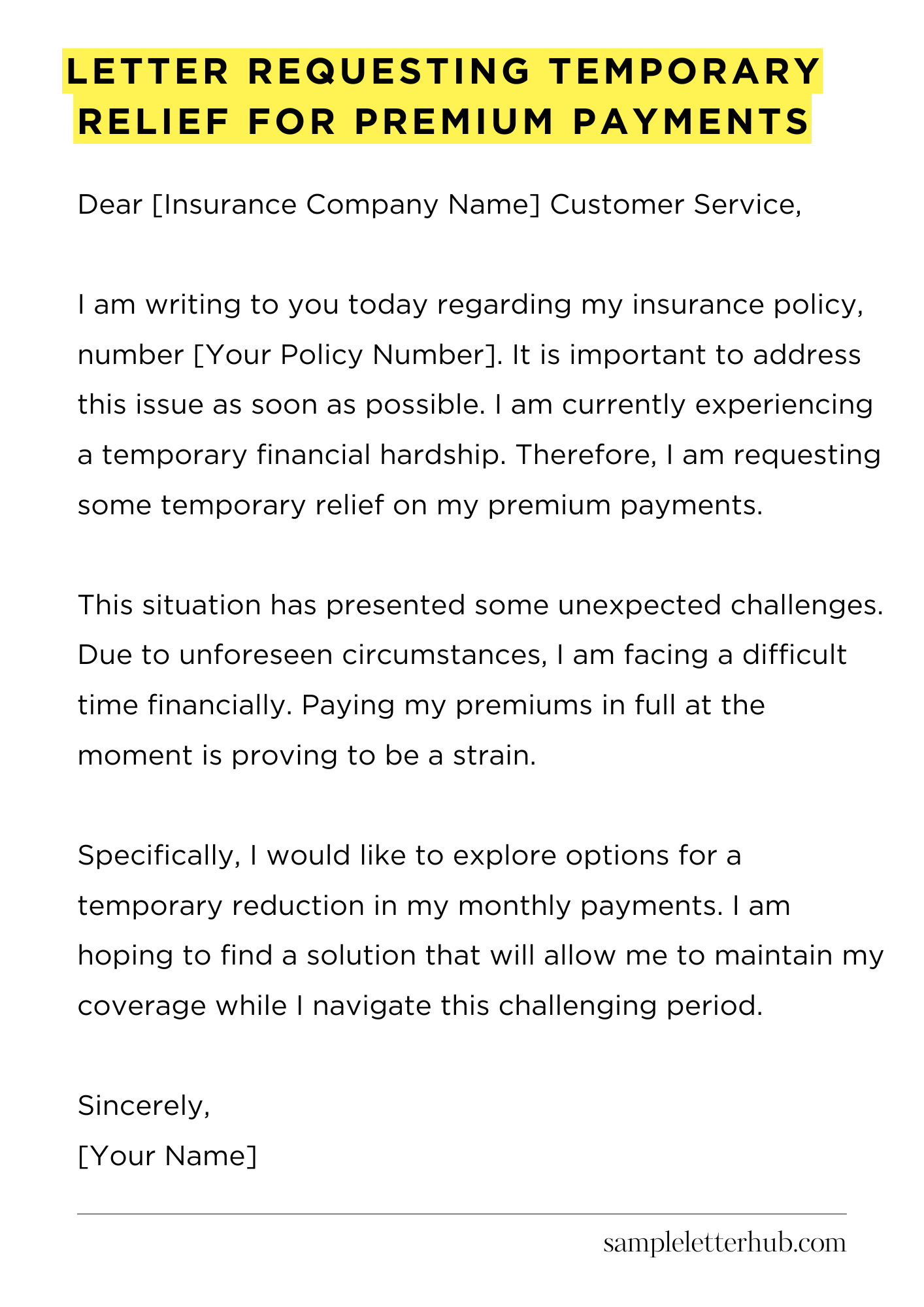
Dear [Insurance Company Name] Customer Service,
I am writing to you today regarding my insurance policy, number [Your Policy Number]. It is important to address this issue as soon as possible. I am currently experiencing a temporary financial hardship. Therefore, I am requesting some temporary relief on my premium payments.
This situation has presented some unexpected challenges. Due to unforeseen circumstances, I am facing a difficult time financially. Paying my premiums in full at the moment is proving to be a strain. I would be extremely grateful if you would consider my request.
Specifically, I would like to explore options for a temporary reduction in my monthly payments. I am hoping to find a solution that will allow me to maintain my coverage while I navigate this challenging period. I am committed to fulfilling my obligations under the policy. I plan to resume my regular payments as soon as my financial situation improves.
I understand the importance of maintaining my insurance coverage. I value the security it provides. I am also eager to find a mutually agreeable solution. I would appreciate it if you could contact me at your earliest convenience to discuss this further.
I am available by phone at [Your Phone Number] or by email at [Your Email Address]. Please let me know what documentation, if any, you might require.
Thank you for your time, understanding, and consideration of my request. I look forward to hearing from you soon.
Sincerely,
[Your Name]
How to Write Letter Requesting Temporary Relief for Premium Payments
Life throws curveballs, doesn’t it? Unexpected financial burdens can strike at any moment, and the obligation to make premium payments can become a significant strain.
In such circumstances, seeking temporary relief from your insurance provider is a prudent course of action. This guide will walk you through the essential steps involved in crafting a compelling letter requesting a payment respite. Let’s start!
1. Initiate Contact and Articulate the Predicament
Your missive should commence with a formal salutation, addressing the appropriate department or individual at your insurance company. Next, the crux of your narrative unfolds.
Be forthright and transparent. Ascribe the specific reason for your financial predicament. Were you impacted by job displacement? Did an unexpected medical expense arise? Detail the circumstances; avoid obfuscation. Provide a concise, yet detailed, overview of the predicament, ensuring factual accuracy.
2. Provide Comprehensive Policy Information
After outlining your difficulties, immediately include all pertinent policy details. This will help the insurer quickly locate your account and begin their review. Include your policy number, the type of insurance policy (e.g., life, health, auto), and any other relevant identification numbers.
This diligent approach expedites the processing of your request, so make sure all the information is accurate. This diligence is crucial for a prompt assessment.
3. Clearly State the Specific Relief Requested
Be explicit about the type of accommodation you seek. Are you requesting a payment deferral? A temporary reduction in premiums? A complete suspension of payments for a set duration?
Clearly specify the desired timeframe for this relief. For instance, “I am requesting a deferral of my premium payments for a period of three months.” Precision is paramount to prevent misunderstandings and streamline the decision-making process.
4. Offer Supporting Documentation
Your letter’s persuasiveness hinges on the evidence you provide. Attach supporting documentation that validates your claims. If you’ve lost your job, include a termination notice. If facing a medical emergency, provide medical bills or a doctor’s statement.
Other types of pertinent documentation might include bank statements or credit card statements that substantiate your reduced financial capacity. The more documentation, the stronger the validity of your situation.
5. Express Gratitude and Maintain a Professional Demeanor
Politeness is a powerful tool. Express your gratitude for the insurance company’s consideration. Acknowledge the importance of maintaining your insurance coverage and reiterate your intent to resume regular payments once your financial situation stabilizes.
Conclude with a professional closing, such as “Sincerely” or “Respectfully,” followed by your full name, address, and contact information. Show them you understand and appreciate them.
6. Proofread and Edit with Meticulous Care
Before dispatching your letter, meticulously proofread it for any grammatical errors or typos. Ensure the tone is professional, the language is clear, and the content is easily understood. A well-written letter reflects positively on your seriousness and increases the likelihood of a favorable response. A polished letter indicates your diligence.
7. Delivery and Follow-Up: Ensuring a Response
Opt for a delivery method that provides a record of receipt, such as certified mail with a return receipt requested. This ensures you have proof that your letter was received. Keep a copy of the letter and all supporting documentation for your records.
If you haven’t received a response within a reasonable timeframe (typically two to four weeks), follow up with the insurance company via phone or email, referencing your original request and the date of submission. This diligent follow-up can often expedite the process and ensures your request remains on their radar.
FAQs about Letter Requesting Temporary Relief for Premium Payments
What is a letter requesting temporary relief for premium payments?
A letter requesting temporary relief for premium payments is a formal written communication sent to an insurance provider, loan company, or other entity to ask for a temporary reduction or suspension of premium payments.
This request is typically made due to unforeseen financial hardship, such as job loss, medical expenses, or other significant changes in the individual’s or company’s financial circumstances. The letter aims to negotiate a short-term solution that prevents the policy or agreement from lapsing while the financial situation stabilizes.
What information should be included in a letter requesting temporary relief?
The letter should clearly state the reason for the financial hardship, providing specific details and supporting documentation (e.g., pay stubs, medical bills). It should include the policy or account number, the desired relief (e.g., a payment reduction, temporary payment suspension, or change in payment schedule), and the proposed duration of the relief.
Contact information, including the sender’s name, address, phone number, and email address, is essential. Be clear, concise, and professional in your request.
What are the possible outcomes after submitting a request for premium relief?
The insurance company or lender will review the request and supporting documentation. The outcome can vary. They may approve the request in full, approve it with modifications (e.g., a shorter duration or different payment plan), or deny the request.
They might also require additional information. If the request is approved, the details of the agreement, including the terms, duration, and any accrued interest or fees, will be provided. If the request is denied, the reason for denial will typically be provided.
How does requesting temporary relief affect my credit score or policy coverage?
The impact on your credit score depends on the terms of the agreement reached. A temporary suspension of payments, if agreed upon, might not directly harm your credit score if it’s explicitly documented and agreed upon. However, defaulting on payments without an agreement can negatively affect your credit.
With regard to policy coverage, a temporary suspension or reduced payment plan often maintains some level of coverage, but the specifics depend on the insurance policy terms. Be sure to understand any changes to coverage before agreeing to a modified payment plan. It is important to know that the policy may lapse if payments are not resumed after the temporary relief period.
What alternatives are available if my request for temporary relief is denied?
If the initial request for temporary relief is denied, there are alternative options. You can try to negotiate a different payment plan, such as a longer repayment period. You could seek assistance from a financial advisor or a credit counselor to explore other options.
If the financial hardship is expected to be prolonged, you could also explore the possibility of selling or refinancing the asset covered by the policy, or if it is an insurance policy, you could consider reducing coverage or exploring alternative policies with lower premiums. It’s often helpful to provide additional documentation or clarify the reasons for the request if the initial denial did not fully reflect the financial difficulty.
Related:
Resignation letter due to rude boss
Resignation letter moving to another state
Resignation letter due to illness of family member
Resignation letter due to study