

Life throws curveballs. Sometimes, these curveballs impact your finances. A “Letter Requesting Reduced Premium Due to Financial Hardship” is a tool. It’s a formal request. You send it to your insurance provider. The goal is simple: to lower your insurance premium payments. This letter explains your current financial struggles.
Dealing with financial hardship is tough. We want to help ease the burden. This article provides helpful resources. You’ll find templates, examples, and samples. These are all for a “Letter Requesting Reduced Premium Due to Financial Hardship”. We will simplify the process.
We understand writing these letters can be tricky. Use these samples to draft your own. Adapt the examples to fit your specific situation. We’ve covered various insurance scenarios. Now, let’s get started. Get ready to download. Your financial relief is within reach!
[Your Name]
[Your Address]
[Your Phone Number]
[Your Email Address]
[Date]
[Insurance Company Name]
[Insurance Company Address]
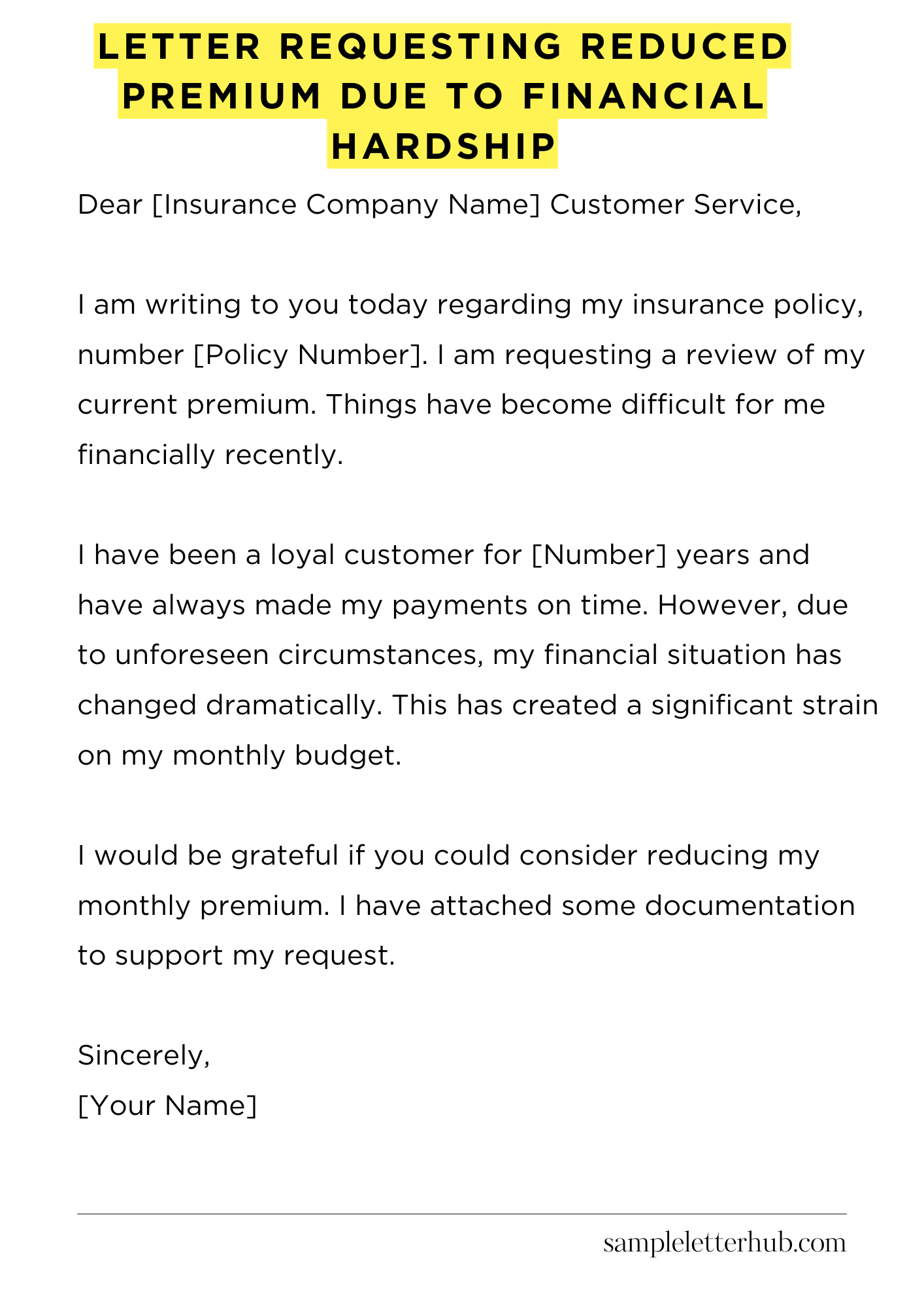
Dear [Insurance Company Name] Customer Service,
I am writing to you today regarding my insurance policy, number [Policy Number]. I am requesting a review of my current premium. Things have become difficult for me financially recently.
I have been a loyal customer for [Number] years and have always made my payments on time. However, due to unforeseen circumstances, my financial situation has changed dramatically. This has created a significant strain on my monthly budget.
I would be grateful if you could consider reducing my monthly premium. I have attached some documentation to support my request. This includes [List of documents, e.g., recent bank statements, proof of job loss, medical bills]. I am hoping to keep my insurance coverage. I need to maintain this protection for myself and my family.
I understand that changes to my premium may depend on many factors. I am willing to discuss my situation further and explore any options available to me. I want to keep my policy active.
Thank you very much for your time and understanding. I look forward to hearing from you soon. I appreciate your assistance with this matter.
Sincerely,
[Your Name]
How to Write Letter Requesting Reduced Premium Due to Financial Hardship
Life throws curveballs. Sometimes, these curveballs manifest as financial setbacks. If you find yourself grappling with economic precarity and struggling to meet your insurance premium payments, crafting a compelling letter requesting a reduced premium is a crucial step.
1. Initiate: The Salutation and Identification
Begin your missive with a formal salutation. Address the recipient, usually the insurance company representative or department, by name if possible.
Follow this with a concise identification of yourself. Include your full name, policy number, and any other pertinent information that facilitates swift processing of your request. This helps the recipient to quickly understand whom they are dealing with.
2. The Premise: Articulating Your Plight
The core of your letter lies in succinctly elucidating your financial straits. Detail the circumstances that have led to your hardship. Be candid and forthright.
This section requires lucidity; avoid ambiguous language. Examples may include job loss, medical expenses, or any other significant, verifiable financial burden. Substantiate your claims with concrete evidence. Evidence can enhance your credibility.
3. Substantiating Your Case: Presenting Supporting Documentation
This is where you fortify your argument. Attach copies of documents that validate your assertions. Include pay stubs (or lack thereof), bank statements reflecting diminished income, medical bills, or any other material that corroborates your financial situation. Avoid sending original documents.
Make sure you retain copies of everything for your records. The more comprehensive your supporting documentation, the stronger your case will be.
4. The Specifics: Detailing Your Request
Clearly state what you are seeking. Are you requesting a temporary reduction in premium payments? A payment plan? Or perhaps a complete waiver of the premium for a defined period? Be precise in your request. Specify the amount or percentage you are seeking to have reduced.
Explicitly articulating your needs prevents any ambiguity and facilitates the recipient’s ability to act upon your request promptly.
5. Illustrating the Impact: Explaining the Consequences of Non-Assistance
This section is designed to illustrate the ramifications of not granting your request. Explain how your inability to pay the premium will impact your ability to maintain coverage. This underscores the potential loss of coverage, which could leave you exposed to further financial vulnerability.
Highlighting the dire consequences of premium non-payment serves as a subtle, yet potent, persuader. This is where you convey the gravity of the situation.
6. Expressing Gratitude and Providing Contact Information: The Closing Act
Conclude your letter with a gracious closing. Express your gratitude for the recipient’s time and consideration. Provide your contact information: phone number and email address. This ensures they can easily reach you for clarification or further information. A prompt response demonstrates professionalism and maximizes the likelihood of a favorable outcome.
7. The Culmination: Proofreading and Dispatch
Before dispatching your letter, meticulously proofread it for any grammatical errors or typos. Ensure all attachments are correctly labeled and secured.
Make copies of the letter and all supporting documents for your records. Then, dispatch the letter via certified mail with a return receipt requested. This provides proof of delivery and ensures a paper trail. This can be very useful if a dispute arises.
FAQs about Letter Requesting Reduced Premium Due to Financial Hardship
What information should I include in a letter requesting a reduced insurance premium due to financial hardship?
Your letter should clearly state your policy number and the specific type of insurance (e.g., auto, home, health). Provide a concise explanation of your financial hardship, including the reasons (job loss, medical bills, etc.) and its impact on your ability to pay the premium.
Include supporting documentation, such as recent pay stubs, bank statements, medical bills, or unemployment benefit statements. Clearly state what premium reduction you are seeking and for how long. Finally, include your contact information for the insurer to reach you.
What types of financial hardship qualify for a reduced insurance premium?
Qualifying financial hardships typically include significant income reduction due to job loss, reduction in work hours, or business closure.
Other qualifying circumstances can be extraordinary medical expenses, unexpected and significant home or car repair costs, or other unforeseen financial burdens that severely impact your ability to pay your premiums. The specific criteria vary by insurance provider and state regulations.
What supporting documentation is typically required with a request for a reduced premium?
You’ll generally need to provide documents that verify your financial situation. Common requirements include recent pay stubs or proof of unemployment benefits to verify income. Bank statements can demonstrate your current financial standing and expenditures.
Medical bills or invoices may substantiate large healthcare expenses. Letters from employers (if applicable) and any documents related to the source of your hardship are all considered helpful documentation.
How long does it typically take to get a response after sending a hardship letter?
Response times can vary depending on the insurance company’s processing procedures and the volume of requests they are receiving.
However, you should generally expect to hear back within a few weeks, sometimes sooner. It is a good practice to follow up with the insurance company if you have not received a response within a reasonable timeframe (e.g., 3-4 weeks).
What happens if my request for a reduced premium is denied?
If your request is denied, the insurance company will typically provide a written explanation. You may have the option to appeal the decision, often requiring additional supporting documentation or providing further details about your circumstances.
You can also explore options such as changing your coverage to a more affordable plan, shopping for a new insurance provider, or seeking assistance from consumer advocacy groups or financial counseling services. Be sure to consider your payment options with your insurance company.
Related:
Resignation letter due to rude boss
Resignation letter moving to another state
Resignation letter due to illness of family member
Resignation letter due to study