

Navigating financial hardship can be tough. Sometimes, you need help adjusting policies. This is where a letter requesting policy adjustment during hardship comes in. It’s a formal way to ask for changes. The goal is to ease your burden. It could be for things like payment plans or temporary relief.
Need help crafting your own letter? We’ve got you covered. We’ll show you how. We provide templates, examples, and samples. Use them to create a compelling letter requesting policy adjustment. It’s easier than you think.
This article is your guide. Get ready to write. We aim to simplify the process. You’ll find different letter formats. Find the best fit for your needs. We believe in making things straightforward.
[Your Name]
[Your Address]
[Your Phone Number]
[Your Email Address]
[Date]
[Recipient’s Name]
[Recipient’s Title]
[Company Name]
[Company Address]
Dear [Recipient’s Name],
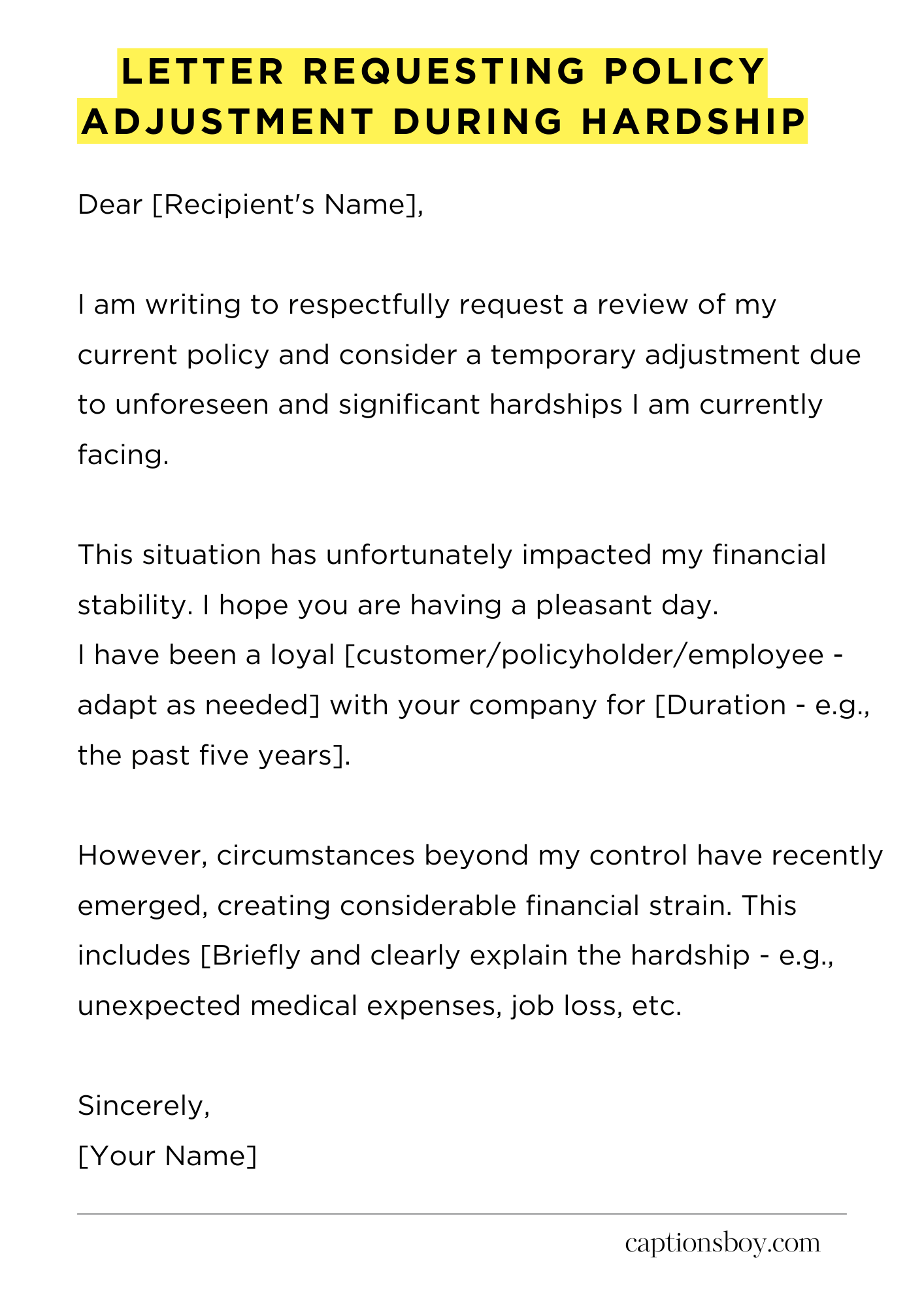
I am writing to respectfully request a review of my current policy and consider a temporary adjustment due to unforeseen and significant hardships I am currently facing. This situation has unfortunately impacted my financial stability. I hope you are having a pleasant day.
I have been a loyal [customer/policyholder/employee – adapt as needed] with your company for [Duration – e.g., the past five years]. Throughout this time, I have always strived to meet my obligations and adhere to the terms of my agreement. I have always held your organization in high regard.
However, circumstances beyond my control have recently emerged, creating considerable financial strain. This includes [Briefly and clearly explain the hardship – e.g., unexpected medical expenses, job loss, etc. Be concise]. This difficult situation presents a substantial challenge to my ability to maintain my regular payments. Therefore, I am finding it difficult.
I understand the importance of fulfilling my commitments. I am eager to work with you to find a solution that will enable me to continue my association with your company without adding further strain during this period. I value my relationship with you all very much.
I would be grateful if you would consider a temporary adjustment to my [Policy type, e.g., payment schedule, coverage, etc.]. I am open to discussing various options, such as a temporary reduction in payments, a modified payment plan, or a temporary suspension of certain features. I would appreciate the opportunity to discuss this further with someone at your convenience. I am also flexible, of course.
I have attached [Optional: List any supporting documentation, e.g., medical bills, unemployment notice, etc.] to support my request and provide additional context for my situation. I have also tried to anticipate any questions you may have.
Thank you for your time, consideration, and understanding during this difficult time. I look forward to your positive response and hope we can reach a resolution. I truly appreciate your attention to this important matter.
Sincerely,
[Your Name]
How to Write Letter Requesting Policy Adjustment During Hardship
Navigating financial adversity can feel like traversing a labyrinth. Sometimes, circumstances conspire to render us incapable of adhering to pre-established agreements. When you find yourself in such a predicament regarding a policy, whether it’s an insurance premium, a loan repayment, or a utility bill, a well-crafted letter requesting an adjustment is your most potent instrument.
1. Commence with Decorum: The Salutation and Introductory Prolegomenon
Begin with a formal salutation. Address the recipient appropriately; “Dear Mr./Ms./Mx. [Last Name]” is generally preferable unless you have a pre-existing rapport. In the introductory paragraph, succinctly state the purpose of your communication. Acknowledge the policy number and the specific policy in question. Briefly, yet clearly, allude to the hardship necessitating the request. Do not immediately delve into a sob story.
2. The Crucible of Circumstance: Articulating the Hardship
This section demands precision and honesty. Detail the specific circumstances leading to your current predicament. Substantiate your claims with concrete evidence. For instance, if you’ve lost your job, state the date of termination and, if possible, attach a copy of the severance documentation. If it’s a medical emergency, provide relevant medical bills or records. Quantify the financial impact where feasible; illustrate the magnitude of your inability to fulfill the original terms. Vagueness breeds suspicion, so be forthright, and transparent.
3. Presenting the Prognosis: Detailing the Proposed Adjustment
Clearly delineate the adjustment you are seeking. Be specific. Are you requesting a temporary reduction in payments? A deferred payment schedule? Or perhaps a complete waiver of specific fees? Specify the desired timeframe for the adjustment. Propose concrete solutions. Avoid sweeping generalizations; suggest concrete modifications that you believe are viable and equitable. This demonstrates your commitment to rectifying the situation, not simply shirking your responsibilities.
4. Armory of Evidence: Assembling Supporting Documentation
This is where you fortify your argument. Include copies of any documents that validate your claims. These might include: bank statements, pay stubs, medical records, unemployment verification, or any other pertinent information. Be meticulous; ensure all documents are legible and clearly labeled. Do not send originals; keep those for your own records. A well-documented letter significantly enhances the likelihood of a favorable response. Always mention the enclosures and describe them briefly.
5. Cultivating Goodwill: Demonstrating Your Intent and Capability
Reiterate your commitment to fulfilling your obligations. Express your desire to work collaboratively with the policy provider. If possible, demonstrate a history of responsible behavior. This might involve highlighting previous on-time payments, proactive communication in the past, or your willingness to explore alternative solutions. Reassure the recipient of your intention to resume adherence to the original terms as soon as your circumstances improve. This signifies your accountability.
6. The Concluding Admonition: Formal Closing and Contact Information
Conclude with a professional closing, such as “Sincerely,” or “Respectfully,” followed by your full name. Provide your contact information, including your address, phone number, and email address. Ensure your contact information is up-to-date and easily accessible. Express gratitude for their consideration and mention that you await their prompt response. This shows respect for their time.
7. Polishing the Parchment: Proofreading and Delivering the Final Draft
Before dispatching your letter, meticulously proofread it for any grammatical errors, spelling mistakes, or typos. Ensure the tone is professional, respectful, and clear. Have someone else review it as a fresh pair of eyes can often catch errors you might miss. Make a copy for your records. If possible, send the letter via certified mail with return receipt requested. This provides proof of delivery. A well-composed letter, adhering to these guidelines, dramatically elevates your prospects of securing the policy adjustment you require.
FAQs about Letter Requesting Policy Adjustment During Hardship
What is a letter requesting a policy adjustment during hardship?
A letter requesting a policy adjustment during hardship is a formal written communication addressed to a company, organization, or institution. It explains a difficult financial, medical, or personal situation (the hardship) that is preventing the individual from meeting the terms of a specific policy or agreement. The letter requests a modification to those terms, such as a temporary payment reduction, a deferred payment plan, or a waiver of certain fees or penalties. The goal is to obtain temporary or permanent relief from the original policy’s requirements due to unforeseen circumstances.
What information should I include in the letter?
A compelling letter should include a clear identification of the policy or agreement impacted (account number, policy number, etc.), a detailed description of the hardship (be specific and provide dates and relevant details), documentation to support your claims (e.g., medical bills, layoff notices, bank statements), the specific adjustment you are requesting, the period of time for which you need the adjustment, and your contact information. Be respectful and professional in tone throughout the letter.
What types of adjustments can I request?
The type of adjustments you can request will depend on the specific policy and the nature of your hardship. Common requests include: a temporary reduction in payments, a payment plan that allows you to catch up on missed payments, a deferral of payments to a later date, a waiver of late fees or penalties, an extension on the due date, and in some cases, a complete waiver of the debt. It’s crucial to tailor your request to your specific situation and the terms of the policy in question.
What supporting documentation should I include?
Supporting documentation is crucial for validating your hardship claim. Examples of documents include: medical bills and records, a doctor’s note, a notice of job loss or furlough, unemployment benefit statements, bank statements showing reduced income or increased expenses, death certificates, divorce decrees, or documentation related to natural disasters or other unexpected events. Gather as much relevant documentation as possible to strengthen your case.
What is the best way to submit the letter?
It’s generally recommended to submit the letter through a method that provides proof of delivery. This could include certified mail with return receipt requested, or electronic methods that provide confirmation of receipt, such as an email with read receipt confirmation. Keep a copy of the letter and all supporting documentation for your records. If the policy specifies a particular method of submission, always follow those instructions.
Related:
Resignation letter due to rude boss
Resignation letter moving to another state
Resignation letter due to illness of family member
Resignation letter due to study
Resignation letter due to long commute