


A letter of explanation for previous surgery is a written document. It details past surgical procedures. Its main purpose is to provide information. This is often to insurance companies, employers, or other entities. They need to understand your medical history.
Need to write a letter of explanation? We get it. It can be tricky. Don’t worry, we’re here to help. This article provides helpful letter of explanation samples. You’ll find templates and examples. This will help you craft your own letter easily.
We are giving you resources. We have templates to guide you. Use these to make your writing process simple. Writing your letter of explanation just got easier!
[Your Name/Address]
[Date]
[Recipient Name/Address]
Dear [Recipient Name],
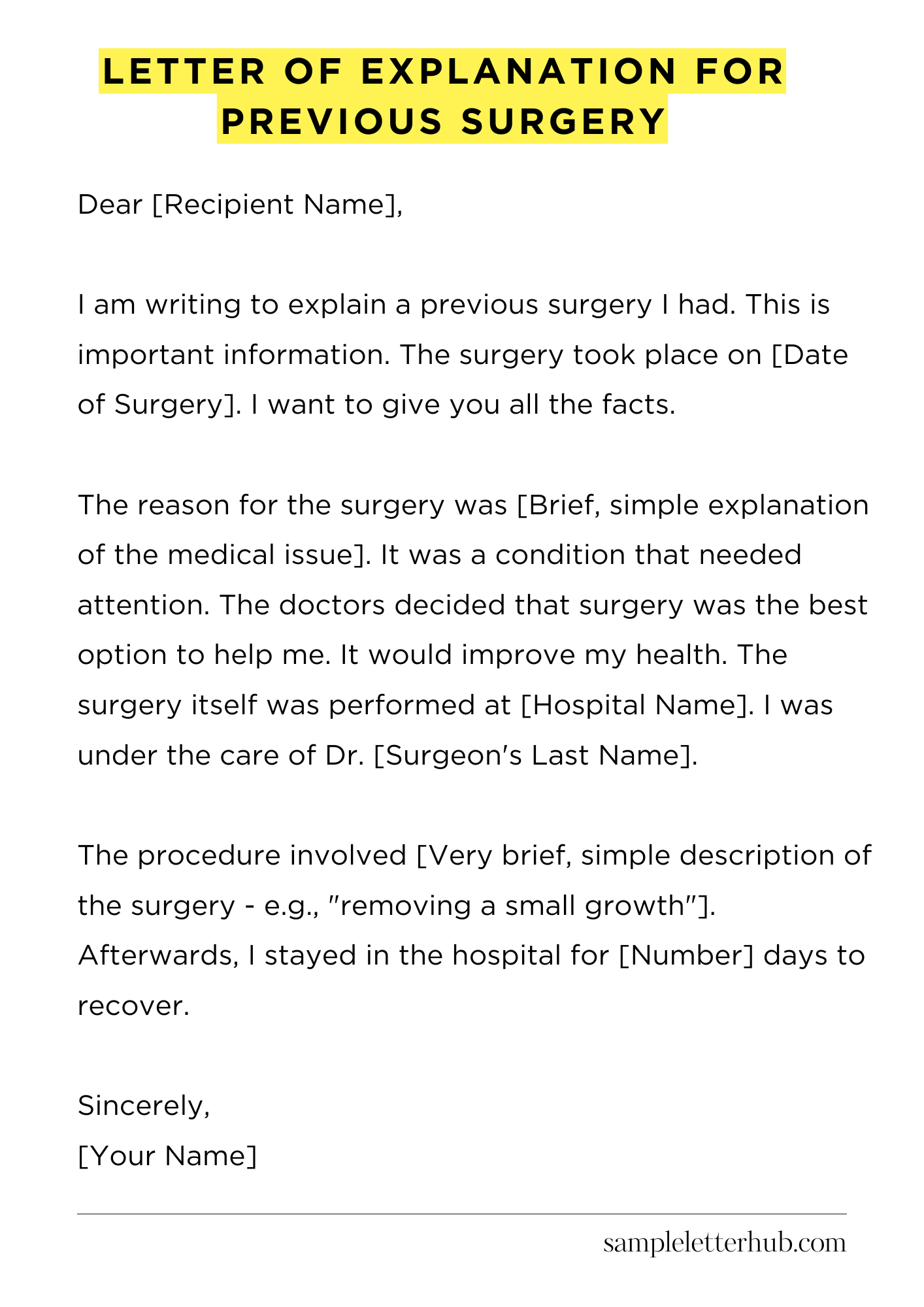
I am writing to explain a previous surgery I had. This is important information. The surgery took place on [Date of Surgery]. I want to give you all the facts.
The reason for the surgery was [Brief, simple explanation of the medical issue]. It was a condition that needed attention. The doctors decided that surgery was the best option to help me. It would improve my health. The surgery itself was performed at [Hospital Name]. I was under the care of Dr. [Surgeon’s Last Name].
The procedure involved [Very brief, simple description of the surgery – e.g., “removing a small growth”]. Afterwards, I stayed in the hospital for [Number] days to recover. This allowed the medical team to monitor me. I followed all the post-operative instructions carefully.
Since the surgery, I have been making good progress. I am feeling much better now. There are some ongoing effects, such as [Brief mention of any lingering effects or limitations, if any – e.g., “a slight scar,” “occasional discomfort”]. These are minor and manageable. I have regular follow-up appointments.
I believe it is crucial to be open about my health. I am available to answer any further questions you may have. Thank you for your time and understanding. I appreciate your willingness to be informed.
Sincerely,
[Your Name]
How to Write Letter of Explanation for Previous Surgery
A letter of explanation serves a critical function; it clarifies details. Crafting a cogent narrative regarding past surgical procedures can feel daunting, but it’s a manageable task when broken down into its constituent parts.
This guide elucidates the essential elements for composing a comprehensive and effective letter of explanation for your previous surgery.
1. Commence with a Salutation and Identification
Begin by addressing the intended recipient using a formal salutation. “Dear [Recipient Name/Title]” is usually appropriate. Immediately following the salutation, furnish your full legal name, date of birth, and any pertinent.
2. Unveiling the Antecedents of the Procedure
The succeeding section demands a concise yet articulate account of the medical situation that necessitated the surgery. What was the ailment? What were the presenting symptoms? What diagnostic investigations, like radiograms or MRIs, confirmed the necessity of surgical intervention?
Provide a succinct narrative that provides context without inundating the reader with extraneous medical jargon. Avoid needless verbosity.
3. Defining the Surgical Intervention in Explicit Terms
This is where you explicate the surgical procedure itself. Use the proper medical terminology, if you know it, or a clear layman’s description of what was done, when it was done, and by whom.
The surgical procedure is a decisive factor. Specify the surgeon’s name and the facility’s location to corroborate the information. If possible, include the date of the surgery to build a chronological timeline of events.
4. Articulating Post-Operative Recovery and Convalescence
Following the surgical event, outline your recuperation process. What was the duration of your recovery? Were there any complications? Describe any physical therapy or rehabilitative actions implemented.
Detail any medications you were prescribed and the duration of their usage. Be as precise as possible when elucidating the evolution of your recovery.
5. Documenting Long-Term Sequelae and Current Status
If there are any long-term consequences of the surgery, now is the time to detail them. Are there any enduring physical limitations or requirements for ongoing medical management?
What is your current state of health concerning the surgical site and its surrounding areas? A comprehensive understanding of your present condition is crucial for the letter’s ultimate objective.
6. Including Supporting Documentation
Augment your explanation with tangible evidence. Attach any relevant medical documentation, such as the operative report, discharge summaries, or follow-up notes from your physician.
Ensure these documents are clearly labeled and referenced within your letter, assisting the recipient in a smooth and seamless data evaluation. This substantiates the accuracy of your claims.
7. Concluding with a Formal Closing and Signature
Conclude with a formal closing, like “Sincerely” or “Respectfully”. Then, below the closing, neatly type your full name. Leave space for your handwritten signature, and then sign it in ink.
The signed signature confirms the veracity of your account and your official agreement with the information therein. Ensure you have retained a copy for your personal records before submission.
FAQs about Letter of Explanation for Previous Surgery
What is the purpose of a letter of explanation for previous surgery?
A letter of explanation for previous surgery serves to provide additional context and details regarding a past surgical procedure. It’s often requested by insurance companies, lenders (for mortgages, loans), or other entities when evaluating a person’s medical history.
The purpose is to clarify the nature of the surgery, the reason for it, the recovery process, and any potential ongoing implications for the individual’s health or financial obligations.
What information should be included in a letter of explanation for previous surgery?
A comprehensive letter should include the date of the surgery, the name and location of the surgical facility, the specific type of surgery performed, the reason for the surgery, the name of the surgeon, a summary of the procedure, the recovery timeline.
Who typically requests a letter of explanation for previous surgery?
Several entities may request this letter. Insurance companies frequently ask for it to understand the circumstances of a surgery when assessing a new policy or processing a claim. Lenders, such as mortgage companies, may request it to evaluate a borrower’s overall health and potential impact on their ability to repay a loan.
Employers, in some cases, might request it if the surgery affects job performance or eligibility for certain roles. Additionally, it might be requested by other financial institutions or even government agencies.
How do I obtain a letter of explanation for previous surgery?
The letter can be written by the patient, the surgeon who performed the procedure, or the patient’s primary care physician. If you are writing the letter yourself, you’ll need to gather information from your medical records and consult with your doctor if necessary.
The surgeon or primary care physician is often the most reliable source, as they have direct knowledge of the procedure and can provide a detailed and accurate explanation. Always include a clear header identifying the letter and your name or the patient’s name and contact information.
Can a letter of explanation for previous surgery impact insurance premiums or loan approvals?
Yes, the information contained in the letter can potentially impact both insurance premiums and loan approvals. For insurance, it may affect the premiums if the surgery relates to a pre-existing condition, or if there is a higher probability of future health issues.
For loans, it might influence the lender’s risk assessment. The letter provides lenders and insurers with a clearer picture of your health, allowing them to assess potential risks and determine terms, such as interest rates or coverage limitations, accordingly.
Related:
Resignation letter due to rude boss
Resignation letter moving to another state
Resignation letter due to illness of family member
Resignation letter due to study