

A Letter of Explanation for Policy Review clarifies why you need an exception to a company’s rules. Its purpose is simple: to convince someone to reconsider a policy based on your unique situation. This document helps you explain your position clearly. Your goal is to secure a positive outcome.
Need help crafting your own Letter of Explanation for Policy Review? You’re in luck! We’ve prepared several helpful samples and templates. This blog provides easy-to-use examples for various scenarios. Use these to tailor your own policy review explanation letter.
We understand the process can be tricky. That’s why we give you a head start. Get ready to download some useful Letter of Explanation templates. Writing this type of letter just became a whole lot easier!
[Your Name/Company Name]
[Your Address]
[Your City, Postal Code]
[Your Email]
[Your Phone Number]
[Date]
[Recipient Name/Company Name]
[Recipient Address]
[Recipient City, Postal Code]
Dear [Recipient Name],
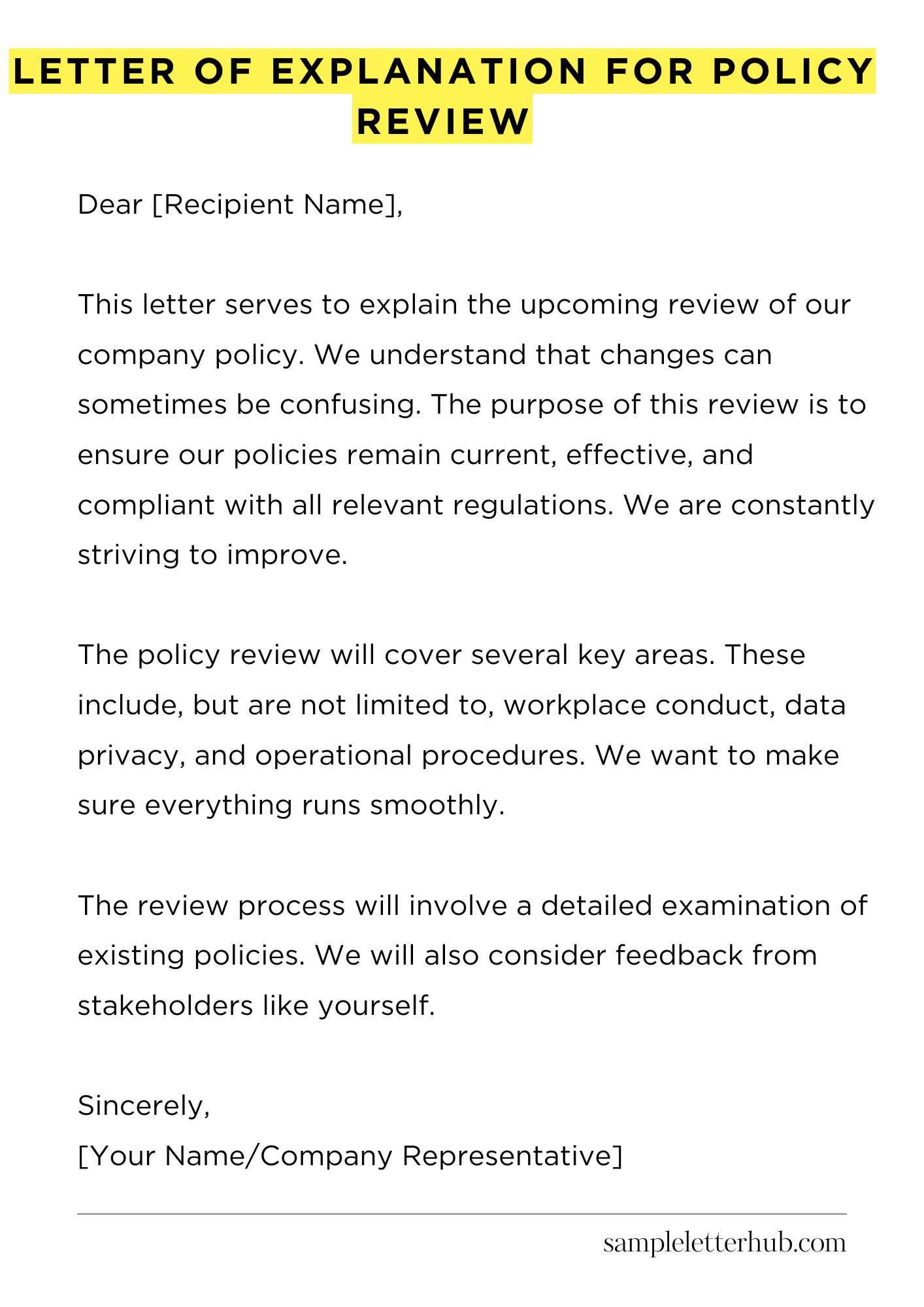
This letter serves to explain the upcoming review of our company policy. We understand that changes can sometimes be confusing. The purpose of this review is to ensure our policies remain current, effective, and compliant with all relevant regulations. We are constantly striving to improve.
The policy review will cover several key areas. These include, but are not limited to, workplace conduct, data privacy, and operational procedures. We want to make sure everything runs smoothly. Your input and understanding are very important to us.
The review process will involve a detailed examination of existing policies. We will also consider feedback from stakeholders like yourself. This collaborative approach helps us create the best possible outcome. Updates to the policy will be communicated clearly and promptly.
We anticipate the review to be completed by [Date]. Following the review, all updated policies will be readily available. Training sessions will also be provided to ensure clarity and proper implementation. We want to equip everyone with the information they need.
We believe these updates will greatly benefit everyone. We appreciate your cooperation and participation. If you have any questions or require further clarification, please do not hesitate to contact us.
Sincerely,
[Your Name/Company Representative]
How to Write Letter of Explanation for Policy Review
Navigating the labyrinthine corridors of policy review can often feel like a Herculean task. However, a well-crafted letter of explanation is your primary tool. It’s your advocate, your clarion call, and your chance to articulate your perspective with precision. Let’s dissect the art of crafting a compelling letter.
1. Understanding the Imperative: Why a Letter of Explanation?
Before you even think about penning a single word, comprehend the significance. A letter of explanation bridges the gap between your viewpoint and the policy reviewer’s understanding. It’s a formal communication.
This document allows you to provide context, clarify ambiguities, and advocate for adjustments. The objective is to make your case comprehensible, convincing, and compliant. Your letter serves as the initial salvo in this interaction.
2. Pre-Writing Ritual: The Genesis of Your Argument
Begin by meticulously researching the policy under scrutiny. Identify the specific clauses and provisions that are of concern to you. Take copious notes. Next, clearly define your central argument. What are you trying to convey?
What is your core assertion? Articulate it succinctly. Consider the potential counterarguments, anticipating the rebuttals that may arise during the policy review. This preparatory phase is indispensable; it lays the foundation for a cohesive and persuasive narrative.
3. Structuring Your Discourse: The Anatomy of a Compelling Letter
The architecture of your letter requires meticulous planning. Employ a formal, professional tone. The introduction must succinctly state the purpose of the letter and the policy in question.
The body should elaborate on your explanation, providing supporting evidence, examples, and reasoned arguments. This is the heart of your communication. Conclude with a clear restatement of your position, summarizing the key points and suggesting a reasonable resolution. Aim for logical flow.
4. Language and Lexicon: Crafting Your Prose
Choose your words carefully. Avoid jargon that the reviewer might not understand. Use precise language, choosing the most appropriate term for each concept. Utilize active voice, which reinforces clarity and directness.
Employ a formal register, avoiding colloquialisms or casual language. Proofread diligently. Remember, the presentation of your argument is as important as the argument itself. A letter marred by errors detracts from your credibility.
5. Supporting Evidence: Bolstering Your Claims
Your claims, however persuasive, require validation. Incorporate supporting evidence to strengthen your points. Include facts, statistics, and any relevant documentation. Reference specific clauses in the policy.
Cite precedents, if applicable. Be scrupulous in your documentation, and make it easy to verify the accuracy of your claims. The more substantiated your argument, the greater its potential for influence.
6. The Art of Persuasion: Advocating for Your Position
The aim is to sway the policy reviewer. In your letter, express your position with respectful assertiveness. Avoid adversarial language. Frame your arguments in a constructive manner, focusing on the potential benefits of the suggested changes.
If possible, offer alternative solutions. Demonstrate an understanding of the reviewer’s perspective, but never compromise your core principles. Remember that a conciliatory approach often yields the best results.
7. Polishing and Presentation: The Final Touches
Before dispatching your letter, perform a final, comprehensive review. Check for any grammatical errors, typos, or inconsistencies. Verify that your arguments are logically sound. Ensure the letter’s formatting is professional and easy to read.
Proofread, and then proofread again. A polished, well-presented letter demonstrates professionalism and attention to detail. This final step is paramount to making a lasting impact.
FAQs about Letter of Explanation for Policy Review
What is a Letter of Explanation for Policy Review, and why is it needed?
A Letter of Explanation (LOE) for Policy Review is a written document that provides context and clarity regarding specific information or circumstances related to an individual’s insurance policy, loan application, or other financial products.
It’s often required when there are discrepancies, inconsistencies, or unusual events that need further elaboration. The primary purpose of an LOE is to help the underwriter or reviewer understand the complete picture and make an informed decision on the application or policy.
What types of situations typically require a Letter of Explanation?
LOEs are commonly requested in various situations, including explaining credit report discrepancies (late payments, collections, etc.), income fluctuations, gaps in employment, the source of large deposits, reasons for previous policy cancellations, and details about specific assets or liabilities. It’s essential to check the specific requirements outlined by the requesting institution or underwriter.
What information should I include in a Letter of Explanation?
A well-written LOE should include a clear and concise explanation of the situation, the specific dates involved, and the reasons behind the event or discrepancy. It should be factual, honest, and avoid jargon.
When possible, provide supporting documentation such as bank statements, pay stubs, or letters from previous employers. Ensure all information provided is accurate and verifiable.
How can I ensure my Letter of Explanation is effective?
To maximize effectiveness, the LOE should be well-organized and easy to understand. Start with a brief introduction, clearly state the issue, explain the cause, and detail the steps taken to resolve the issue if applicable.
Be transparent and avoid making excuses. Use a professional tone and proofread carefully for any errors in grammar or spelling before submitting the letter. Always tailor the letter to the specific requirements mentioned by the requesting party.
What happens if my Letter of Explanation is not accepted?
If the Letter of Explanation is deemed insufficient, the requesting party may request further clarification, additional documentation, or reject the application or policy change. It’s essential to respond promptly to any follow-up requests.
If the reason for rejection is unclear, consider contacting the reviewer to understand the areas of concern and provide additional information or a revised explanation. Being proactive and responsive often increases the chance of a positive outcome.
Related:
Resignation letter due to rude boss
Resignation letter moving to another state
Resignation letter due to illness of family member
Resignation letter due to study