

Have you been in a car accident and need to report it late? You might need a letter of explanation for late accident reporting. This letter clarifies why you missed the initial deadline. Its primary purpose is to help you avoid penalties.
Writing a good letter can be tricky. We’ve got you covered. This article offers helpful letter of explanation samples. You can easily adapt these templates for your specific situation.
Our goal is to make things easier for you. We provide various examples. You will find it easy to create your own accident report letter. Focus on crafting a clear and concise explanation.
[Your Name/Company Name]
[Your Address]
[Your City, Postal Code]
[Your Email]
[Your Phone Number]
[Date]
[Recipient Name/Company Name]
[Recipient Address]
[Recipient City, Postal Code]
Dear [Recipient Name],
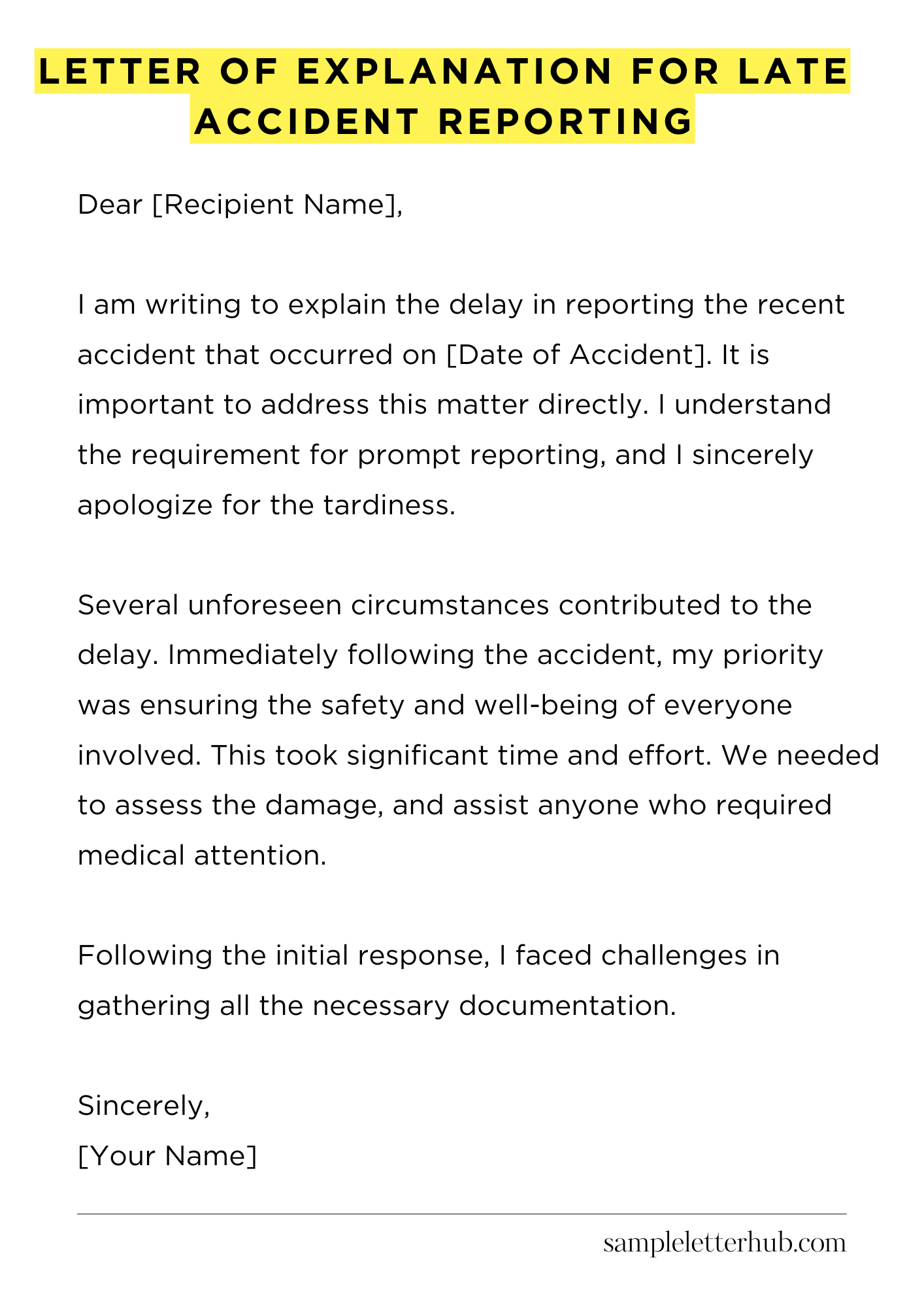
I am writing to explain the delay in reporting the recent accident that occurred on [Date of Accident]. It is important to address this matter directly. I understand the requirement for prompt reporting, and I sincerely apologize for the tardiness.
Several unforeseen circumstances contributed to the delay. Immediately following the accident, my priority was ensuring the safety and well-being of everyone involved. This took significant time and effort. We needed to assess the damage, and assist anyone who required medical attention. This phase was understandably complex.
Following the initial response, I faced challenges in gathering all the necessary documentation. This included obtaining statements from witnesses and accessing relevant information related to the incident. Gathering all the details proved to be a more difficult task than anticipated. There were also some technical difficulties with accessing the required forms.
I have now completed the accident report and have attached it to this letter for your review. The report contains a comprehensive account of the incident, including the circumstances, the involved parties, and the extent of the damage. I have made every effort to provide accurate and complete information.
I understand the importance of timely reporting in such matters. I deeply regret any inconvenience or disruption my delayed report may have caused. I assure you that this was not intentional. Moving forward, I am committed to improving my procedures to ensure that similar situations are reported promptly.
Thank you for your understanding and attention to this matter. Please do not hesitate to contact me if you require any further clarification or information. I am available to answer any questions you may have.
Sincerely,
[Your Name]
How to Write Letter of Explanation for Late Accident Reporting
Accidents happen; sometimes, their reporting isn’t as prompt as it should be. Circumstances can conspire, causing a delay in the notification process. When this occurs, a Letter of Explanation (LOE) becomes your stalwart.
This crucial document elucidates the reasons behind the tardy report of an incident. To craft a compelling LOE, consider the following:
1. Commence with Clarity: The Salutation and Introductory Cadence
Begin with a professional salutation. Address the intended recipient, usually the insurance provider or relevant authority, formally. If you have a specific contact person, use their name; otherwise, a general title such as “To Whom It May Concern” is appropriate.
The introductory paragraph should immediately state the purpose of the letter: to explain the delay. Briefly mention the accident and the date it occurred. This sets the stage for the subsequent explanations.
2. The Genesis of Delay: Articulating the Predicament
This section represents the core of your LOE. Detail the specific reasons that led to the late accident report. Be meticulous and forthright. Avoid generalizations; instead, provide concrete details and factual accounts.
Was it due to injuries necessitating medical attention? Perhaps the immediate aftermath involved securing the scene or dealing with logistical challenges.
Did you experience an incapacitating state that rendered you unable to communicate, or were you navigating some extenuating circumstances? Every aspect needs a justification, backed up with any supporting documentation.
3. Supporting Accoutrements: The Inclusion of Evidence
Whenever possible, supplement your narrative with corroborating evidence.
Documentation significantly bolsters your claims. Examples include medical records (hospital reports, doctor’s notes), police reports, witness statements, or any other proof to substantiate your claims. Attach these documents as supporting accoutrements to fortify the veracity of your explanation.
4. Time-Stamping for Transparency: Detailing the Timeline
Provide a clear and concise timeline of events. Outline the progression from the accident’s occurrence to the eventual reporting. Note the dates and times of key events, such as when you sought medical attention, when you contacted a legal representative (if applicable), and the eventual date of the report.
This chronological structuring helps the reader understand the series of events and the reasons for the delay’s duration.
5. A Testament of Intent: Expressing Remorse and Responsibility
Express genuine remorse for the delay. Acknowledge the importance of timely reporting and underscore your commitment to fulfilling your obligations. This demonstrates accountability and a willingness to cooperate.
While apologizing for the delay is often appropriate, avoid admitting fault regarding the accident itself unless specifically required.
6. Finalizing the Discourse: The Closing and Declarations
Conclude your letter with a formal closing and your signature. Reiterate your commitment to assisting with any further investigations or inquiries. Provide your contact information (phone number, email address) to facilitate communication.
Consider including a concise declaration stating that the information provided is true and accurate to the best of your knowledge.
7. Polishing the Prosaic: Review and Refinement
Before dispatching your LOE, review it meticulously. Proofread for any grammatical errors, typographical errors, or inconsistencies. Ensure the tone is professional, clear, and unambiguous.
Have someone else read the letter to provide a fresh perspective and identify any ambiguities. Only after careful revision should you submit the completed Letter of Explanation. The objective is to convey your rationale precisely and persuasively.
FAQs about Letter of Explanation for Late Accident Reporting
What is a Letter of Explanation for Late Accident Reporting, and why is it needed?
A Letter of Explanation (LOE) for late accident reporting is a formal document required when an accident is reported to an insurance company or relevant authority after the initially stipulated timeframe. It’s needed to provide a detailed and justified reason for the delay.
This letter helps the insurer or authority understand the circumstances surrounding the delay and determine whether the late reporting warrants consideration for processing the claim or investigating the incident. Without a satisfactory explanation, the claim may be denied, or penalties may be imposed.
What information should be included in a Letter of Explanation for late accident reporting?
The letter should include the date and time of the accident, details of the accident itself (who was involved, what happened), and a clear and concise explanation for the delay in reporting.
This explanation should be factual and include specific dates and times when relevant. It’s crucial to provide contact information, including your name, address, and phone number.
If there were any extenuating circumstances such as medical emergencies, legal advice, or other factors that contributed to the delay, these should be detailed with supporting documentation, if available.
What are some acceptable reasons for late accident reporting?
Acceptable reasons often depend on the specific regulations of the insurance provider or governing body. Generally, common and acceptable reasons include: being incapacitated due to injuries sustained in the accident, seeking legal advice, being unaware of the extent of the damage.
How can I ensure my Letter of Explanation is effective?
To make your LOE effective, start by being truthful and providing all relevant facts. Be clear, concise, and professional in your writing style. Include specific dates, times, and locations whenever possible.
If you have supporting documentation (medical records, police reports, witness statements, etc.), make sure to include copies or references to them. It’s often advisable to have the letter reviewed by a legal professional or someone familiar with insurance claims before submitting it, to ensure accuracy and completeness.
What are the potential consequences of not providing a Letter of Explanation, or providing an inadequate one?
The consequences of failing to provide a Letter of Explanation, or submitting a letter that is deemed inadequate, can be significant. The most common consequence is the denial of the insurance claim, leaving you responsible for the cost of repairs, medical bills, or other related expenses.
Additionally, the insurance company might flag your account, potentially leading to increased premiums in the future or difficulty obtaining coverage. In some cases, authorities may investigate the late reporting, potentially resulting in legal penalties, depending on the severity of the accident and the reason for the delay.
Related:
Resignation letter due to rude boss
Resignation letter moving to another state
Resignation letter due to illness of family member
Resignation letter due to study