


Applying for insurance? You might need a “Letter of Explanation for Insurance Application.” This letter clarifies information on your application. Its purpose is simple: to provide context. It helps the insurance company understand your situation.
We know writing these letters can be tricky. Don’t worry, we’ve got you covered. We’re sharing templates! We will provide examples and samples of a Letter of Explanation for Insurance Application. This article is your guide to easy writing.
Need help crafting your own letter? Use our Letter of Explanation templates! Find Letter of Explanation samples here. Simplify your *insurance application* process today.
[Your Name/Your Company Name]
[Your Address]
[Your Phone Number]
[Your Email Address]
[Date]
[Insurance Company Name]
[Insurance Company Address]
Subject: Explanation Regarding Insurance Application – [Your Name] / Policy Number (if applicable)
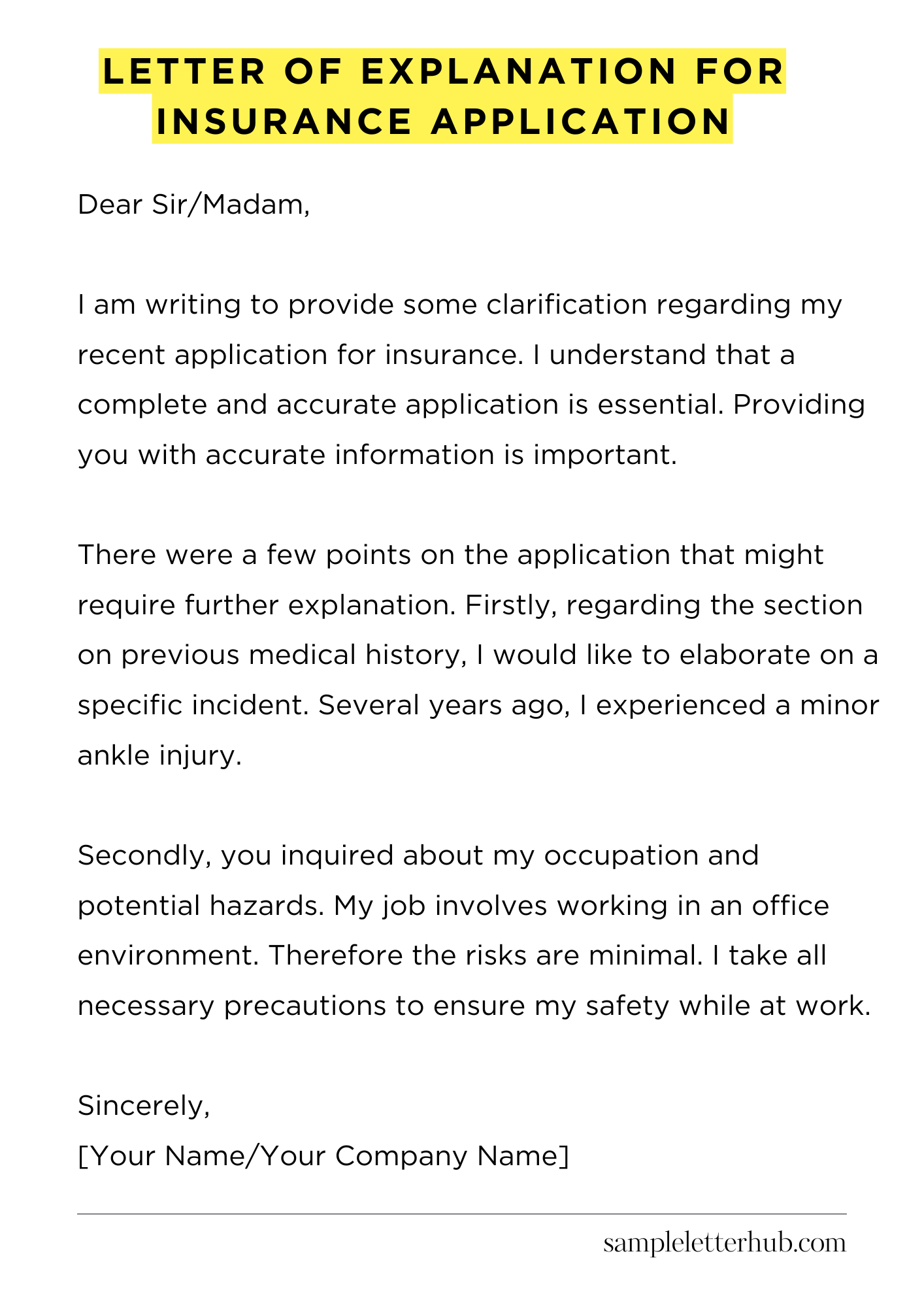
Dear Sir/Madam,
I am writing to provide some clarification regarding my recent application for insurance. I understand that a complete and accurate application is essential. Providing you with accurate information is important.
There were a few points on the application that might require further explanation. Firstly, regarding the section on previous medical history, I would like to elaborate on a specific incident. Several years ago, I experienced a minor ankle injury. The injury was promptly treated and fully recovered. I have had no further issues with my ankle.
Secondly, you inquired about my occupation and potential hazards. My job involves working in an office environment. Therefore the risks are minimal. I take all necessary precautions to ensure my safety while at work.
Finally, I wanted to address a question about my driving record. I have a clean driving record for the past five years. There have been no accidents or traffic violations during this time.
I have attached copies of relevant medical documentation for your review. Please feel free to contact me if you require any further information or clarification. I am available to answer any questions you may have. Your prompt attention to this matter would be greatly appreciated. I look forward to hearing from you soon.
Sincerely,
[Your Name/Your Company Name]
How to Write Letter of Explanation for Insurance Application
Applying for insurance can sometimes be a cumbersome process, riddled with requests for clarification. Often, an insurance provider will necessitate a “Letter of Explanation” to further assess your application.
This document serves as a crucial conduit for communicating specific circumstances or providing context to details that might appear ambiguous or raise concerns during underwriting.
Crafting a cogent and persuasive letter is paramount to securing your desired coverage. So let’s dissect the art of writing a Letter of Explanation for your insurance application, focusing on clarity and efficacy.
1. Comprehending the Imperative: What is a Letter of Explanation?
The crux of this document lies in its explicatory purpose. An insurance provider utilizes the Letter of Explanation to delve deeper into specifics that surface during the application process.
These specifics might include, but are not limited to, lapses in coverage, past medical maladies, or previous driving infractions. The objective is to allay any apprehensions the insurer might harbor, giving you the best chance of acceptance.
2. Pre-emptive Preparation: Gathering Necessary Documentation
Before you even begin composing your letter, amass all pertinent documentation. This may involve medical records, police reports, or records pertaining to past insurance policies.
These documents will not only substantiate your claims but also lend veracity to your explanations. Ensure you have concrete evidence to support your position; this is vital.
3. Structuring Your Narrative: The Art of Organization
Your letter should follow a logical and easily digestible structure. Begin with a clear and concise salutation, identifying the intended recipient.
Briefly state the purpose of the letter in the opening paragraph; mention the insurance application and the specific item(s) you are addressing. Then, sequentially address each point requiring explanation, providing detailed context for each.
4. The Anatomy of an Explanation: Crafting Each Response
Each explanation should be thorough yet succinct. Avoid verbosity; get straight to the point. Provide a clear narrative of the events, avoiding embellishment or obfuscation.
Be truthful and forthright in your account. If the situation was due to an error, acknowledge the fault and highlight steps taken to preclude similar incidents in the future. Demonstrate accountability and a commitment to responsible behavior.
5. Verifying Veracity: Supporting Your Claims with Evidence
Whenever possible, incorporate supporting documentation to fortify your explanations. Briefly reference the attached documents within your letter.
For instance, “As evidenced by the attached medical records, I recovered fully from [condition].” This strengthens your case and reinforces your credibility. Cross-reference your explanations to external data; it demonstrates transparency.
6. The Art of Closure: Summarizing and Re-iterating
Conclude your letter with a brief summary, re-emphasizing the key points and assuring the insurer of your good faith. Thank the recipient for their time and consideration.
Reinforce your commitment to compliance with all policy requirements. End with a professional closing and your full name. It’s the final opportunity to leave a positive impression.
7. Polishing the Prosaic: Proofreading and Editing
Once you’ve completed your draft, meticulously proofread and edit your letter. Correct any grammatical errors, spelling mistakes, or stylistic inconsistencies.
Ensure the language is clear, concise, and professional. Seek a second opinion from a trusted friend or colleague who can provide objective feedback. A well-written letter reflects professionalism and underscores your commitment to accuracy.
FAQs about Letter of Explanation for Insurance Application
What is a Letter of Explanation (LOE) for an Insurance Application?
A Letter of Explanation (LOE) is a written document you submit to an insurance provider to clarify information related to your application. This could involve explaining inconsistencies in your medical history, lapses in coverage, past claims, or other factors that might affect your eligibility or premium.
When is a Letter of Explanation Required?
An insurance provider typically requests an LOE when they need more information or clarification regarding information you provided in your application.
Common triggers include discrepancies in your medical records, gaps in your employment history, previous insurance denials or cancellations, or high-risk activities you’ve engaged in.
What Information Should I Include in a Letter of Explanation?
A well-written LOE should be clear, concise, and accurate. It should address the specific issue the insurer is asking about. Include the date, the specific item needing clarification, a detailed explanation of the situation, and any supporting documentation (e.g., medical records, police reports, proof of employment). Maintain a professional tone.
How Do I Write a Compelling Letter of Explanation?
Be honest and transparent. Start by clearly stating the issue. Provide a thorough explanation, avoiding vague statements. If applicable, explain what steps you’ve taken to address the situation. Support your explanation with factual details and relevant documentation. Proofread carefully before submitting.
What Happens If I Don’t Provide a Letter of Explanation?
If you fail to provide a requested LOE, the insurance provider may delay processing your application. They could deny your application outright, offer less favorable terms (higher premiums), or require more information. Providing the requested explanation promptly and accurately is crucial for a smooth application process.
Related:
Resignation letter due to rude boss
Resignation letter moving to another state
Resignation letter due to illness of family member
Resignation letter due to study