

A letter of explanation for a car accident is a written statement. It details your account of a car accident. Its main purpose is to clearly communicate what happened. Insurance companies and law enforcement often require it. This letter helps them understand the accident from your perspective.
We understand writing a letter can be tough. That’s why we’re here to help! We’ve compiled letter of explanation for car accident templates. You’ll find a variety of sample letters here. These cover different accident scenarios. Use these to easily craft your own car accident letter.
Need a car accident letter that’s a breeze to write? We’ve got you covered. Consider these samples as your cheat sheets. They’ll simplify your letter writing process. Simply customize and personalize to fit your specific accident situation. Good luck!
[Your Name]
[Your Address]
[Your Phone Number]
[Your Email Address]
[Date]
[Recipient’s Name]
[Recipient’s Title]
[Recipient’s Address]
Dear [Recipient’s Name],
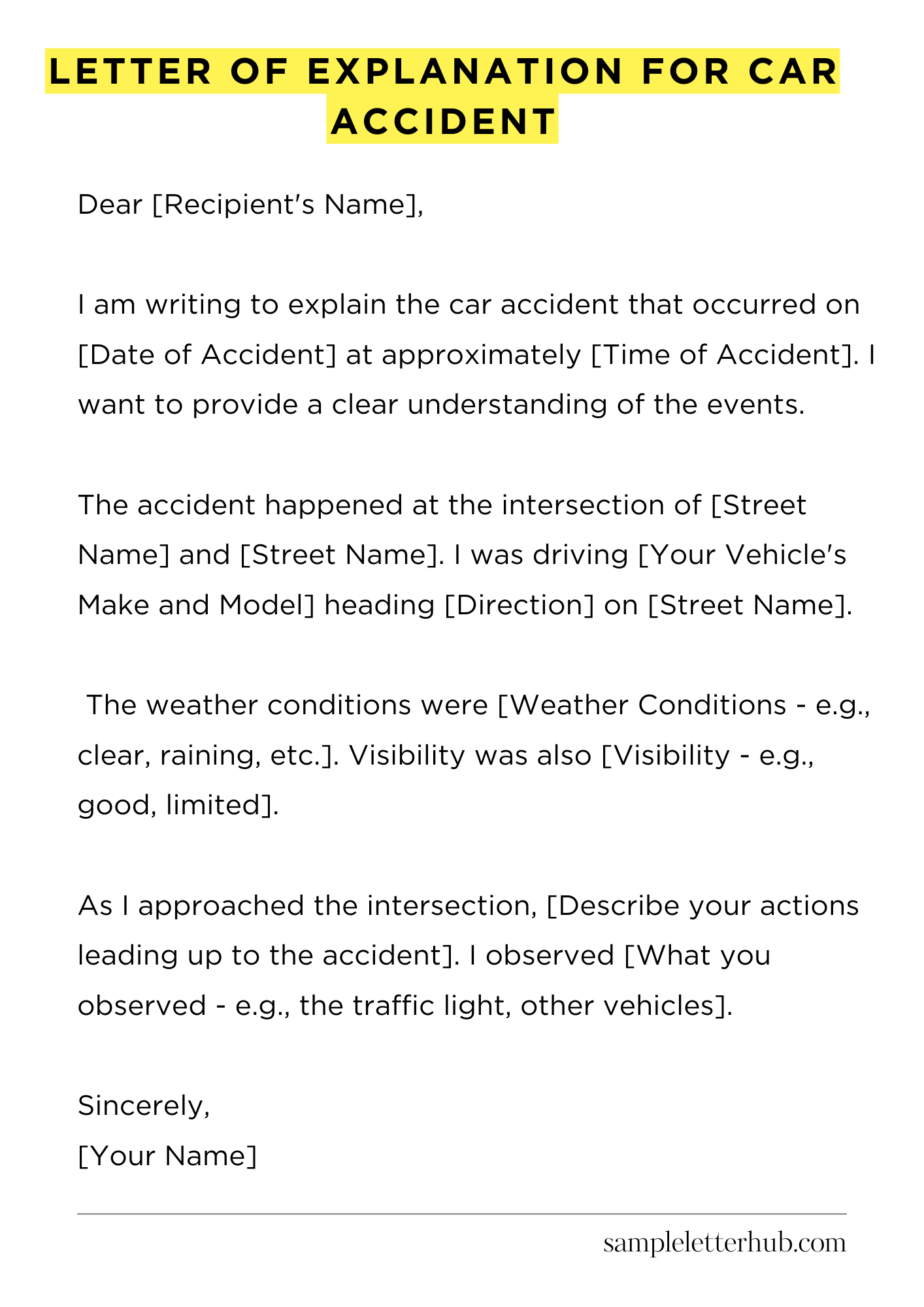
I am writing to explain the car accident that occurred on [Date of Accident] at approximately [Time of Accident]. I want to provide a clear understanding of the events.
The accident happened at the intersection of [Street Name] and [Street Name]. I was driving [Your Vehicle’s Make and Model] heading [Direction] on [Street Name]. The weather conditions were [Weather Conditions – e.g., clear, raining, etc.]. Visibility was also [Visibility – e.g., good, limited].
As I approached the intersection, [Describe your actions leading up to the accident]. I observed [What you observed – e.g., the traffic light, other vehicles]. Suddenly, [Describe the moment of impact and what you saw]. The other vehicle involved was a [Other Vehicle’s Make and Model], driven by [Other Driver’s Name if known].
Following the impact, I immediately [Your actions after the accident – e.g., checked for injuries, contacted the police, exchanged information]. The police arrived at the scene and [What the police did – e.g., documented the accident, filed a report]. I cooperated fully with their investigation.
I understand this was a stressful event. I deeply regret the incident. I have provided the details to the best of my recollection.
I have attached copies of [Mention any attached documents – e.g., the police report, insurance information, photos]. I am also available to answer any further questions you may have.
Sincerely,
[Your Name]
How to Write Letter of Explanation for Car Accident
A vehicular collision can be a discombobulating experience. Following the adrenaline rush, you’ll likely need to pen a Letter of Explanation. This document is a crucial component in the aftermath, particularly for insurance claims and legal proceedings. Understanding how to craft a cogent and persuasive letter can significantly impact the outcome.
1. Commence with the Essentials
The genesis of your letter should be a formal introduction. Begin by clearly stating the purpose of the letter: to explain the circumstances surrounding the car accident. Include your full name, address, contact details, and the date.
Identify the other parties involved, as precisely as possible, referencing their names and any available identifying information, like license plate numbers or insurance details. Be meticulous; this is your starting point.
2. Chronicles of the Incident: Detailing the Event
This is where you elucidate the pivotal details of the accident. Paint a clear picture of the event. Offer a blow-by-blow account of what transpired. Explain the geographical context – the location of the accident – including the street names, landmarks, and any relevant traffic signals.
Describe the sequence of events. Detail the actions of all involved, including yourself. Be judicious; avoid hyperbole and stick to the verifiable facts.
3. Deciphering the Context: Atmospheric Conditions and Perceptual Issues
Consider the ambiance of the accident. Were there extenuating circumstances? Did inclement weather, like heavy rain or fog, play a role? Was visibility compromised?
Did any factors – bright sunlight, a blind curve, or obstructed view – impair your perception of the situation? Objectively account for anything that may have impacted the incident.
4. Examination of the Damage and Its Ramifications
Meticulously catalog the physical damage. Specify the points of impact on each vehicle. Describe any injuries sustained by yourself or others involved. Include the extent of the damage to each vehicle, giving a sense of the impact.
Be as specific as possible. If the police came to the scene, note their involvement and their observations.
5. Accentuating Compliance: Adherence to Protocols
Emphasize your adherence to all traffic laws and safety protocols. State that you were driving within the speed limit, observing traffic signals, and practicing defensive driving techniques.
If there were any deviations, provide a lucid explanation. Demonstrating that you were operating within the legal framework is essential.
6. The Art of Attestation: Supporting Documentation
Substantiate your claims with concrete evidence. Attach copies of the police report, photographs of the vehicles and the accident scene, and any witness statements. Include medical reports, if applicable, to underscore the nature and scope of any injuries sustained. This supporting documentation reinforces the veracity of your account.
7. The Culmination: Closing and Declaration
Conclude your letter with a clear and concise summary of the accident. Reiterate your perspective on the sequence of events. Express your willingness to cooperate fully with the investigation.
Sign and date the letter. Consider having it notarized, for added legal protection. This ensures your account is properly attested and serves as a formal declaration.
FAQs about Letter of Explanation for Car Accident
Understanding the nuances of a letter of explanation following a car accident is crucial for navigating insurance claims and legal proceedings. Here are five frequently asked questions, along with their answers:
What is a Letter of Explanation for a Car Accident?
A Letter of Explanation (LOE) is a written statement providing a detailed account of a car accident. It is typically requested by insurance companies or legal professionals to clarify the circumstances surrounding the incident.
The primary purpose is to offer context and clarity regarding the accident, including your perspective and understanding of the events.
What Information Should I Include in My Letter of Explanation?
Your LOE should be comprehensive and include the following: the date, time, and location of the accident; a clear and concise description of the events leading up to the accident, the accident itself, and the aftermath; the names and contact information of all parties involved, including witnesses.
Why is a Letter of Explanation Important?
The LOE is a critical document because it helps insurance companies determine liability, assess damages, and process claims. It provides your version of events and can influence the outcome of your claim.
It also serves as a permanent record of your account, which may be referenced in the future, particularly if legal action is involved.
When Should I Write a Letter of Explanation?
You should write a Letter of Explanation promptly after being requested to do so by your insurance company or legal counsel. It’s generally best to provide it as soon as possible while the details are still fresh in your mind. However, ensure you have gathered any essential evidence, like photos or police reports, before submitting it.
Can My Letter of Explanation Be Used Against Me?
Yes, your letter of explanation can be used against you. It is crucial to be truthful and accurate in your statement. Anything you write can be used as evidence.
Therefore, be careful about what you include, and seek legal advice if you are unsure about any aspect of the letter. If you are at fault, it can be used to establish your liability and impact your insurance rates.
Related:
Resignation letter due to rude boss
Resignation letter moving to another state
Resignation letter due to illness of family member
Resignation letter due to study