

Dealing with an accident? You likely need to file an accident claim. A crucial step? Submitting your accident claim documents. This letter formally introduces these documents to the insurance company or relevant party. Its purpose is to officially notify them and initiate the claim process.
Writing this letter can seem tricky. But don’t worry! We’ve got you covered. This article offers helpful templates and examples. They cover various situations. You can easily adapt them to your specific needs.
Need a letter for a car accident claim? Or perhaps for a workplace incident? Explore our ready-made samples. Craft your own letter quickly and confidently. Simplify your accident claim with these templates. Save time and reduce stress!
[Your Name]
[Your Address]
[Your Phone Number]
[Your Email Address]
[Date]
[Insurance Company Name]
[Insurance Company Address]
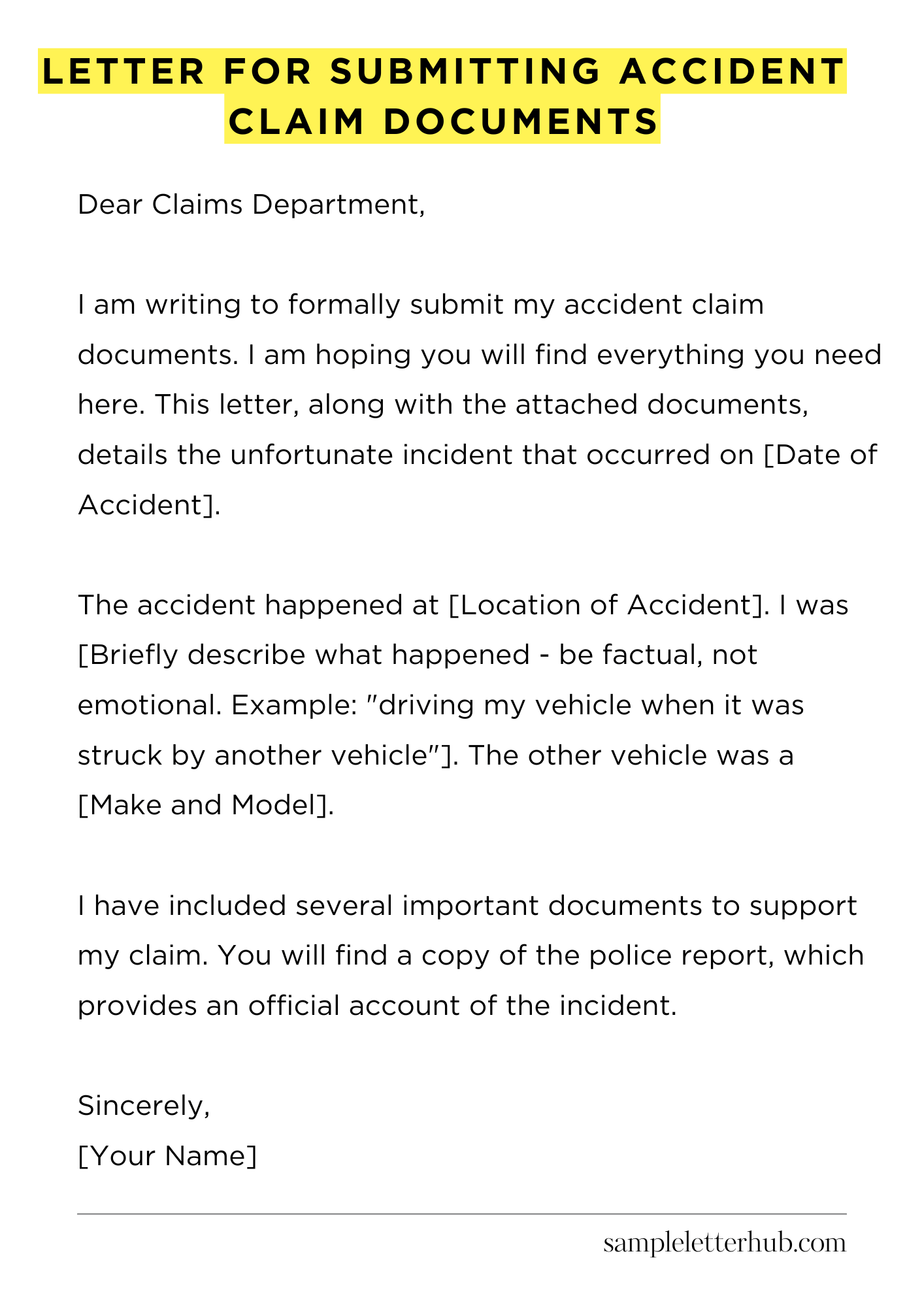
Dear Claims Department,
I am writing to formally submit my accident claim documents. I am hoping you will find everything you need here. This letter, along with the attached documents, details the unfortunate incident that occurred on [Date of Accident].
The accident happened at [Location of Accident]. I was [Briefly describe what happened – be factual, not emotional. Example: “driving my vehicle when it was struck by another vehicle”]. The other vehicle was a [Make and Model].
I have included several important documents to support my claim. You will find a copy of the police report, which provides an official account of the incident.
This report should clarify the circumstances surrounding the accident. I have also attached photographs of the damage to my vehicle, which clearly illustrate the extent of the impact.
Furthermore, I have enclosed medical reports from [Doctor/Hospital Name]. These reports outline the injuries I sustained in the accident and the treatment I have received.
You will see that I am seeking reimbursement for my medical expenses. The enclosed repair estimate from [Repair Shop Name] details the cost to fix the damage to my vehicle.
I have also attached all of the relevant receipts related to my loss. The insurance policy number is [Policy Number]. Please review all the information provided carefully.
I would appreciate it if you could begin processing my claim as soon as possible. I would like to get this matter resolved quickly. Please let me know if you require any further information from my side.
Thank you for your time and attention to this matter. I look forward to hearing from you soon regarding the status of my claim.
Sincerely,
[Your Name]
How to Write Letter for Submitting Accident Claim Documents
1. Initiate with Precision: The Salutation
Begin your letter with a formal salutation. Employ “Dear [Recipient’s Name],” or if the name is unknown, “To Whom It May Concern.” Avoid informal greetings. This sets a tone of professionalism from the onset.
Ensure you spell the recipient’s name meticulously; a misstep can undermine your credibility. It is crucial to be accurate.
2. The Core Tenet: Subject Matter Articulation
The subject line of the letter must be succinct and directly pertinent. Use language like: “Subject: Submission of Accident Claim Documents – [Your Name] – Policy Number: [Your Policy Number].”
This instantly clarifies the letter’s purpose. A well-crafted subject line is your first line of defense against being overlooked in a deluge of correspondence.
3. Recounting the Incident: A Concise Narrative
In the opening paragraph, briefly and objectively describe the accident. State the date, time, and location of the incident with clarity. Do not offer opinions or conjectures; stick to provable facts. The objective is to provide a factual prelude. Keep it concise.
4. Document Nomenclature: The Enumeration
The subsequent section should list the documents you are submitting. Use bullet points or numbered lists for optimal clarity. Include the document title, and the number of pages for each.
Example: “Police Report (3 pages),” “Medical Records (10 pages).” This methodical approach ensures nothing is missed. This meticulous organization reflects attention to detail.
5. The Imperative: Statement of Responsibility
If applicable, and you want to point the direction, include a sentence stating you are the claimant, and are formally submitting documents for an accident claim. The onus is on you. This solidifies your role and intention.
6. Reinforcement and Closure: The Closing Paragraph
Conclude your letter by reiterating your commitment to cooperating fully with the claims process. Include your contact information (phone number, email address).
Express your anticipation of a prompt response. Formally close the letter with “Sincerely,” or “Respectfully,” followed by your full name and signature (if a physical letter). This is the summation of your efforts.
7. Proofreading and Rectification: The Verifying Act
Before sending, meticulously proofread the entire letter. Check for grammatical errors, spelling mistakes, and factual inaccuracies. Ensure all attachments are included and legible.
Consider having a second set of eyes review the letter. This final step is paramount in ensuring accuracy.
FAQs about Letter for Submitting Accident Claim Documents
What is the primary purpose of a letter submitting accident claim documents?
The primary purpose of a letter submitting accident claim documents is to formally notify the insurance company or relevant party about an accident and to officially submit supporting documentation to initiate the claims process. It serves as a record of communication and provides essential information for processing the claim.
What essential information should be included in the letter?
A well-written letter should include the date, your full name and contact information, the policy number, a clear description of the accident (including the date, time, and location), the names of any other parties involved, details of any injuries or damages, a list of enclosed documents.
What types of documents are typically submitted with the letter?
The documents typically submitted depend on the nature of the accident, but often include a police report, photos of the damage, medical reports (if applicable), witness statements, repair estimates, and any other evidence supporting your claim. You should carefully review your insurance policy for specific requirements.
How should the letter be formatted and submitted?
The letter should be written in a professional and clear manner. It’s best to use a formal business letter format, including your address, the recipient’s address, a salutation, a clear body, a closing, and your signature.
Submission methods vary; often, insurers accept letters via mail, email, or through an online portal. Always retain a copy of the letter and all supporting documents for your records, along with proof of submission (e.g., tracking number).
What are some common mistakes to avoid when writing the letter?
Common mistakes include failing to include all necessary information, providing unclear or ambiguous descriptions of the accident, omitting key documents, missing deadlines, or using overly casual language. It’s also important to avoid admitting fault or providing unsubstantiated information. Proofread carefully before submitting.
Related:
Resignation letter due to rude boss
Resignation letter moving to another state
Resignation letter due to illness of family member
Resignation letter due to study