


Sometimes your insurance company decides not to renew your policy. They will send you a letter explaining why insurance was not renewed. This is a crucial document. Its purpose is to inform you about the insurance cancellation. It also details the reasons behind this decision.
Understanding these non-renewal letters is key. We are here to help. This article provides you with templates and examples. We offer sample letters explaining why insurance was not renewed. These will help you compose your own letter.
Need to write a quick letter? Our examples are easy to adapt. You can tailor them to your specific needs. Get started crafting your insurance non-renewal letter today.
[Your Name/Insurance Company Letterhead (if applicable)]
[Your Address]
[Your Phone Number]
[Your Email Address]
[Date]
[Recipient Name/Insured’s Name]
[Recipient Address]
Dear [Recipient Name],
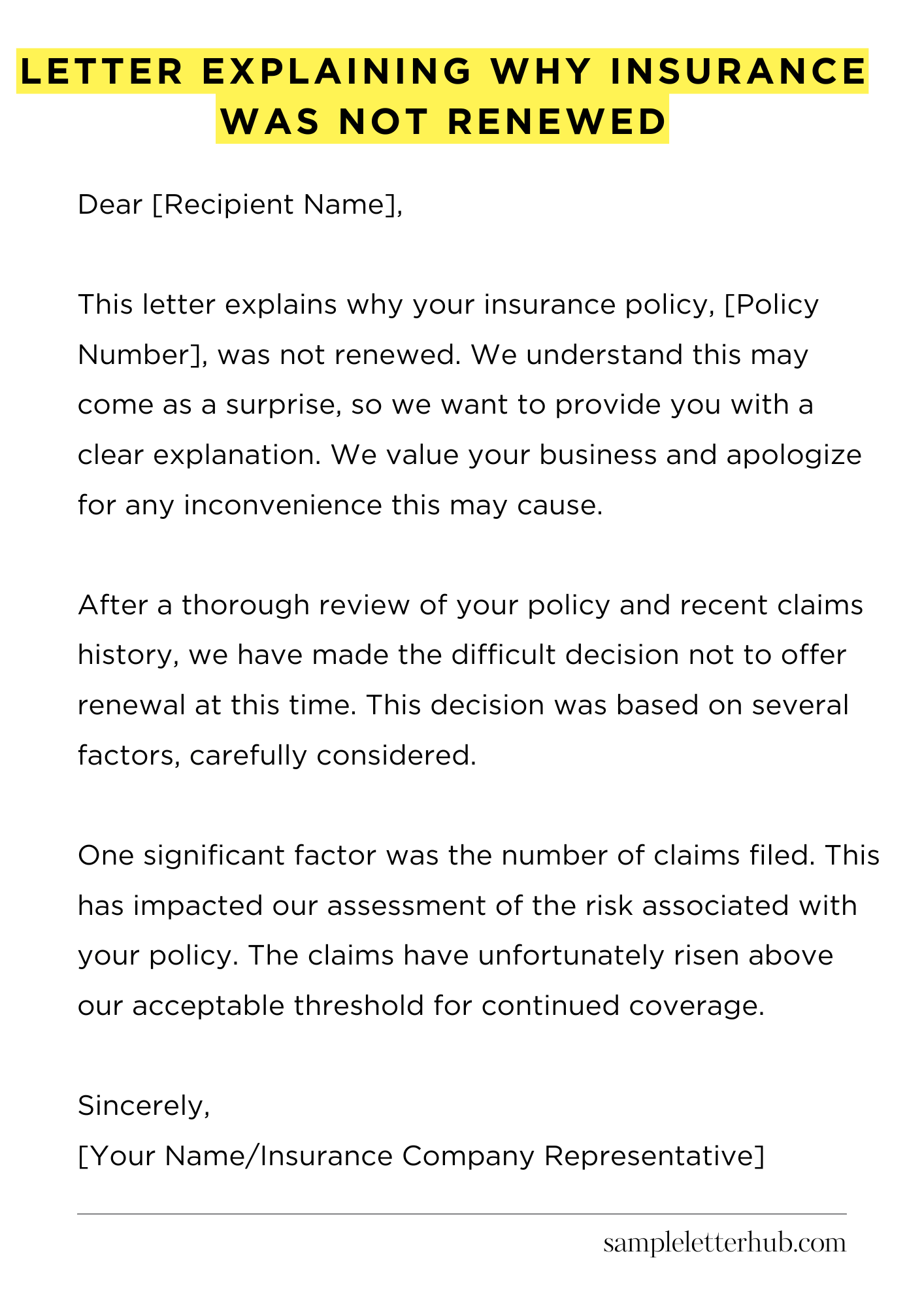
This letter explains why your insurance policy, [Policy Number], was not renewed. We understand this may come as a surprise, so we want to provide you with a clear explanation. We value your business and apologize for any inconvenience this may cause.
After a thorough review of your policy and recent claims history, we have made the difficult decision not to offer renewal at this time. This decision was based on several factors, carefully considered.
One significant factor was the number of claims filed. This has impacted our assessment of the risk associated with your policy. The claims have unfortunately risen above our acceptable threshold for continued coverage.
We also looked at current market conditions within the insurance industry. These are important for our overall financial stability. Premiums are influenced by these conditions.
We understand the importance of having continuous insurance coverage. It is vital for your peace of mind. To help you find alternative coverage, we are providing some resources.
We recommend contacting an independent insurance broker. They can explore other options from various insurance providers. You can also visit the [State/Region] Department of Insurance website. They have a wealth of information.
We encourage you to explore these options as soon as possible. Doing so helps ensure you have uninterrupted coverage.
We want to express our sincere appreciation for your past business with us. Thank you for the opportunity to have served your insurance needs. We regret any hardship this non-renewal causes.
Sincerely,
[Your Name/Insurance Company Representative]
How to Write Letter Explaining Why Insurance Was Not Renewed
1. Commence with a Formal Salutation
Begin your missive with a professional greeting. Address the recipient, usually the insurance provider or a specific underwriter, using their correct title and last name.
If you are uncertain about the specific individual, opt for a general salutation like “Dear Insurance Provider.” Maintaining formality at the outset sets a tone of respect and careful deliberation.
2. Subject Line Specificity
Craft a subject line that is crystal clear. This is the first impression; it directs the recipient to the essence of your communication. Include your policy number and explicitly state that the letter is concerning non-renewal.
Avoid ambiguity – be succinct. For example, “Subject: Policy # [Your Policy Number] – Non-Renewal Explanation”
3. Articulate the Rationale Precisely
This is the crux of the discourse. The explanation for non-renewal should be unambiguous. Enumerate your reasons with precision. Whether it’s a shift in financial circumstances, dissatisfaction with services, or a search for more competitive premiums, lay it all out.
Provide verifiable evidence where applicable, such as quotes from other insurers or documentation related to changing needs. Avoid vague generalizations; instead, be explicit and leave no room for misinterpretation.
4. Review of Contractual Obligations
Refer to the policy document and the terms of your contract. Indicate, with citations to specific sections, how these terms may have influenced your decision. Perhaps the terms were no longer favorable, or the coverage no longer met your evolving requirements. Use legalistic jargon sparingly. It’s better to convey clarity.
5. Address Policy Deficiencies
If the policy had shortcomings, now is the time to illuminate those perceived deficits. Be factual and focus on areas where the coverage was inadequate, the claims handling was problematic, or the premium-to-value ratio was unfavorable. Be polite, but firm. Mention how this impacted your overall experience.
6. Express Gratitude (If Appropriate) and Maintain Professionalism
Even when expressing dissatisfaction, maintain a respectful demeanor. Thank the insurer for the past service, if applicable. Acknowledging previous positive interactions can defuse any potential acrimony.
End the letter with a professional closing, such as “Sincerely” or “Respectfully,” followed by your full name, contact information, and signature. This is to convey that this is your legitimate correspondence.
7. Document and Dispatch
Before dispatching, meticulously preserve a copy of your letter for your records. Consider sending the letter via certified mail with return receipt requested. This provides proof of delivery and ensures a paper trail. This safeguards against potential disputes regarding communication.
FAQs about Letter Explaining Why Insurance Was Not Renewed
Why did I receive a non-renewal letter?
You received a non-renewal letter because your insurance company has decided not to extend your current policy. This decision can be based on several factors, including but not limited to, a change in your risk profile, excessive claims filed, failure to pay premiums on time.
What are the common reasons for non-renewal?
Common reasons include: a significant increase in claims, leading the insurer to believe your risk is too high; multiple traffic violations or accidents if it’s an auto insurance policy; a change in the use of a property, such as a home being used for commercial purposes.
What should I do after receiving a non-renewal letter?
Upon receiving a non-renewal letter, you should first carefully review the reason provided by your insurance company. Then, you should immediately begin seeking alternative insurance coverage from other providers.
Contacting an independent insurance agent can be a helpful starting point as they can shop around on your behalf. Ensure you have the necessary information (prior policies, driving record, etc.) ready for the new application. Finally, understand the effective date of non-renewal to ensure continuous coverage.
How much notice is the insurance company required to give me before non-renewal?
The required notice period for non-renewal varies by state and is often determined by the type of insurance. However, the insurer is legally obligated to provide a certain amount of notice prior to the policy’s expiration.
This allows you ample time to search for a new insurance policy. The specific time frame is usually stated in your insurance policy or is available through your state’s insurance regulatory agency.
Can I appeal the non-renewal decision?
In certain circumstances, you might be able to appeal the non-renewal decision. The possibility and process depend on the reason for the non-renewal, your state’s regulations, and the terms of your policy.
If the non-renewal seems inaccurate or based on incorrect information, you should gather evidence to dispute it. Reach out to your insurance company to question the decision and ask for a review, and also contact your state’s insurance regulatory agency for guidance on how to file a formal appeal if necessary.
Related:
Resignation letter due to rude boss
Resignation letter moving to another state
Resignation letter due to illness of family member
Resignation letter due to study