

Let’s talk about the letter explaining policy cancellation and reinstatement. It’s a formal written document. Its purpose is to communicate important information. This includes why a policy was canceled and the steps to get it back. The policy cancellation and reinstatement letter is crucial for insurance, memberships, or services.
Want to learn how to write a good policy cancellation letter? Or maybe a reinstatement request letter? You’re in the right place! We’ll provide you with various templates. We’ll share letter samples and examples to guide you. These easy-to-use documents make writing your own policy letters simple.
Consider us your friendly writing helpers. We know drafting these letters can be tricky. That’s why we’ve prepared everything you need. This article offers the best letter templates and policy cancellation and reinstatement examples available. Let’s get started.
[Your Name/Company Name]
[Your Address]
[Your City, Postal Code]
[Your Email]
[Your Phone Number]
[Date]
[Recipient Name/Company Name]
[Recipient Address]
[Recipient City, Postal Code]
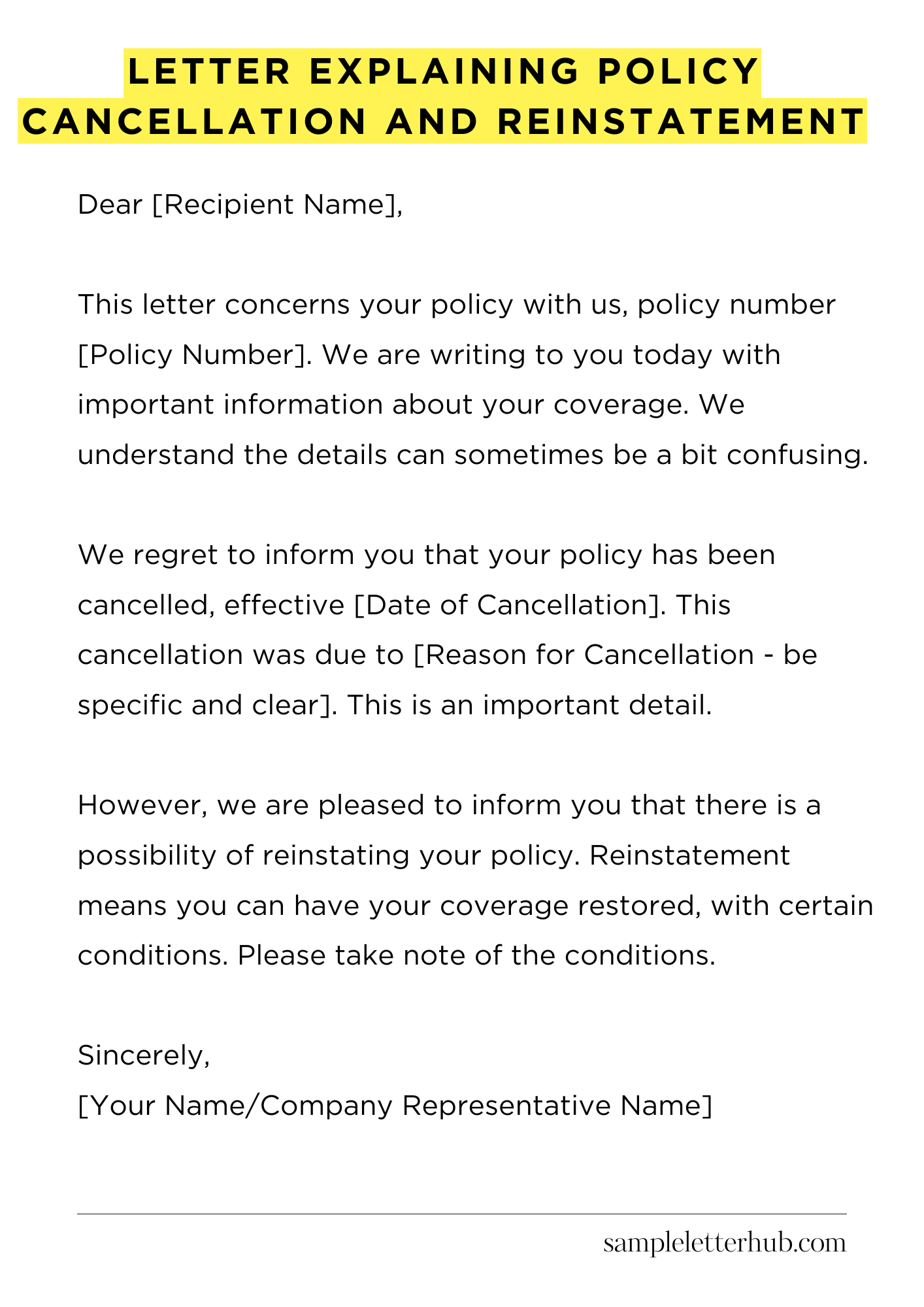
Dear [Recipient Name],
This letter concerns your policy with us, policy number [Policy Number]. We are writing to you today with important information about your coverage. We understand the details can sometimes be a bit confusing.
We regret to inform you that your policy has been cancelled, effective [Date of Cancellation]. This cancellation was due to [Reason for Cancellation – be specific and clear]. This is an important detail.
We understand that policy cancellations can be unsettling. We want to help you understand the situation and explore your options.
However, we are pleased to inform you that there is a possibility of reinstating your policy. Reinstatement means you can have your coverage restored, with certain conditions. Please take note of the conditions.
To reinstate your policy, you will need to [Specific Action Required for Reinstatement – be detailed]. The deadline to complete this action is [Date of Deadline]. Please be prompt.
Upon successful completion of these requirements, your policy will be reinstated, and coverage will resume on [Date of Reinstatement]. The premium will be [amount] which you can pay via [Mode of Payment].
If you have already taken the necessary steps to meet the requirements, please disregard this notice. You may have already begun the process.
We have attached [Enclosures – if any, e.g., payment instructions, application form]. Carefully review these documents.
If you have any questions or require further clarification, please do not hesitate to contact us at [Phone Number] or reply to this email. We are here to assist you.
We value your business and hope to continue providing you with the insurance coverage you need. We look forward to hearing from you soon. We are always ready to assist.
Sincerely,
[Your Name/Company Representative Name]
How to Write Letter Explaining Policy Cancellation and Reinstatement
1. Commence with a Cogent Salutation
Begin your letter with a formal greeting, a salutation that’s not only polite but also specific. Instead of a generic “To Whom It May Concern,” opt for the recipient’s name and title, if known.
Addressing the recipient directly signals respect and attentiveness. Furthermore, it personalizes the communication and heightens the chances of a favorable response. Precision in this preliminary phase sets a professional tone from the outset.
2. Declare the Purpose – State Your Premise
Immediately after the salutation, clearly state the letter’s purpose. This section is all about clarity; you must be upfront. Specify you are detailing a policy cancellation, its rationale, and options for reinstatement.
A succinct, unambiguous statement sets the stage. Make sure to include the policy number, as it is a crucial piece of information. This proactive approach ensures the reader quickly understands the matter at hand.
3. Stipulate the Circumstances: The Cancellation Rationale
This is where you explain the “why” behind the policy cancellation. Be meticulous and direct. Did the policy lapse due to non-payment? Were there breaches of terms and conditions?
Provide concise details, avoiding circumlocution. Be transparent about the specific reason. Remember, honesty is the best policy, even when delivering less-than-desirable news. Your candor builds trust, even when the news is undesirable.
4. Outline the Reinstatement Procedure
Now, detail the steps the recipient must take to reinstate their policy. Be specific. Include precise instructions: documents required, deadlines, and how to submit everything.
State the methods for submitting the paperwork, be it via mail or email, etc. Ensure the information is simple and easy to digest, with a bulleted list format. The more straightforward you are, the better the experience will be for the reader.
5. Financial Acumen: Addressing Payment and Potential Fees
Here, you must discuss the financial implications of reinstatement. Clearly state any outstanding premiums, late fees, or potential penalties. Be clear and honest about all charges associated with reinstatement.
Include payment options and acceptable methods (checks, online payments, etc.). Honesty in this section ensures financial understanding and trust.
6. Reinforce with a Firm Closing and Contact Information
Conclude your letter with a professional closing. Use a courteous phrase, such as “Sincerely” or “Respectfully.” Provide your contact information, including your name, title, phone number, and email address.
This offers the recipient easy access for questions or further clarification. Ensure your contact information is correct and promptly checked, allowing for efficient communication.
7. The Culmination: Proofreading and Delivering Your Letter
Before sending, meticulously proofread your letter. Check for grammar, spelling, and clarity. Ensure the tone is professional, yet empathetic. Consider the recipient’s perspective.
Finally, deliver the letter using the appropriate method (certified mail for important documents), ensuring a record of receipt. This final step guarantees the credibility of your communication.
FAQs about Letter Explaining Policy Cancellation and Reinstatement
What information should be included in a letter explaining policy cancellation?
A letter explaining policy cancellation should include the policyholder’s name and address, the policy number, the effective date of the cancellation, the reason for the cancellation (e.g., non-payment, violation of policy terms), any refund amount due to the policyholder.
What are the typical reasons for policy cancellation?
Common reasons for policy cancellation include non-payment of premiums, misrepresentation or fraud in the application process, violation of policy terms (e.g., changes in risk exposure), and sometimes, the policyholder’s request for cancellation. Specific reasons will vary depending on the type of insurance and the policy’s terms and conditions.
What does a letter about policy reinstatement entail, and what are the requirements?
A reinstatement letter outlines the process for restoring a canceled policy. It typically provides information on how the policyholder can reinstate the policy, such as paying outstanding premiums, providing proof of compliance with policy terms, or completing a new application.
Requirements for reinstatement depend on the insurance company and the specific policy, but often involve demonstrating that the reason for the cancellation has been resolved.
What are the implications of policy cancellation and reinstatement for future coverage?
A policy cancellation can negatively affect the policyholder’s ability to obtain future coverage. It may increase premiums or make it more difficult to find coverage, especially if the cancellation was due to actions that increased the risk. Reinstatement may involve a waiting period or other conditions.
If a policy is reinstated, it is important to understand whether any prior exclusions are applicable and also consider the potential implications on future insurance premiums.
Where can I find sample letters explaining cancellation and reinstatement?
Sample letters can often be found on insurance company websites or through a search online, although it is important to remember that these should only be used as a guide.
Legal document providers, consumer websites, and insurance-related resources may also provide samples. Be aware that the specifics of the letter will depend on the type of insurance, the reason for the cancellation, and the reinstatement options available, so it is important to adapt it to your specific situation and understand the insurance policy.
Related:
Resignation letter due to rude boss
Resignation letter moving to another state
Resignation letter due to illness of family member
Resignation letter due to study