


Facing financial strain? You’re not alone. A “Letter Explaining Financial Hardship to Insurer” helps you communicate your situation. Its purpose? To inform your insurance provider about your inability to pay premiums. This letter can help you explore payment options. It may also prevent policy cancellation.
We understand writing this can be tough. Don’t worry. We’ve got you covered. We’ll share templates. We also have examples and samples of this crucial letter. These will cover various financial hardship scenarios.
Use our samples. They’re designed to simplify the writing process. They help you tailor your “Letter Explaining Financial Hardship to Insurer”. Get the help you need. Craft your letter with ease.
[Your Name]
[Your Address]
[Your Phone Number]
[Your Email Address]
[Date]
[Insurance Company Name]
[Insurance Company Address]
Dear [Insurance Company Name],
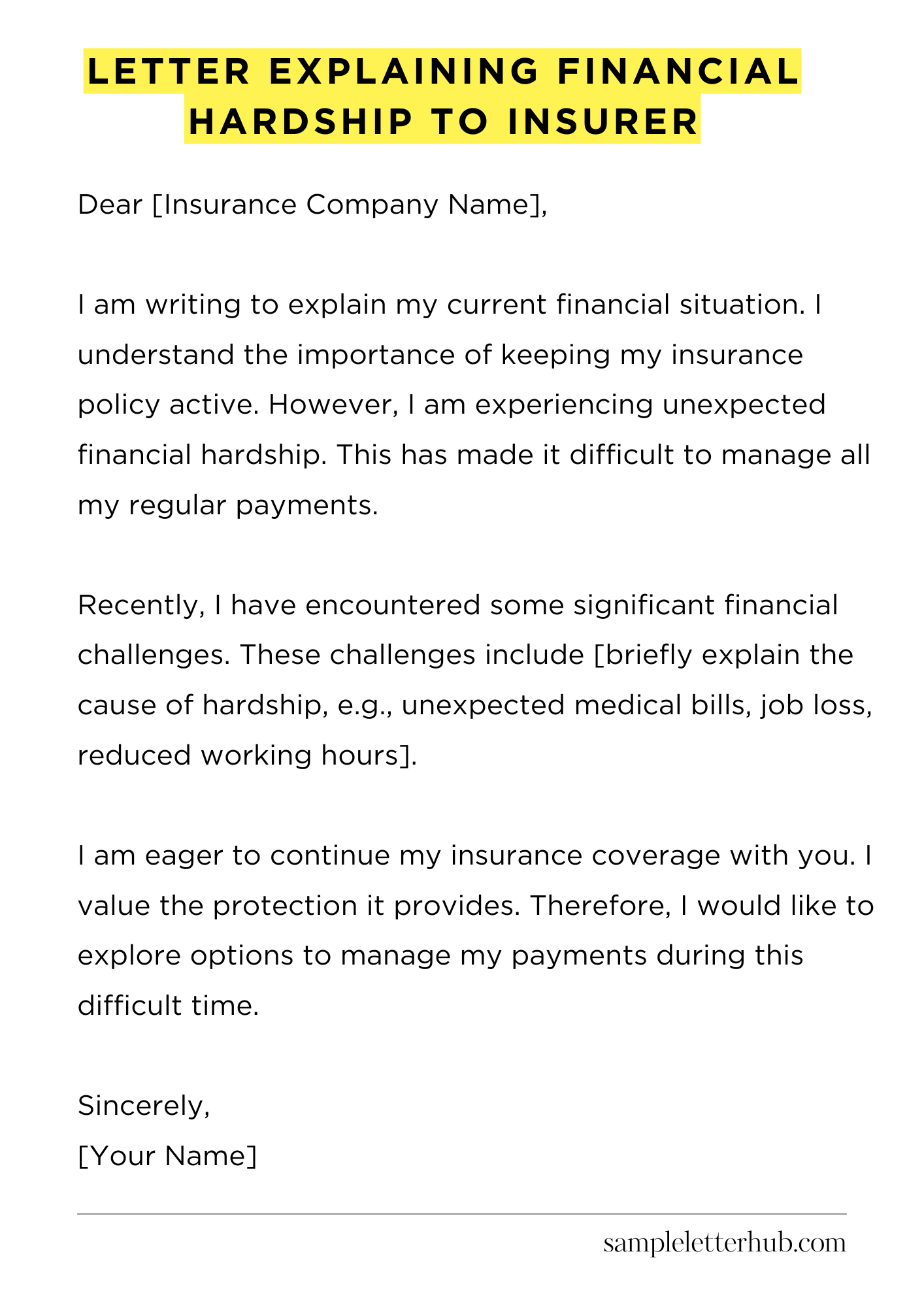
I am writing to explain my current financial situation. I understand the importance of keeping my insurance policy active. However, I am experiencing unexpected financial hardship. This has made it difficult to manage all my regular payments.
Recently, I have encountered some significant financial challenges. These challenges include [briefly explain the cause of hardship, e.g., unexpected medical bills, job loss, reduced working hours]. As a result, my income has been significantly impacted. I am now struggling to meet my monthly financial obligations.
I am eager to continue my insurance coverage with you. I value the protection it provides. Therefore, I would like to explore options to manage my payments during this difficult time.
Could you please provide information on any programs or payment plans that might be available? I would be grateful for any assistance you can offer. This could include, for example, a temporary reduction in premiums or a deferred payment plan. I would be happy to discuss my situation further and provide any necessary documentation.
I am committed to resolving this issue as quickly as possible. I would appreciate it if you could contact me at your earliest convenience. I can be reached by phone or email. Thank you for your time and consideration of this matter.
Sincerely,
[Your Name]
How to Write Letter Explaining Financial Hardship to Insurer
Life throws curveballs. Sometimes, those curveballs manifest as financial hardship. If you’re grappling with economic difficulties and need to communicate this to your insurer, a well-crafted letter is your ally. This guide provides a step-by-step approach to articulate your situation effectively, potentially leading to amenable solutions.
1. Commence with a Formal Salutation and Identification
Begin your epistle with a formal salutation, such as “Dear [Insurance Company Name] Claims Department” or, if known, “Dear Mr./Ms. [Adjuster’s Last Name]”.
It is vital to establish your identity immediately. State your full name, policy number, and any other pertinent identification details. This guarantees the letter is routed correctly and promptly acknowledged. Precision in this section prevents bureaucratic bottlenecks.
2. Briefly Summarize the Circumstances
Provide a concise and compelling summary of the event(s) precipitating your financial strain. This is your chance to set the stage. Frame the situation clearly and succinctly.
Specify the date the event occurred, its immediate impact, and the resulting financial implications. Avoid verbose explanations. Aim for clarity and a direct, incisive narrative. Maintain a professional tone throughout this narrative.
3. Detail the Nature of Your Financial Hardship
Elucidate the specifics of your financial difficulties. Be transparent. Detail exactly how this hardship affects your ability to meet premium payments, or any other financial obligations.
Quantify the impact as much as possible. Present concrete figures, such as lost income, increased expenses, or the inability to fulfill financial commitment. Documentation is paramount. Include any supporting documentation such as medical bills, proof of job loss or utility bills.
4. Explain Why You Cannot Meet Your Obligations
Articulate the correlation between the event(s) detailed and your inability to fulfill your financial obligations. This is where you connect the dots for the insurer.
Directly address how the event(s) have compromised your financial stability. Clearly state the consequences and the severity of the situation. This section provides the critical rationale for your request. Leave no room for ambiguity. This clarity is imperative for achieving the desired outcome.
5. Propose a Solution or Relief
This is where you advocate for a pragmatic solution. Clearly state what you are seeking from the insurer. This could include a temporary reduction in premiums, a payment plan, or a deferral of payments.
Be reasonable. Demonstrate a proactive approach. The more specific your proposal, the better. Show that you have given thought to possible solutions. This proactive step underscores your commitment to resolving the issue.
6. Provide Supporting Documentation and Information
This is where you amass evidence to bolster your claims. Attach copies of any documentation that validates your claims and supports your requests. This may include income statements, medical bills, bank statements, or any other relevant documentation.
Do not send originals. These documents underscore your credibility and reinforce the validity of your request. Compile a comprehensive, meticulous supporting package.
7. Conclude Professionally and State Your Intentions
Conclude your letter with a professional closing. “Sincerely,” or “Respectfully,” is often appropriate. Reiterate your contact information, including your phone number and email address, to facilitate a prompt response. Indicate your willingness to provide any further information that may be required. Express your optimism for a favorable outcome.
A clear, concise, and professional concluding remark leaves a lasting positive impression. Thank the insurer for their time and consideration.
FAQs about Letter Explaining Financial Hardship to Insurer
What is the purpose of a letter explaining financial hardship to an insurer?
The primary purpose of a letter explaining financial hardship to an insurer is to inform them about your current inability to meet your insurance premium payments due to unforeseen financial difficulties. This letter aims to request potential accommodations, such as a payment plan, temporary premium reduction, or waiver of late fees, allowing you to maintain your insurance coverage.
What information should be included in a financial hardship letter to an insurer?
A comprehensive financial hardship letter should include your policy information (policy number, type of insurance), a clear and concise explanation of the financial hardship you are experiencing (e.g., job loss, medical bills, unexpected expenses), supporting documentation to verify the hardship.
What types of supporting documentation are typically required to prove financial hardship?
Supporting documentation varies depending on the nature of the financial hardship. Common examples include pay stubs, unemployment benefits letters, bank statements, medical bills, invoices, proof of essential expenses (e.g., rent/mortgage statements, utility bills).
How can I increase my chances of a favorable response to my financial hardship letter?
To increase your chances of a favorable response, be honest and transparent in your letter. Provide clear and concise details about your situation, including dates, amounts, and any steps you’ve taken to mitigate the financial hardship. Include all necessary supporting documentation, and be specific in your request for assistance. Polite and respectful communication can also be beneficial.
What are the possible outcomes after submitting a financial hardship letter to an insurer?
The possible outcomes vary depending on the insurer’s policies and your individual circumstances. The insurer might approve your request for a payment plan, reduce your premiums temporarily, waive late fees, or offer alternative solutions.
They might also deny your request, potentially leading to policy cancellation. It is also possible that they may request additional information. It is crucial to review the response carefully and understand its implications.
Related:
Resignation letter due to rude boss
Resignation letter moving to another state
Resignation letter due to illness of family member
Resignation letter due to study