


Dealing with unexpected medical bills can be overwhelming. A letter explaining financial hardship due to medical expenses is a written document. It is used to inform creditors, healthcare providers, or other institutions about your inability to pay. Its purpose is to request assistance. This could include payment plans, reduced bills, or even debt forgiveness.
Facing financial strain from medical costs is tough. We understand. That’s why we’re here to help. This article provides letter explaining financial hardship due to medical expenses templates. You’ll find ready-to-use samples and examples. Need a quick solution? Our provided financial hardship letter options are easy to adapt.
We’ve made it simple for you. These letter samples are crafted to guide you. Use them to create a compelling letter addressing your specific situation. Navigate medical debt with more confidence. Let us help you find a bit of ease during a difficult time.
[Your Name]
[Your Address]
[Your Phone Number]
[Your Email Address]
[Date]
[Recipient’s Name]
[Recipient’s Title]
[Organization Name]
[Organization Address]
Dear [Recipient’s Name],
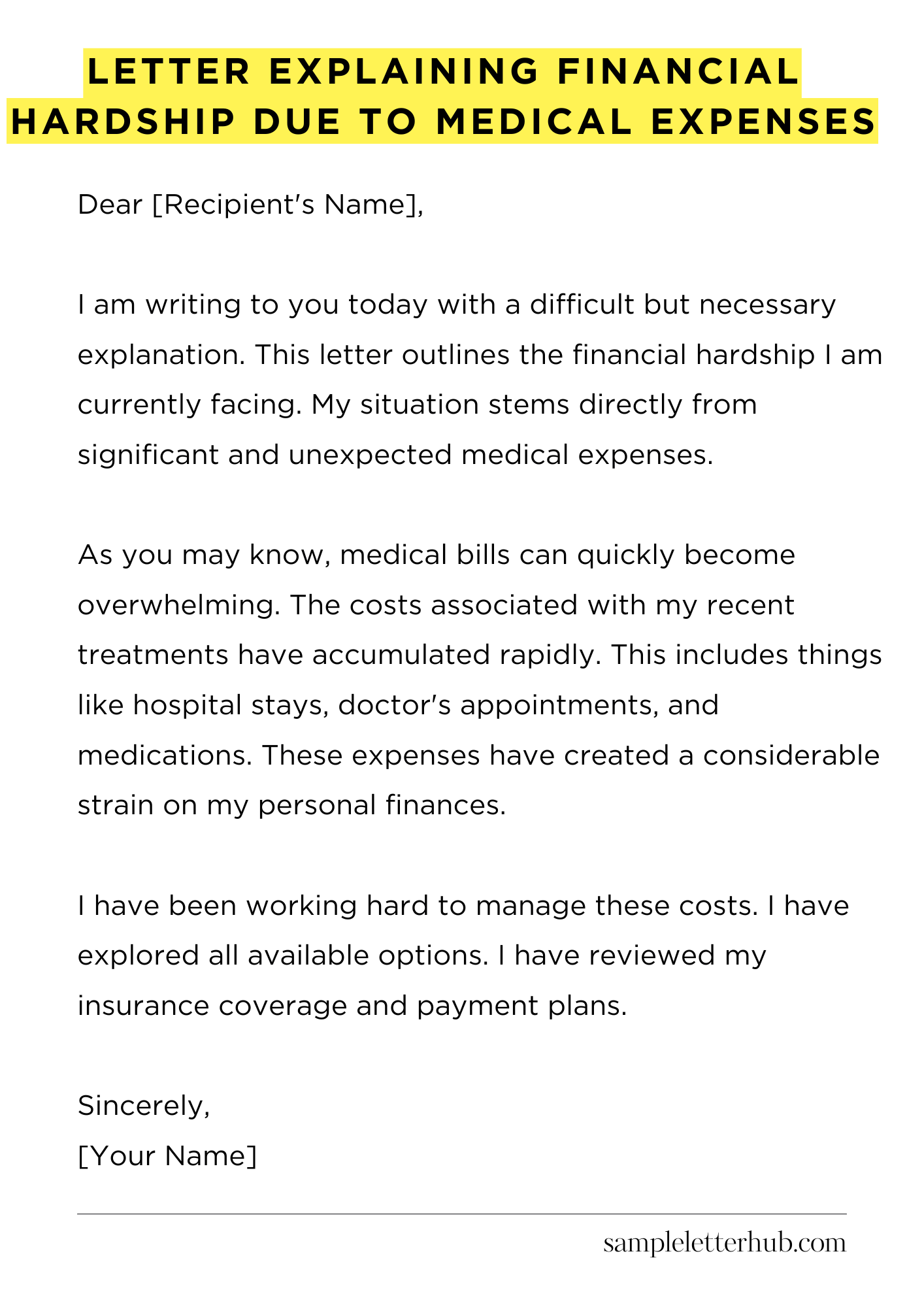
I am writing to you today with a difficult but necessary explanation. This letter outlines the financial hardship I am currently facing. My situation stems directly from significant and unexpected medical expenses.
As you may know, medical bills can quickly become overwhelming. The costs associated with my recent treatments have accumulated rapidly. This includes things like hospital stays, doctor’s appointments, and medications. These expenses have created a considerable strain on my personal finances.
I have been working hard to manage these costs. I have explored all available options. I have reviewed my insurance coverage and payment plans. Unfortunately, the magnitude of the bills makes it extremely challenging to keep up with all my other obligations.
This has left me in a challenging position. Paying for essential needs is becoming increasingly difficult. The future feels uncertain. I am seeking any possible assistance.
I would be grateful for any understanding and assistance you might be able to offer. Perhaps there are options for payment arrangements, or other resources available. I am open to discussing this further and providing any necessary documentation to support my situation.
Thank you for taking the time to read this letter. I sincerely appreciate your consideration and compassion during this difficult time. I look forward to hearing from you soon.
Sincerely,
[Your Name]
How to Write Letter Explaining Financial Hardship Due to Medical Expenses
Navigating the complexities of medical expenses can be arduous, but sometimes, a well-crafted letter can offer a lifeline. When grappling with financial duress stemming from medical costs, articulating your situation effectively is paramount. This guide provides a pragmatic roadmap for constructing a letter that persuasively conveys your hardship.
1. Comprehending the Core Components: The Anatomy of Your Appeal
Before you even begin to commit words to paper, you must understand the essential building blocks. Your missive, regardless of the intended recipient, requires precision. Address the recipient directly, ensuring clarity. Include your contact information at the top—name, address, phone number, and email. The date is vital.
The core of your letter should be a clear and concise explanation of your medical expenses, their impact on your finances, and the specific relief you’re seeking. Remember, a well-structured narrative is a powerful tool.
2. Delimiting the Narrative: Detailing Your Medical Expenditures
Detailing the specific medical expenses is crucial. This is where you substantiate your claims of financial hardship. Provide a meticulous list of your medical bills. You should include the date, the service rendered, the name of the provider, and the amount owed.
If you possess documentation such as receipts, invoices, or statements, consider providing copies. Remember, authenticity and transparency are vital components. Include the specific periods and the impact on your finances. This may also include any ongoing treatments or projected future costs.
3. Assessing the Financial Impediments: Quantifying Your Economic Burden
Your goal is to highlight the detrimental economic effects of your medical bills. Provide insights into your income and expenses. What are your monthly earnings?
What are your essential expenses? Include details regarding rent/mortgage, utilities, food, and other necessary costs. Demonstrate how your medical expenses, added to these obligations, are creating a fiscal shortfall. Specify if you’ve reduced other expenses to pay medical bills. Make it clear and to the point. This section should serve as concrete evidence of your hardships.
4. Defining the Recipient: Tailoring Your Communication
The recipient of your letter dictates the tone and content of your message. Are you writing to a hospital, a collection agency, or a government agency? Your approach should vary accordingly.
If writing to a hospital, you might focus on payment plans or charity care options. When corresponding with a collection agency, you might negotiate a settlement or provide documentation of your financial situation. If you are writing to a government agency, you will need to include your social security number and the proper channels.
5. Structuring the Proposition: Explicitly Stating Your Request
Be unequivocal. Clearly state what you are seeking from the recipient. Are you requesting a payment plan, a reduction in the bill, or assistance through a charitable program? Explain your desired outcome. Provide a timeframe for a response. Ensure your request is reasonable and within the purview of the recipient. The intention is to avoid ambiguity; a clear appeal is essential.
6. Crafting a Resolute Conclusion: The Final Flourish
Conclude your letter with a polite but assertive closing. Reiterate your appreciation for their consideration. Include your contact information once more for easy reference. Consider a closing statement, such as, “Thank you for your time and assistance in this matter,” followed by your full name and signature. This final step leaves a lasting impression.
7. Polishing the Presentation: Proofreading and Editing
Before dispatching your letter, proofread it meticulously. Correct any grammatical errors, spelling mistakes, or stylistic inconsistencies.
Ensure the tone is professional, clear, and respectful. Have another person review your letter. A fresh pair of eyes can often catch errors that you might miss. An error-free, well-written letter strengthens your argument and increases the likelihood of a favorable response.
FAQs about Letter Explaining Financial Hardship Due to Medical Expenses
What is the primary purpose of a letter explaining financial hardship due to medical expenses?
The primary purpose of such a letter is to formally communicate to creditors, healthcare providers, or other relevant parties about your inability to meet financial obligations due to the unforeseen and significant burden of medical expenses.
It aims to explain the circumstances leading to the financial strain and, often, to negotiate for more favorable payment terms, such as a reduced payment, a payment plan, or a temporary hold on collections.
What key information should be included in the letter?
A comprehensive letter should include your personal and account information, a clear explanation of the medical situation and associated expenses, the specific reasons for the financial hardship (e.g., loss of income, high medical bills, insurance limitations), and a request for specific accommodations.
It is crucial to provide supporting documentation, such as medical bills, insurance statements, and proof of income, to substantiate your claims. Also, detail what kind of assistance you are requesting.
Who should I send this letter to?
This letter should be sent to any individual or organization to whom you owe money due to medical expenses. This typically includes healthcare providers (doctors, hospitals, clinics), collection agencies, and potentially, credit card companies or loan providers if the expenses were financed.
Determine who needs to be informed, and send the letter to their designated billing or customer service address. If you’re disputing a bill, send it to the address listed on the bill.
How can I increase the chances of a favorable response?
To increase the likelihood of a positive outcome, be honest, clear, and concise in your communication. Provide as much supporting documentation as possible to validate your claims. Consider including a proposed solution, such as a manageable payment plan or a request for a partial debt forgiveness.
Additionally, send the letter via certified mail with return receipt requested to have proof that the letter was received. Follow up with a phone call to the recipient.
What happens if my request is denied?
If your initial request is denied, don’t give up. Review the reasons provided for the denial. You may be able to appeal the decision by providing additional information or documentation that was previously unavailable.
You can also explore options such as seeking assistance from a non-profit organization, a credit counselor, or legal aid to explore all available options. Consider negotiating or trying a new approach for a different outcome.
Related:
Resignation letter due to rude boss
Resignation letter moving to another state
Resignation letter due to illness of family member
Resignation letter due to study