


Dealing with an insurance company can be tricky. Sometimes, life gets in the way. You might need more time to respond. A letter explaining delay in responding to insurance company is essential. It tells your insurance provider why you haven’t replied. The purpose is simple. It keeps the communication open. It also helps avoid any penalties.
Need help crafting your own letter explaining delay? You’re in luck! We’ve got you covered. We’ll provide several letter explaining delay to insurance company samples. You’ll find templates and examples here. These will make writing your letter super easy.
We understand insurance can be confusing. Our examples are clear and straightforward. This will help you write a letter to insurance company for delay. Get ready to save time and stress. Let’s get started.
[Your Name]
[Your Address]
[Your Phone Number]
[Your Email Address]
[Date]
[Insurance Company Name]
[Insurance Company Address]
Dear [Name of Contact Person, if known, otherwise: Claims Department],
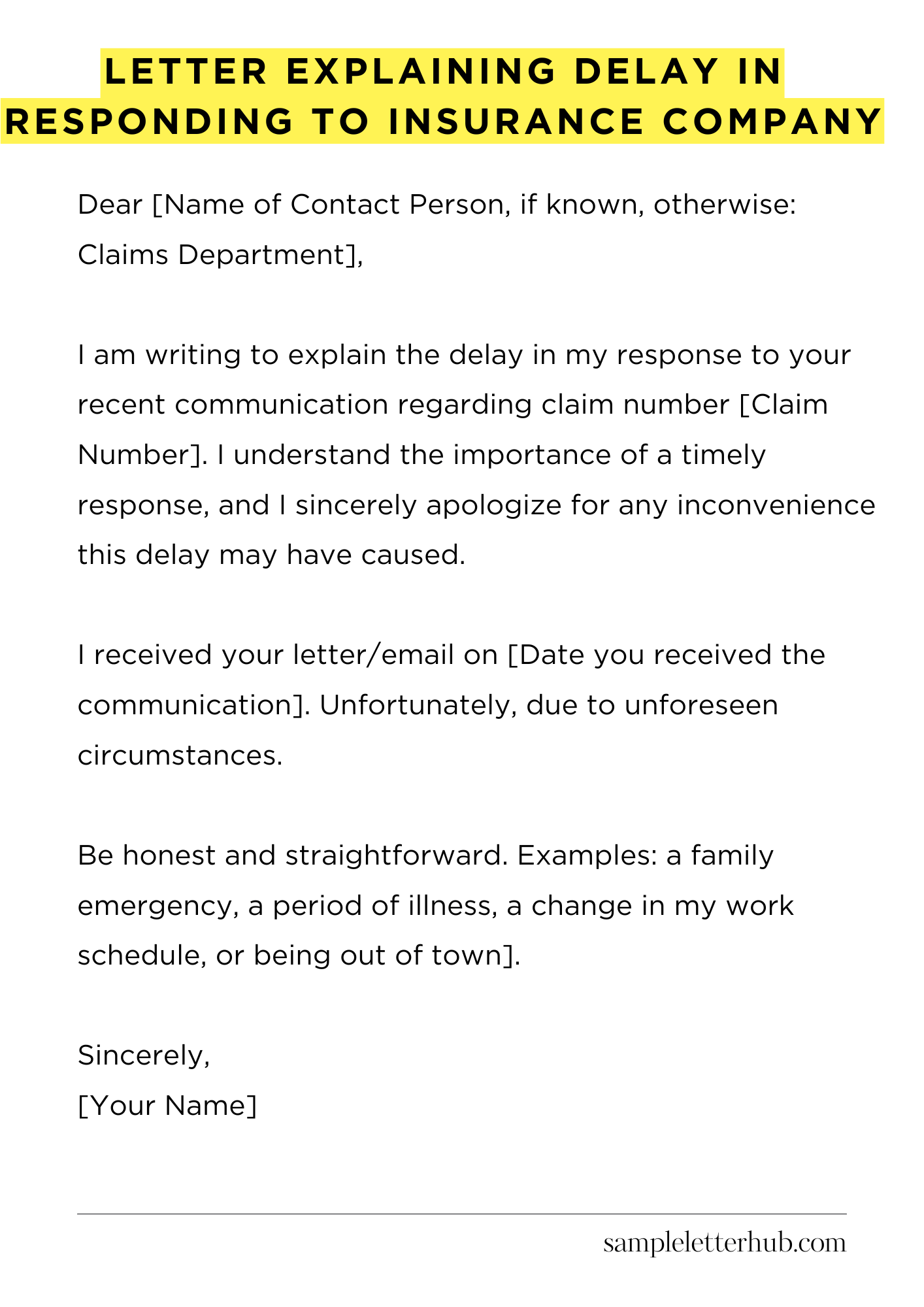
I am writing to explain the delay in my response to your recent communication regarding claim number [Claim Number]. I understand the importance of a timely response, and I sincerely apologize for any inconvenience this delay may have caused.
I received your letter/email on [Date you received the communication]. Unfortunately, due to unforeseen circumstances, I was unable to reply sooner. These circumstances included [Briefly explain the reason for the delay.
Be honest and straightforward. Examples: a family emergency, a period of illness, a change in my work schedule, or being out of town]. The details required to fully address your request were difficult to gather during this time.
I am now able to dedicate the necessary time to address the matters you raised. I am currently working on gathering all the required information. You can expect a full response from me by [Date you will respond].
I want to assure you that I am committed to resolving this claim as quickly as possible. I appreciate your patience and understanding in this matter. I am hopeful that the process will continue smoothly from here on.
Thank you for your time and attention to this important issue.
Sincerely,
[Your Name]
How to Write Letter Explaining Delay in Responding to Insurance Company
Life can be a tempestuous affair, frequently throwing curveballs that necessitate adjustments to our schedules. If you’ve found yourself tardy in responding to an insurance company, fret not. This guide will navigate you through crafting a cogent and persuasive letter that adequately explains your delay.
1. Commence with a Formal Salutation and Identification
Begin with a professional salutation. Address the letter to the appropriate claims adjuster or representative, if known. If not, use a general salutation like “To Whom It May Concern.”
Subsequently, unambiguously identify yourself, providing your full name, address, policy number, and any reference numbers associated with the claim. This immediately provides the insurer with the necessary contextual information.
2. Acknowledge the Correspondence and Express Regret
Immediately reference the original correspondence from the insurance company that you are responding to. For instance, “This letter is in reference to your correspondence dated [Date] regarding claim number [Claim Number].” Following this, articulate your sincere regret for the delay. This establishes a tone of accountability and demonstrates your recognition of the importance of the matter.
3. Extricate the Reasons for the Procrastination
This is the crux of the letter. Articulate the specific reasons for your delayed response with clarity and candor. Be forthright, but circumspect. Consider these scenarios:
- Medical Issues: If you’ve been grappling with illness, a family medical emergency, or hospitalization, explicitly state this. Include dates if possible, and avoid excessive personal detail that may overshare.
- Geographic Displacement: Perhaps you were travelling and had limited access to your mail or the ability to respond promptly. Describe the situation briefly, giving the dates of absence.
- Extenuating Circumstances: If you were overwhelmed with unforeseen personal obligations, like a demanding project or a death in the family, be succinct.
4. Offer Supporting Documentation, If Applicable
Whenever feasible, furnish supporting documentation to bolster your explanation. For medical reasons, consider enclosing a brief note from your physician. If you were travelling, a copy of your itinerary can be helpful. Remember to only include documentation that is relevant and necessary.
5. Demonstrate Your Intent to Cooperate
Reassure the insurance company of your commitment to cooperate fully and provide all necessary information to facilitate the claims process. This affirms your commitment to resolving the matter expeditiously. If any documentation is required, state that you will be providing the requested documentation or will do so shortly.
6. Set Forth a Timeline and Provide Contact Information
Indicate when you expect to be fully responsive moving forward. Providing a specific date or timeframe suggests a plan of action and demonstrates that you have regained control. Offer your contact information. Include your phone number and email address, thereby allowing the insurance company to easily reach you for any further inquiries.
7. Conclude with a Professional Closing
Conclude with a professional closing, such as “Sincerely” or “Respectfully.” Sign your name above your typed name. If sending via mail, ensure the letter is printed on high-quality paper and is free of grammatical errors.
A well-crafted letter can mitigate any negative implications of the delay, reinforcing your credibility and facilitating a favorable resolution to your claim.
FAQs about Letter Explaining Delay in Responding to Insurance Company
What is the primary purpose of a letter explaining a delay in responding to an insurance company?
The primary purpose is to formally notify the insurance company that you require additional time to provide the requested information or documentation. This letter serves as a record of your communication and helps manage expectations by proactively informing the insurer of the forthcoming delay and the reasons behind it.
What key pieces of information should be included in the letter?
Essential components include your policy number, the claim or request reference number (if applicable), the date of the insurance company’s initial request, a clear explanation for the delay, an estimated timeframe for when you will respond, and your contact information. Additionally, you should express your intent to cooperate fully and promptly.
What are some acceptable reasons for a delay in responding?
Acceptable reasons can vary but commonly include needing to gather documentation, seeking legal or professional advice, experiencing unforeseen circumstances such as illness or a family emergency, or the need to investigate or assess the situation more thoroughly. The specific reason should be detailed clearly and concisely.
How should the letter be formatted and delivered?
The letter should be professionally formatted, using a clear and concise tone. Use formal language and maintain a polite and cooperative approach. It’s best practice to send the letter via certified mail or another method that provides proof of delivery, such as email with a read receipt. Always retain a copy for your records.
What are the potential consequences of failing to respond or provide a timely response?
Failing to respond or delaying without adequate explanation can lead to several consequences. These can include denial of your claim, delays in the processing of your claim, or even potential cancellation of your insurance policy, depending on the terms of your policy and the specific circumstances.
It’s crucial to understand the implications outlined in your policy and to communicate proactively with the insurer.
Related:
Resignation letter due to rude boss
Resignation letter moving to another state
Resignation letter due to illness of family member
Resignation letter due to study