

After a car accident, life can become incredibly difficult. A letter explaining car accident financial hardship is a formal document. It clearly outlines the financial struggles caused by the accident. Its purpose is to request assistance. This could be from an insurance company or other source.
Need help crafting your own financial hardship letter? You’re in the right place. We’ve got you covered. We’re sharing templates and samples of car accident hardship letters. These samples will make it easier for you. You can easily adapt them to your specific situation.
We know it can be overwhelming. Writing this kind of letter is tough. Our goal is to simplify the process. These letter samples will provide a great starting point. They will make sure you explain your situation clearly. Good luck.
[Your Name]
[Your Address]
[Your Phone Number]
[Your Email Address]
[Date]
[Insurance Company Name or Recipient Name]
[Recipient Address]
Dear [Recipient Name or Insurance Company],
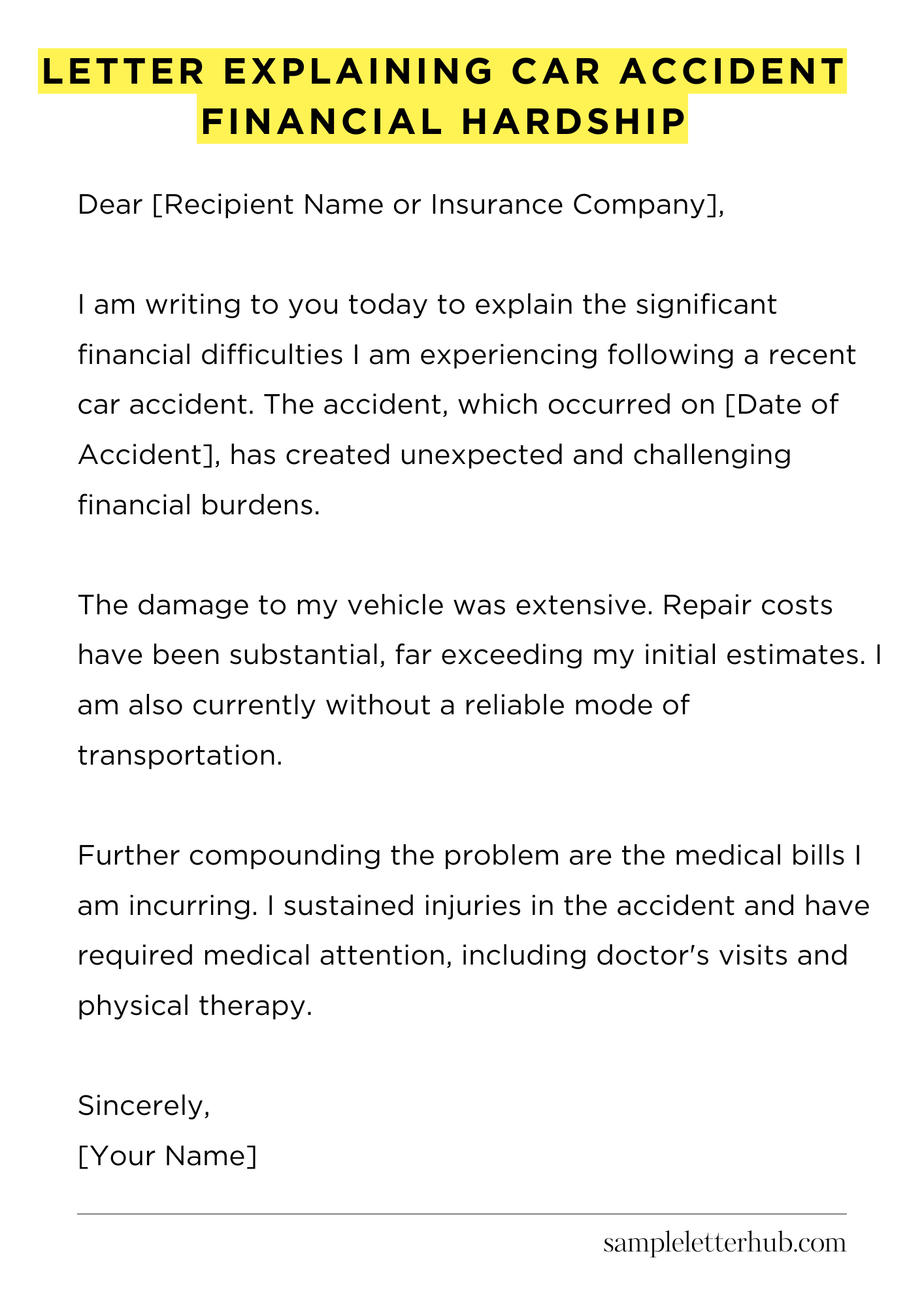
I am writing to you today to explain the significant financial difficulties I am experiencing following a recent car accident. The accident, which occurred on [Date of Accident], has created unexpected and challenging financial burdens.
The damage to my vehicle was extensive. Repair costs have been substantial, far exceeding my initial estimates. I am also currently without a reliable mode of transportation. This is causing serious issues.
I now face added expenses for alternative transportation, such as taxis, ride-sharing services, and public transport. These costs are mounting daily and quickly becoming unsustainable.
Further compounding the problem are the medical bills I am incurring. I sustained injuries in the accident and have required medical attention, including doctor’s visits and physical therapy.
These medical expenses are adding significantly to my overall financial strain. The bills keep arriving, a constant reminder of the situation.
Additionally, due to my injuries, I have been unable to work for [Number] days/weeks. This has resulted in a loss of income, making it even more difficult to manage my finances.
The impact on my ability to pay bills and meet my financial obligations has been severe. I am struggling to maintain my standard of living.
I am requesting assistance. I kindly ask for your understanding and consideration as I navigate these difficult circumstances. I am available to provide any further documentation or information you may require to support my claim and the financial hardship caused by this accident. I hope we can find a way through this together.
Thank you for your time and attention to this matter.
Sincerely,
[Your Name]
How to Write a Letter Explaining Car Accident Financial Hardship
A car accident can be a cataclysmic event, not just physically but also financially. When you find yourself in such a predicament and need to articulate your financial woes to an insurer, a well-crafted letter is your key to mitigation. This guide will walk you through the essential components of composing such a missive, ensuring your plight is understood and, hopefully, addressed.
1. Commence with a Cogent Salutation
Begin with a professional and respectful salutation. Use “Dear [Insurance Adjuster’s Name],” if you know it. Otherwise, opt for “Dear Claims Department” or a similar formal greeting. This sets a tone of civility that is vital.
2. Explicitly State Your Purpose
The opening paragraph should immediately declare the letter’s intent. State that you are writing to explain the financial hardship caused by the car accident. Be direct and concise. Avoid circumlocution, as clarity is paramount in this context.
3. Detail the Precipitating Incident
Briefly describe the car accident. Include the date, location, and a succinct description of what transpired. Reference any police reports or claim numbers to facilitate easy reference for the recipient. Remember, this isn’t a comprehensive account, but a contextual backdrop for your financial distress.
4. Delve into the Financial Ramifications
This is the crux of your letter. Detail the financial implications of the accident. Be meticulous in delineating your expenses. Include medical bills, vehicle repair costs, lost wages, and any other related expenditures.
Attach copies of supporting documentation—bills, invoices, pay stubs—as corroborative evidence. Organize your information in a logical manner, perhaps itemizing each expense to enhance readability.
5. Articulate the Impact on Your Life
Explain how these financial burdens have affected your life. Are you struggling to pay rent or mortgage? Are you unable to afford essential medications?
Have you had to make drastic changes to your lifestyle? This section humanizes your predicament, making it easier for the adjuster to empathize with your situation. Use emotive language, but avoid hyperbole. Authenticity is key.
6. Propose a Resolution
Clearly state what you are seeking from the insurance company. Are you requesting a lump-sum payment to cover expenses? Are you proposing a payment plan?
Be realistic in your requests. Specify the exact amount or the terms you are seeking. This section conveys a sense of resolution and helps the adjuster understand what action is expected of them.
7. Conclude with a Professional Closing
End with a polite and professional closing. Use “Sincerely,” or “Respectfully,” followed by your full name and contact information. Ensure your address and phone number are readily available.
Proofread the entire letter for any grammatical errors or typos before sending. Consider sending it via certified mail with return receipt requested to provide evidence of delivery. This is your definitive statement; make it count.
FAQs about Letter Explaining Car Accident Financial Hardship
What is the purpose of a letter explaining car accident financial hardship?
The primary purpose of a letter explaining financial hardship due to a car accident is to formally communicate the financial difficulties you are experiencing to relevant parties.
This may include insurance companies, creditors, or potential lenders. The letter aims to provide a clear and concise account of how the accident has impacted your finances, often seeking assistance such as a delay in payments, a reduced payment plan, or consideration for leniency.
Who should I send a financial hardship letter to?
You should send this letter to any entity to whom you owe money or anticipate owing money because of the car accident. This often includes your insurance provider, the at-fault driver’s insurance, medical providers, car loan lenders, credit card companies, and possibly even utility companies.
The goal is to inform all parties involved in your financial strain and explore available options for assistance.
What information should be included in a financial hardship letter?
Your letter should include your personal details, details of the car accident, and a comprehensive explanation of how the accident has created financial hardships. Be sure to provide specific examples of financial loss, such as medical bills, lost wages, vehicle repair costs, and any ongoing treatment.
Include supporting documentation like medical bills, pay stubs, and repair estimates. Clearly state what assistance you are seeking, such as a payment plan, or temporary payment relief.
How should I structure a financial hardship letter?
The letter should follow a formal business letter format. Start with your contact information, the date, and the recipient’s information. Next, provide a clear subject line indicating the reason for the letter (e.g., “Financial Hardship Due to Car Accident”). Begin with a brief introduction, outlining the accident and its impact.
Detail your financial situation, supported by evidence, in the body of the letter. Conclude with a clear request for assistance and your contact information. Be concise, professional, and empathetic to the recipient’s position.
Is a financial hardship letter legally binding?
A financial hardship letter itself is not legally binding. However, it can serve as evidence and support any legal claims. It documents your attempts to communicate with the entities you owe.
Agreements made as a result of the letter, such as a modified payment plan, may become legally binding if documented in writing. Always retain a copy of the letter and any responses you receive for your records.
Related:
Resignation letter due to rude boss
Resignation letter moving to another state
Resignation letter due to illness of family member
Resignation letter due to study