

So, what exactly is a “Letter Explaining Additional Information for Claim Review?” It’s a crucial document. You send it when your insurance company or another organization needs more details. The purpose? To provide extra facts. They use this to process your claim.
Dealing with these letters can feel overwhelming. Don’t worry, we’ve got you covered. This article will help you understand the process. We are sharing ready-to-use Letter Explaining Additional Information for Claim Review templates. We’ll offer multiple sample letters for various situations.
Our claim review letter samples simplify writing. Use these examples as your guide. Creating the right letter for claim review becomes easy. You can adapt them to your specific needs. Get ready to streamline your claim process with our help!
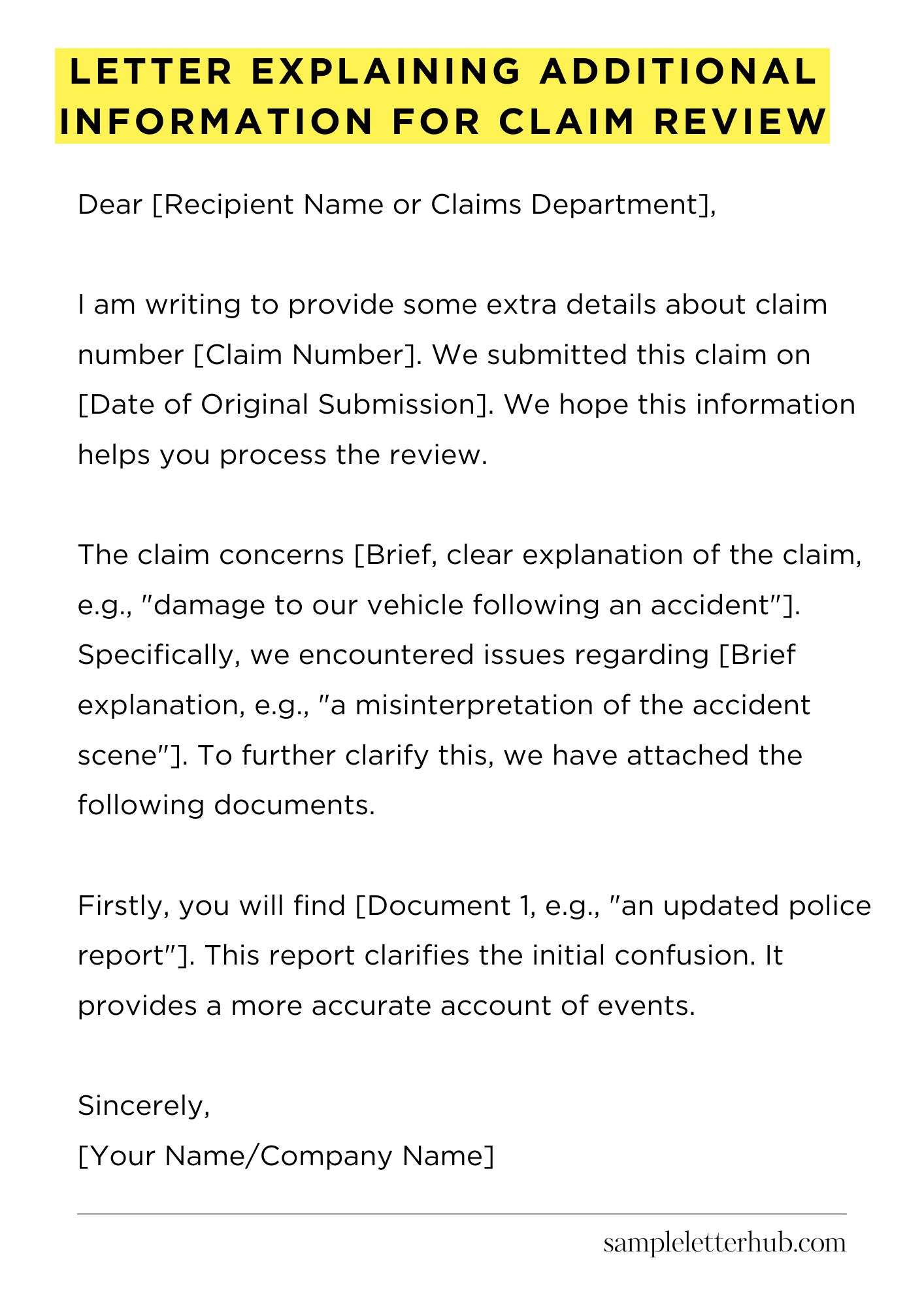
[Your Name/Company Name]
[Your Address]
[Your Phone Number]
[Your Email Address]
[Date]
[Recipient Name/Insurance Company]
[Recipient Address]
Dear [Recipient Name or Claims Department],
I am writing to provide some extra details about claim number [Claim Number]. We submitted this claim on [Date of Original Submission]. We hope this information helps you process the review.
The claim concerns [Brief, clear explanation of the claim, e.g., “damage to our vehicle following an accident”]. Specifically, we encountered issues regarding [Brief explanation, e.g., “a misinterpretation of the accident scene”]. To further clarify this, we have attached the following documents.
Firstly, you will find [Document 1, e.g., “an updated police report”]. This report clarifies the initial confusion. It provides a more accurate account of events. Secondly, we have included [Document 2, e.g., “photographs of the damage”]. These photographs show the true extent of the damage to the vehicle.
Finally, we also attached a statement from [Witness name, if applicable, e.g., “a witness, Mr. Jones”]. His statement supports our claim. These extra details should assist in expediting the claim review.
We believe that this information will help you to reach a decision quickly. Please let us know if you require any further information. We appreciate your time and attention to this matter. Thank you for your consideration.
Sincerely,
[Your Name/Company Name]
How to Write Letter Explaining Additional Information for Claim Review
Navigating the claims process can feel like traversing a labyrinth. Often, a claims reviewer requests supplementary documentation. This is where a well-crafted letter can be your guiding light. Your meticulous attention to detail is crucial here.
Let’s illuminate the process of composing a compelling letter to elucidate the additional information needed for a claim review.
1. Commence with a Formal Salutation
Your missive should begin with a professional salutation. Always address the claims reviewer by name. This personalized touch demonstrates respect and attention to detail. “Dear Mr./Ms. [Last Name],” is a standard and effective approach. Avoid casual greetings; instead, prioritize formality.
2. State the Purport of the Letter Immediately
Clarity is paramount. Begin the body of your letter by explicitly stating its purpose. This avoids any ambiguity and immediately informs the recipient. For instance, you could begin with: “This letter is in response to your request for supplementary information regarding claim number [Claim Number].” A strong, declarative sentence sets the tone.
3. Provide a Succinct Summary of the Claim
Provide a brief, yet comprehensive overview of the claim. This acts as a contextual framework for the additional information. Briefly state the nature of the claim, the date, and the services or goods in question. Focus on brevity and accuracy; omit superfluous details.
4. Enumerate and Explain the Requested Information
This is the core of your letter. Systematically address each piece of information requested by the claims reviewer. Number each item clearly and provide a concise explanation alongside each one.
Ensure that your explanations are straightforward and readily understandable, avoiding any jargon. If you are attaching documents, explicitly state this, such as: “Attached is the invoice for the services rendered.” Use bullet points if necessary to improve readability and improve the efficacy of your letter.
5. Maintain a Tone of Professionalism and Politeness
Even if you are frustrated, maintain a professional and courteous tone throughout the letter. Avoid accusatory language and focus on providing accurate information.
Use phrases like, “I am happy to provide the requested information” or “I trust that this information will facilitate the review process.” Civility can greatly influence the reviewer’s perception.
6. Ensure Clarity and Conciseness in Your Writing
The writing must be clear, concise, and easy to understand. Eliminate any unnecessary words or phrases. Use short, impactful sentences, which keeps the flow. Proofread the letter meticulously to catch any grammatical errors or typos. Poor writing can easily undermine the credibility of your submission.
7. Conclude with a Call to Action and Proper Closing
End your letter with a polite call to action. You might write: “I trust that this information is sufficient for the review of the claim. Please do not hesitate to contact me if you require any further information.
” Use a professional closing, such as “Sincerely,” or “Respectfully,” followed by your full name and contact information. Remember to sign the letter if it is being sent via postal mail.
FAQs about Letter Explaining Additional Information for Claim Review
What is the primary purpose of a letter explaining additional information for a claim review?
The primary purpose of this letter is to provide the necessary clarification and supporting documentation that an insurance company, or other claims reviewer, has requested to properly assess and potentially approve a claim.
This information helps them make an informed decision by filling in gaps or validating details presented in the initial claim submission.
What types of information are typically requested in these letters?
Common information requests include additional medical records (like test results, doctor’s notes, or treatment plans), further details regarding the incident (such as witness statements or police reports), proof of purchase, repair estimates, or clarification on specific items or services claimed. The specific information depends on the nature of the original claim and the reviewer’s needs.
What are the key elements to include in a well-written letter explaining additional information?
A well-written letter should clearly identify the claim being addressed (e.g., claim number, date of incident). It should also include a concise explanation of the information being provided, referencing the specific requests made by the claims reviewer.
The supporting documentation should be clearly organized and easily accessible. It’s often helpful to include a brief summary of how the provided information supports the claim’s validity. Finally, always include contact information for any follow-up.
How should I organize the supporting documentation I include with the letter?
Organizing supporting documentation is crucial. It’s best to number or label each piece of documentation and refer to these labels within your letter. Group similar documents together (e.g., all medical records).
Use tabs, page numbers, or a table of contents, if necessary, to make it easy for the reviewer to locate and understand the provided information. Always make sure to send copies, not original documents, unless explicitly instructed otherwise.
What should I do if I disagree with the claim reviewer’s initial assessment or information request?
If you disagree with the assessment or the information requested, it’s important to respond promptly and professionally. Clearly state your disagreement and the reasons behind it in the letter.
Provide any evidence or reasoning to support your position, being respectful and constructive in your approach. You may consider consulting with an expert or seeking legal advice if the matter is complex or the amount in question is substantial.
Related:
Resignation letter due to rude boss
Resignation letter moving to another state
Resignation letter due to illness of family member
Resignation letter due to study