

A lecturer resignation letter is a formal document. It informs your employer of your intention to leave your job. The letter officially ends your employment. It states your last day of work.
This can be a tricky thing to write. Finding the right words matters. We’re here to help. This article offers several templates. We’ll also share various examples.
We have a variety of samples. You can use them to craft your own perfect letter. They are easy to adapt. Choose the one that suits your needs best.
Lecturer Resignation Letter
Below is a sample of a Lecturer Resignation Letter:
[Your Name]
[Your Address]
[Your Phone Number]
[Your Email Address]
[Date]
[Recipient’s Name] (e.g., Head of Department)
[Recipient’s Title]
[Department Name]
[University/Institution Name]
[University/Institution Address]
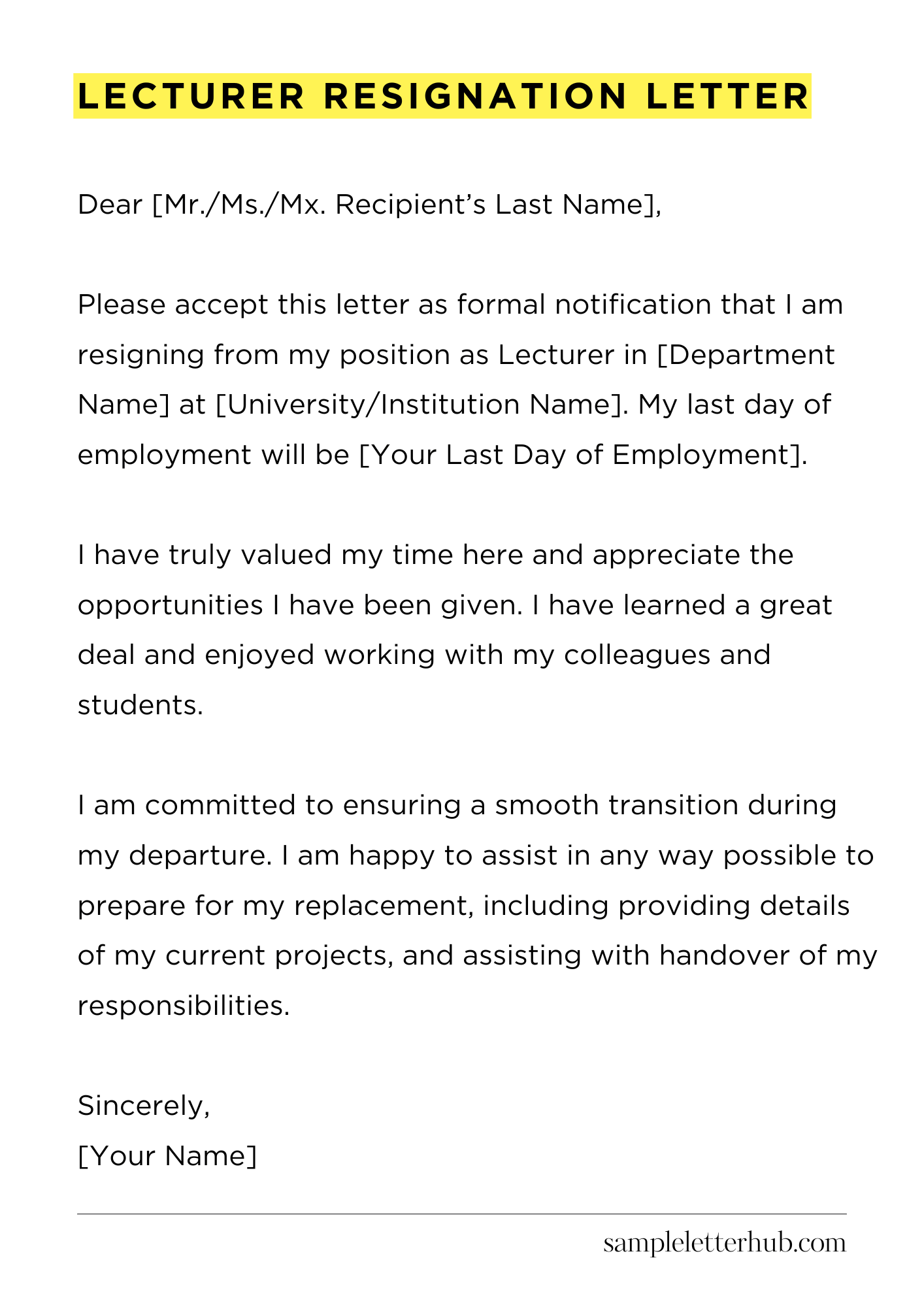
Dear [Mr./Ms./Mx. Recipient’s Last Name],
Please accept this letter as formal notification that I am resigning from my position as Lecturer in [Department Name] at [University/Institution Name]. My last day of employment will be [Your Last Day of Employment].
I have truly valued my time here and appreciate the opportunities I have been given. I have learned a great deal and enjoyed working with my colleagues and students.
I am committed to ensuring a smooth transition during my departure. I am happy to assist in any way possible to prepare for my replacement, including providing details of my current projects, and assisting with handover of my responsibilities.
I wish you and the university all the best in the future.
Sincerely,
[Your Name]
How to Write a Lecturer Resignation Letter
1. Why You Need to Resign Properly
Leaving a job, especially a position as a lecturer, requires professionalism. It is essential. A well-crafted resignation letter is more than just a formality; it’s a bridge.
This bridge connects your past employment with your future endeavors. It ensures a smooth transition, protects your reputation, and can even serve as a valuable reference point later on. Think of it as a farewell gift. It’s the final impression you leave.
A poorly written resignation, on the other hand, can create unnecessary complications. It could damage relationships with colleagues, hinder future job prospects, and potentially impact your ability to receive a positive recommendation. This is not the goal. Remember, the academic world is small. Protect yourself.
2. Essential Elements: What to Include
Several key components are necessary for a successful resignation letter. Start with the basics. Begin with your name, the date, and the recipient’s name and title.
Then, state your intention clearly and directly: “I am writing to formally resign from my position as Lecturer in [Department] at [University/Institution].” This is important.
Next, specify your last day of employment. This is a critical detail. Usually, this date is determined by your contract or institutional policies. Be sure to double-check these terms and conditions.
Next, you can include a brief statement of gratitude. Express your appreciation for the opportunities and experiences you’ve gained during your time there. This should be sincere.
Optionally, you could offer assistance with the transition. Offer to help train your replacement, if appropriate. This shows professionalism. Finally, close with a polite and professional closing, such as “Sincerely” or “Respectfully,” followed by your signature and typed name.
3. Key Considerations: Tone and Style
The tone of your letter should be professional, respectful, and positive, even if you are leaving due to negative circumstances. Avoid negativity. Avoid making personal attacks or complaining about your experience. Your letter should reflect your maturity. Keep it concise, clear, and to the point. Long, rambling letters are generally not well-received.
Proofread carefully. Grammatical errors and typos can detract from your credibility. Make sure the writing is polished and error-free. Be sure the formatting is correct. Use a standard business letter format. This is vital.
4. Tailoring Your Letter: Examples and Variations
You can adjust your resignation letter based on your specific situation. Consider a scenario where you are leaving for a better job offer. Your letter might highlight the new opportunity. If you are leaving due to personal reasons, you can keep the explanation brief and general, such as “for personal reasons.”
You can also adapt the level of formality. Be sure to align the tone with the institution’s culture and your relationship with your supervisor. There are various templates available online. Use these as a starting point. Customization is key.
5. Following Up: The Next Steps
Once you’ve submitted your letter, be prepared for a response. Your supervisor may schedule a meeting to discuss your departure. Be professional and courteous during this conversation. You might also need to complete an exit interview or return institutional property.
Maintain a positive attitude throughout the transition period. This ensures you leave a positive lasting impression. Finally, keep a copy of your resignation letter for your records. It’s always smart to keep a paper trail. These steps make a big difference.
FAQs about Lecturer resignation letter
How do I write a compelling resignation letter as a lecturer?
A compelling resignation letter for a lecturer should be professional, concise, and positive. Start by clearly stating your intention to resign and your last day of employment.
Express gratitude for the opportunity to work at the institution, mentioning specific experiences or individuals if appropriate. Keep it brief, focusing on your departure and any necessary information for a smooth transition. Proofread carefully for any errors.
What should I include in my lecturer resignation letter?
Your resignation letter should include your formal announcement of resignation, your last working day, a brief expression of gratitude for the opportunity, and any relevant details for a handover process, such as your willingness to assist in the transition. While not required, you might also briefly state your reason for leaving, but this is optional.
How much notice should I give when resigning as a lecturer?
The standard notice period for a lecturer typically varies depending on your contract and the institution’s policies, but it is often one to three months. Review your employment contract to determine the required notice period. Adhering to the specified time frame is essential to maintain a professional relationship.
Can I provide a reason for resigning in my letter, and should I?
You can optionally include the reason for your resignation, but it is not always necessary. If you choose to, keep it brief and positive. Avoid negative comments about the institution or colleagues. You can simply state that you are pursuing a new opportunity or personal goals. The focus should be on your departure rather than complaints.
What are some common mistakes to avoid in a lecturer resignation letter?
Avoid being overly emotional or negative. Don’t include complaints or criticisms about the institution or individuals. Avoid vague or ambiguous language. Do not make demands or threats. Ensure that you adhere to the notice period specified in your contract. Always maintain a professional tone and proofread your letter before submitting it.
Related:
Resignation letter due to rude boss
Resignation letter moving to another state
Resignation letter due to illness of family member
Resignation letter due to study