


A leader resignation letter is a formal document. It announces a leader’s departure from their role. The letter’s primary purpose is to inform the organization. It officially communicates the resignation and its effective date.
Writing a resignation letter can be tricky. Don’t worry, we’re here to help. We’ll share several templates. These templates include examples and samples. You can adapt them to your specific situation.
Need to resign but unsure where to start? Consider these sample letters. We’ve got you covered. Crafting your letter will be easy. Let’s get started.
Leader Resignation Letter
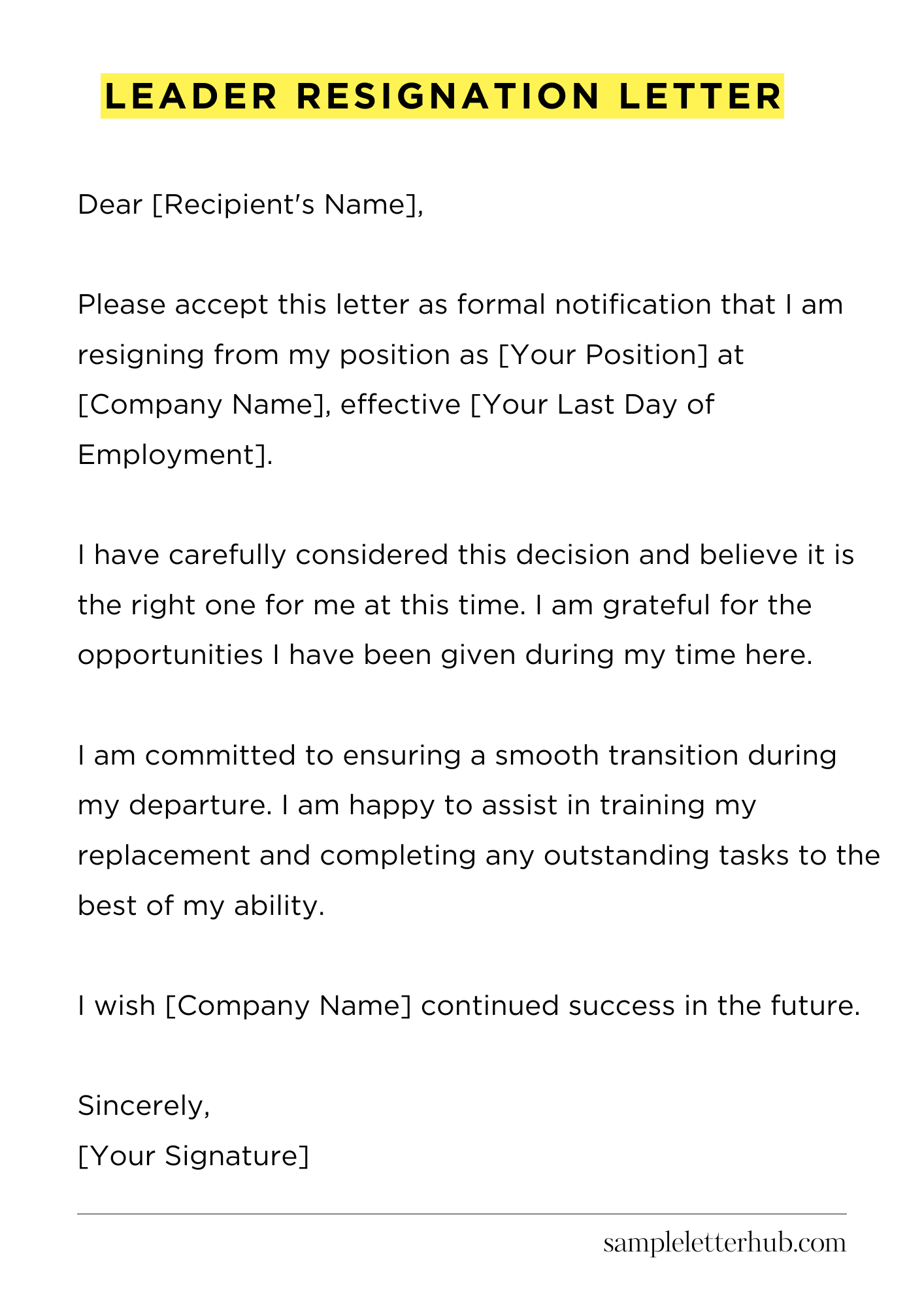
Below is a sample of a Leader Resignation Letter:
[Your Name/Address]
[Your Email]
[Your Phone Number]
[Date]
[Recipient’s Name/Title]
[Company Name]
[Company Address]
Dear [Recipient’s Name],
Please accept this letter as formal notification that I am resigning from my position as [Your Position] at [Company Name], effective [Your Last Day of Employment].
I have carefully considered this decision and believe it is the right one for me at this time. I am grateful for the opportunities I have been given during my time here.
I am committed to ensuring a smooth transition during my departure. I am happy to assist in training my replacement and completing any outstanding tasks to the best of my ability.
I wish [Company Name] continued success in the future.
Sincerely,
[Your Signature]
How to Write a Leader Resignation Letter
Leaving a leadership role is a significant step. It’s often filled with mixed emotions, and properly communicating your departure is critical. A well-crafted resignation letter shows respect, professionalism, and sets the stage for a smooth transition. Don’t underestimate the power of your words here.
1. Start with Clarity and Purpose
Your letter’s primary goal is simple: to officially announce your resignation. Begin with a clear and concise statement. State your intention to resign from your position and specify the effective date. This date is crucial for both you and the organization. It allows time for them to plan and initiate the process of finding your replacement.
For example, you could start with: “Please accept this letter as formal notification that I am resigning from my position as [Your Position] at [Company Name], effective [Date].” Keep it simple, direct, and unambiguous. You want to avoid any confusion.
2. Express Gratitude and Acknowledge Accomplishments
Even if your reasons for leaving are complex, expressing gratitude is important. Acknowledge your time with the organization and any positive experiences you’ve had. This fosters a sense of goodwill and leaves a favorable impression.
Think about the people you’ve worked with. Consider mentioning specific projects or achievements you’re proud of. It’s always nice to end on a positive note.
You might write: “I am grateful for the opportunity to have served as [Your Position] for the past [Number] years. During this time, I am proud of [mention a key accomplishment or contribution].” Remember, authenticity matters.
3. Provide a Smooth Transition Plan (If Possible)
Offer assistance with the transition process if you’re able to. This demonstrates your commitment to the organization’s success, even after you leave. This shows consideration and can ease the burden on your former colleagues. Think about what you can offer, and be realistic about your availability.
Consider offering to: “I am committed to ensuring a seamless handover. I am happy to assist in training my replacement and providing any necessary documentation before my departure.” Suggesting a meeting to discuss ongoing projects is always helpful. A well-planned transition reflects positively on your leadership.
4. Keep It Concise and Professional
The resignation letter is not the place for lengthy explanations or airing grievances. Stay professional and to the point. Focus on the essential information: your resignation, the effective date, and any assistance you can offer. Use a formal tone and avoid casual language.
Keep the letter concise, usually within one page. Edit and proofread it carefully to avoid any errors in grammar or spelling. The focus needs to be on leaving gracefully, not detailing every dissatisfaction.
5. Finalize with Contact Information and Closing
End your letter with a professional closing, such as “Sincerely,” or “Regards,” followed by your full name. Include your contact information (phone number and personal email address) for any follow-up questions or discussions. Remember, you might need to stay in touch for a bit.
Before submitting, review the letter one last time. Make sure it accurately reflects your intentions and leaves a positive lasting impression. Your exit matters.
FAQs about Leader Resignation Letter
What is the primary purpose of a leader resignation letter?
The primary purpose of a leader’s resignation letter is to formally communicate their decision to leave their position to the appropriate authority, usually the board of directors, CEO, or relevant governing body. It officially announces the departure, clarifies the effective date, and often provides a brief, professional explanation or expression of gratitude.
What key elements should a leader’s resignation letter include?
A well-crafted leader’s resignation letter typically includes the following: a formal statement of resignation, the specific leadership role being vacated, the effective date of resignation, a brief and professional reason for leaving (optional but often included), an expression of gratitude for the opportunity (if applicable), and an offer to assist with the transition.
Contact information might also be included.
How much notice should a leader provide when resigning?
The amount of notice a leader should provide depends on the company’s policies, their employment contract, and the specific circumstances. Generally, it’s customary to give a notice period of at least two weeks, but for leadership positions, a longer period, such as one month or even longer, is frequently expected to allow for a smooth transition and the selection of a successor.
Always refer to your employment contract for the required notice period.
What tone and language are appropriate for a leader’s resignation letter?
The tone and language should be professional, respectful, and concise. Avoid negative comments about the company or colleagues. Instead, focus on conveying the decision clearly, expressing appreciation for the opportunity, and offering assistance with the transition. Using a formal, business-like tone is crucial.
Positive language is always better, even if the departure is due to disagreement.
Should a leader explain the reasons for resigning in detail in the letter?
While leaders should include a brief reason for their departure, it is generally not necessary or advisable to provide an extensive explanation of the reasons for resigning in the letter itself. Keep it concise, and, if you desire, the leader can offer to discuss it separately with the appropriate party.
The level of detail depends on the relationship with the company and the circumstances of the resignation.
Related:
Resignation letter due to rude boss
Resignation letter moving to another state
Resignation letter due to illness of family member
Resignation letter due to study