

A Lead Software Engineer resignation letter is a formal document. It announces your departure from your current role. It officially informs your employer of your decision. It also states your last day of employment.
So, you’re ready to move on? Good for you! We know writing a resignation letter can be tricky. We’ll make it easier for you. We’ll share some ready-to-use letter templates. They are tailored for Lead Software Engineers.
Our examples cover different scenarios. You might want to be brief. Or maybe you want to express gratitude. We have something to suit your needs. You can adapt these samples. They will help you craft your own professional letter quickly.
Lead Software Engineer Resignation Letter
Below is a sample of a Lead Software Engineer Resignation Letter:
[Your Name]
[Your Address]
[Your Phone Number]
[Your Email Address]
[Date]
[Employer’s Name]
[Company Name]
[Company Address]
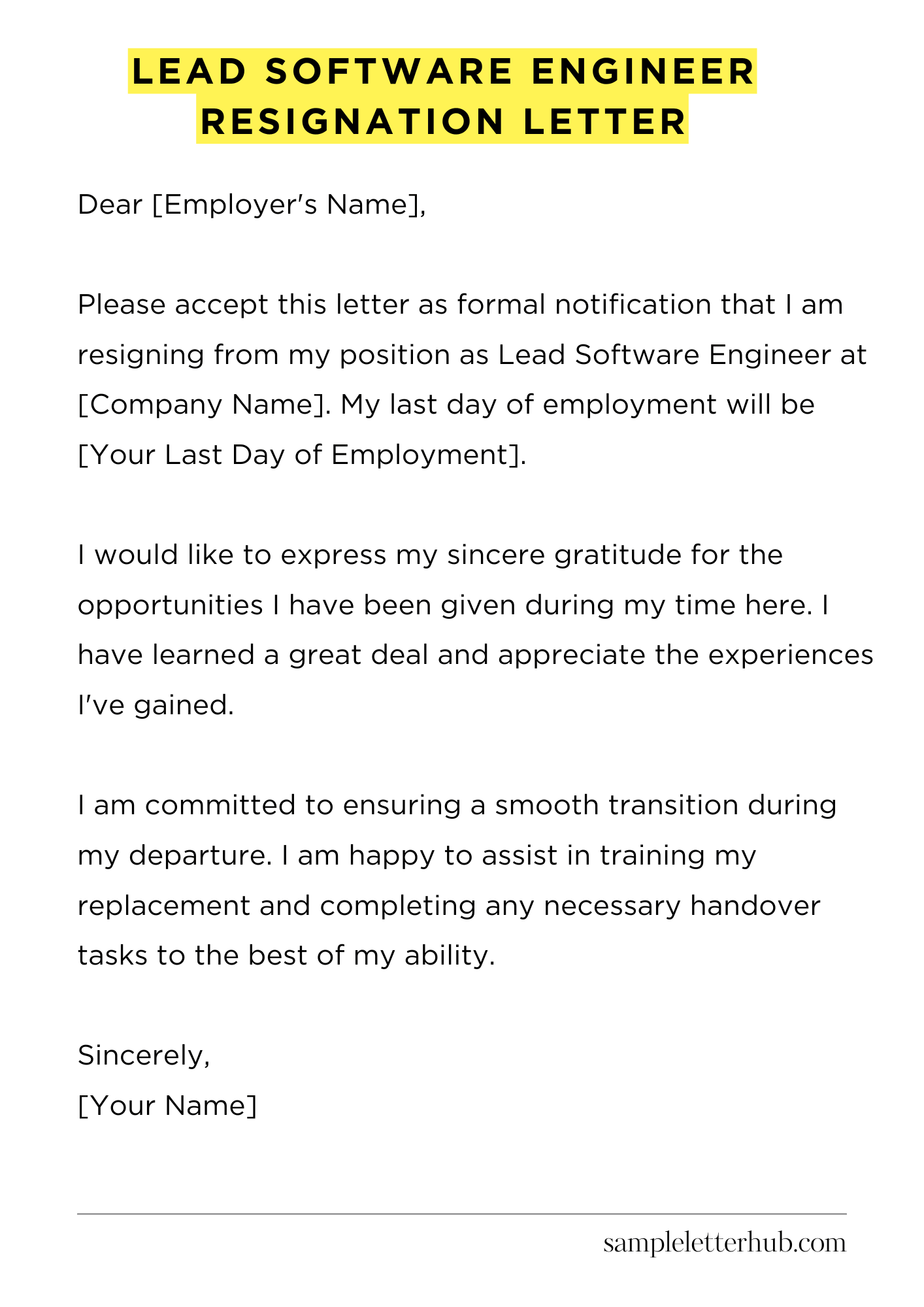
Dear [Employer’s Name],
Please accept this letter as formal notification that I am resigning from my position as Lead Software Engineer at [Company Name]. My last day of employment will be [Your Last Day of Employment].
I would like to express my sincere gratitude for the opportunities I have been given during my time here. I have learned a great deal and appreciate the experiences I’ve gained.
I am committed to ensuring a smooth transition during my departure. I am happy to assist in training my replacement and completing any necessary handover tasks to the best of my ability.
I wish you and [Company Name] all the best in the future.
Sincerely,
[Your Name]
How to Write a Lead Software Engineer Resignation Letter
Leaving a job, especially a prominent one like Lead Software Engineer, requires a thoughtful and professional approach. Your resignation letter is more than just a formality; it’s a critical document that can impact your future opportunities and relationships. It’s important to handle this process with care, ensuring a smooth transition.
1. Start with the Basics: Clarity and Formality
The first step is to establish a clear and concise tone. Begin by explicitly stating your intention to resign. Make it absolutely clear you are leaving the company, and specify your last day of employment. Use a formal tone, avoiding slang or overly casual language. Address the letter to your direct manager, or to the designated person in HR, as per company policy.
A simple subject line, such as “Resignation – [Your Name],” is perfectly acceptable and efficient. The date of the letter should be clearly visible.
2. Express Your Gratitude and Acknowledge the Opportunity
Even if you’re leaving for less-than-ideal reasons, showing gratitude is crucial. Thank the company for the opportunity and express appreciation for the experiences you’ve gained.
Mention specific projects, mentors, or skills you’ve developed. This shows professionalism and respect. A short, sincere thank-you goes a long way. Consider mentioning the value you’ve received, even if the role didn’t fully align with your long-term goals.
3. The Transition Plan: Offer Assistance
As a Lead Software Engineer, you possess vital knowledge. Offer to assist with the transition. This includes things like: outlining current projects, documenting essential information, and training or knowledge transfer. Provide a realistic assessment of what you can accomplish during your remaining time.
Offer to help train your replacement, if possible. Detail how you can assist in the transfer of your responsibilities. Demonstrating a willingness to help shows responsibility and helps maintain a positive relationship with your former employer.
4. Keep It Concise: Focus on the Essentials
Your resignation letter isn’t the place to air grievances. Stick to the key points: your intention to leave, your last day, gratitude, and your offer of assistance.
Avoid negative comments about the company or its employees. Keep the letter brief and to the point. A well-written, concise letter is more impactful than a lengthy, rambling one. Save detailed explanations for the exit interview, if one is scheduled.
5. The Closing: Professionalism and Contact Information
End your letter with a professional closing, such as “Sincerely,” “Best regards,” or “Respectfully.” Include your full name, and consider adding your contact information (phone number and personal email address) in case the company needs to reach you after your departure.
Remember, this is a document that will become part of your professional record. Proofread carefully before sending it. Double-check the formatting, spelling, and grammar. A polished letter reflects well on you and leaves a positive lasting impression.
FAQs about Lead Software Engineer resignation letter
How do I formally resign from my position as a Lead Software Engineer?
To formally resign, you must submit a written resignation letter to your direct supervisor and/or Human Resources department. This letter should clearly state your intention to resign, the effective date of your resignation, and your official title. It is also good practice to express gratitude for the opportunity and mention your willingness to assist with the transition.
What should I include in a Lead Software Engineer resignation letter?
Your resignation letter should include:
- Your name and contact information
- The date of the letter
- The name and title of the recipient (usually your supervisor or HR representative)
- A clear statement of your resignation (e.g., “I am writing to resign from my position as Lead Software Engineer…”)
- Your last day of employment (the effective date)
- A brief expression of gratitude
- Offer of assistance during the transition, if applicable
- Your signature
What is the typical notice period for a Lead Software Engineer?
The typical notice period for a Lead Software Engineer is usually two to four weeks. However, the specific notice period can vary depending on your employment contract, company policy, and local labor laws.
It’s crucial to review your employment agreement to understand the required notice period. Adhering to the specified notice period is vital for a smooth transition and maintaining a professional reputation.
Can I provide a shorter or longer notice period than what is typically expected?
Yes, you can. While the typical notice period is usually two to four weeks, you may be able to negotiate a different timeframe with your employer. If you desire a shorter notice period, consider discussing it with your supervisor, explaining your reasons and potential impact.
Providing a longer notice period can be beneficial if you want to assist extensively with the handover process. Ultimately, the agreement on the notice period is determined by both you and your employer.
What should I do after submitting my Lead Software Engineer resignation letter?
After submitting your resignation letter, you should:
- Confirm receipt with your supervisor or HR
- Cooperate with your employer on transition tasks such as documentation, knowledge transfer, or training of replacements
- Return all company property, like laptops or phones, before your last day
- Complete any necessary exit interviews or paperwork
- Maintain a professional demeanor throughout your remaining employment
Related:
Resignation letter due to rude boss
Resignation letter moving to another state
Resignation letter due to illness of family member
Resignation letter due to study