

A Junior Programmer resignation letter is a formal document. It informs your employer of your intention to leave your job. The letter officially ends your employment. It’s a crucial step in the job-leaving process.
Writing a resignation letter can be tricky. Don’t worry, we are here to help. This article provides helpful examples. We’ll share various templates. They will make the writing process simple.
Consider it your guide to saying goodbye. We will break down different scenarios. You’ll find a suitable letter for your situation. Choose the one that suits you best!
Junior Programmer Resignation Letter
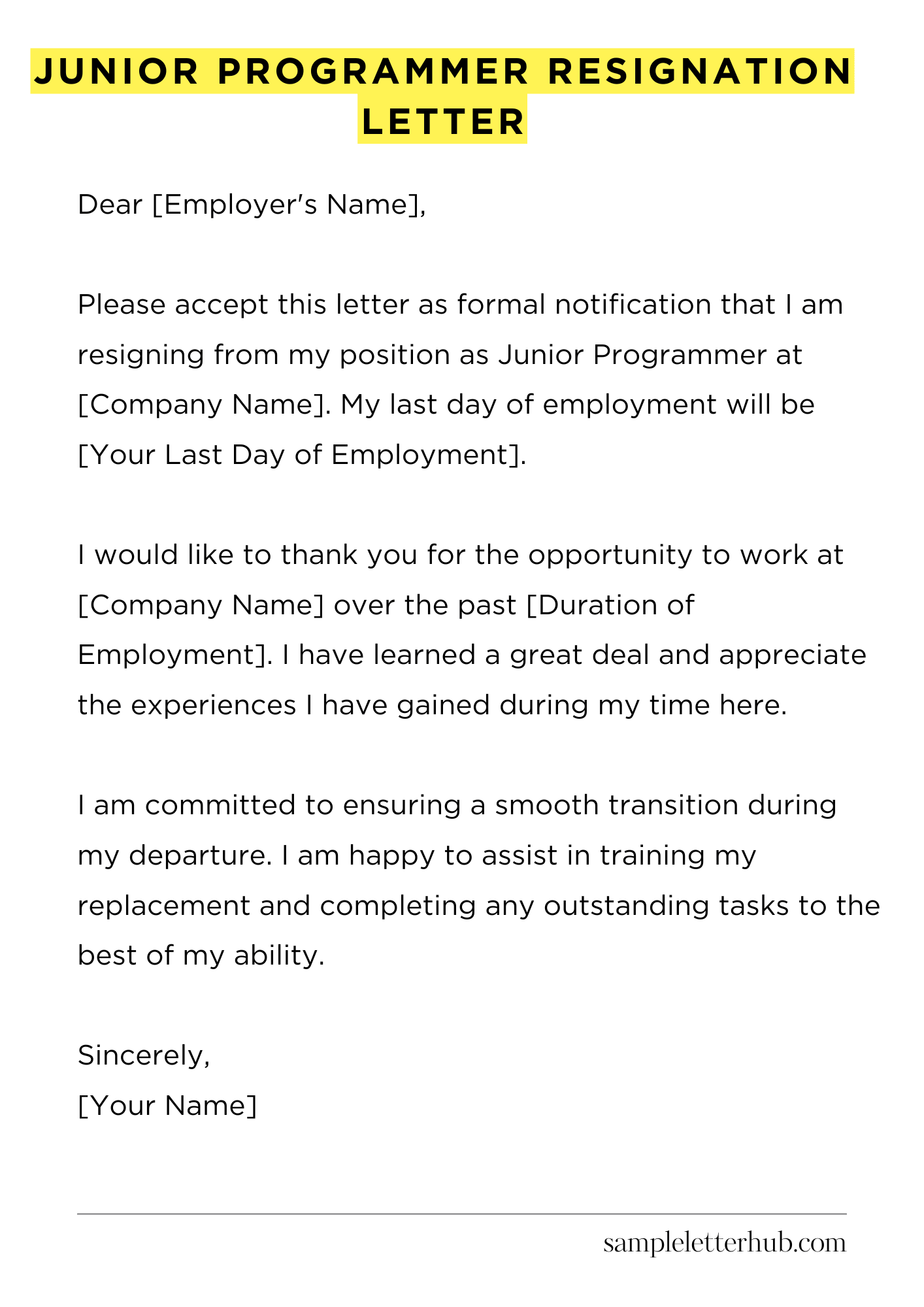
Below is a sample of a Junior Programmer Resignation Letter:
[Your Name]
[Your Address]
[Your Phone Number]
[Your Email Address]
[Date]
[Employer’s Name]
[Company Name]
[Company Address]
Dear [Employer’s Name],
Please accept this letter as formal notification that I am resigning from my position as Junior Programmer at [Company Name]. My last day of employment will be [Your Last Day of Employment].
I would like to thank you for the opportunity to work at [Company Name] over the past [Duration of Employment]. I have learned a great deal and appreciate the experiences I have gained during my time here.
I am committed to ensuring a smooth transition during my departure. I am happy to assist in training my replacement and completing any outstanding tasks to the best of my ability.
I wish you and the company all the best in the future.
Sincerely,
[Your Name]
How to Write a Junior Programmer Resignation Letter
So, you’re ready to move on. Congratulations! Starting a new job is exciting, but before you do, you need to handle the formalities. One of the most important steps in this process is writing a professional resignation letter, especially as a junior programmer. It can feel daunting, but don’t worry, it doesn’t have to be!
1. Keep It Concise and Clear
Your resignation letter is not the place to write a novel. Be brief and to the point. State your intent to resign clearly and unambiguously. The goal is to make sure your message is understood quickly and effectively.
Include your name, the date, and the specific date of your last day of employment. This information makes sure your letter is official and easily processed by HR.
Here’s a simple structure you can follow:
- Start with a polite salutation. “Dear [Manager’s Name],” is a good choice.
- State your intention to resign. “Please accept this letter as formal notification that I am resigning from my position as Junior Programmer, effective [Your Last Day of Employment].”
- Keep it short!
2. Express Gratitude (Always a Good Idea)
While you’re leaving, remember to maintain a positive tone. Thank your employer for the opportunity to work there. Briefly mention any positive experiences or skills you’ve gained.
This demonstrates professionalism and leaves a good impression. Consider adding a sentence or two acknowledging what you’ve learned. It’s always good to show appreciation for your past. Remember, the world is small, and you may cross paths with these people again.
For example, you could write, “I am grateful for the opportunities I have been given during my time here and for the skills I’ve developed working on [mention a specific project or technology].”
3. Be Professional and Organized
Formatting is important. Use a standard business letter format. Avoid slang, jargon, or overly casual language. Proofread carefully for any typos or grammatical errors. A well-written, error-free letter reflects well on your professionalism and attention to detail. Make sure you use a readable font like Times New Roman or Arial. Keep the letter to one page.
A simple and professional closing like “Sincerely,” or “Respectfully,” is perfect. Always type your name at the bottom and provide your signature above your typed name. This confirms you have read the message and are aware of its implications.
4. Offer Assistance with the Transition
A generous gesture can go a long way. Offer to help with the transition. This shows that you are considerate and willing to leave your projects in good shape. It also suggests that you care about the company’s well-being and that you are helpful. It reinforces that you’re leaving on good terms.
Be realistic about what you can do, but offering some form of assistance shows maturity and professionalism.
You could add a sentence like, “I am happy to assist with the transition in any way I can to ensure a smooth handover of my responsibilities.”
5. Proofread and Deliver
Before you hit send or hand in the physical letter, take a moment to review it again. Read it carefully. Check for any errors in spelling, grammar, or formatting. Ask a friend or colleague to proofread it for you if you’re unsure. Once you’re confident, deliver the letter to your manager. Follow any company procedures regarding resignations. Finally, good luck in your next endeavor!
FAQs about Junior Programmer Resignation Letter
What are the essential elements to include in a Junior Programmer resignation letter?
A Junior Programmer’s resignation letter should include: a clear statement of resignation (e.g., “I am writing to formally resign”), the effective date of your last day of employment, a brief expression of gratitude for the opportunity (optional but recommended), a professional and courteous tone, and your signature.
Consider adding a short, positive note about your experience if you wish, but keep it concise.
How much notice should a Junior Programmer give when resigning?
The standard notice period for a Junior Programmer, and most employees, is typically two weeks. However, this can vary based on your employment contract or company policy.
Always review your employment agreement to confirm the required notice period. Providing more notice, if possible, is often appreciated, but two weeks is generally the minimum expectation.
Should a Junior Programmer explain the reason for leaving in their resignation letter?
While not mandatory, it’s generally best to keep the reason for leaving brief and positive, if you choose to include it. You can simply state that you are pursuing another opportunity or that it’s time for a career change. Avoid negative comments about your current employer or colleagues.
If you have a particularly good reason for leaving, a very short, factual statement might be appropriate, but maintain a professional tone.
How should a Junior Programmer deliver their resignation letter?
The preferred method of delivering a resignation letter is usually a formal written letter addressed to your direct manager or HR department. It’s best to hand it in person, followed by a digital copy via email for record-keeping. Make sure that you keep a copy for your records. The delivery should always be done professionally, with a courteous attitude.
What are some common mistakes to avoid in a Junior Programmer resignation letter?
Avoid these common mistakes: being overly negative, using unprofessional language, including excessive detail about your new opportunity or reasons for leaving, failing to proofread for errors, and not adhering to your contract’s required notice period. Maintain professionalism throughout the process.
Related:
Resignation letter due to rude boss
Resignation letter moving to another state
Resignation letter due to illness of family member
Resignation letter due to study