

So, you’re a journalist looking to move on? A journalist resignation letter is your official goodbye. It’s a formal document. Its purpose is to notify your employer of your departure. It details your last day of employment. It also expresses your gratitude (optional, but often recommended).
This article will help. We understand it can be tough to put your thoughts into words. We have got you covered. We’ll provide you with templates. You’ll find examples and samples. Use them to craft your own perfect letter.
Whether you’re moving to a new role or a different career path, we’ll give you a head start. These samples will guide you. Writing your resignation letter should be easy.
Journalist Resignation Letter
Below is a sample of a Journalist Resignation Letter:
[Your Name]
[Your Address]
[Your Phone Number]
[Your Email Address]
[Date]
[Editor’s Name] (If known, otherwise use title)
[Editor’s Title]
[News Organization Name]
[News Organization Address]
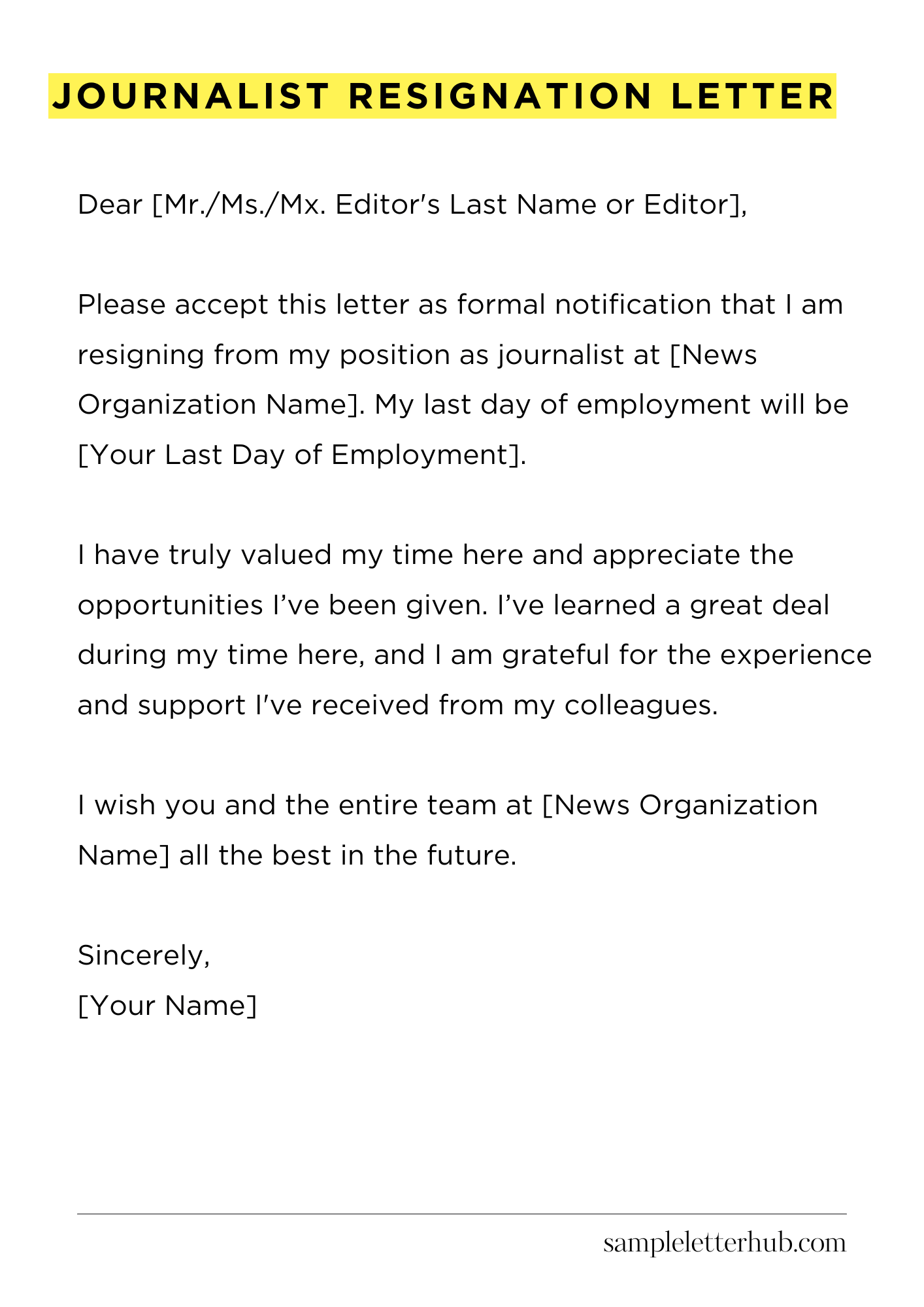
Dear [Mr./Ms./Mx. Editor’s Last Name or Editor],
Please accept this letter as formal notification that I am resigning from my position as journalist at [News Organization Name]. My last day of employment will be [Your Last Day of Employment].
I have truly valued my time here and appreciate the opportunities I’ve been given. I’ve learned a great deal during my time here, and I am grateful for the experience and support I’ve received from my colleagues.
I wish you and the entire team at [News Organization Name] all the best in the future.
Sincerely,
[Your Name]
How to Write a Journalist Resignation Letter
Getting Started: The Essentials
So, you’re moving on from your journalism job? That’s great! Whatever the reason, crafting a professional resignation letter is essential. This crucial document formally announces your departure. It officially informs your employer. A well-written letter protects your reputation and helps ensure a smooth transition.
Think of it as your final, important act as a journalist for that organization.
First things first: keep it concise. Your letter shouldn’t be a novel. Aim for one page, if possible. Focus on the core information; avoid unnecessary drama or lengthy explanations.
Remember this will be part of your permanent record. Start with the date and your contact information. Then, the recipient’s information, followed by a formal salutation like “Dear [Manager’s Name],” is best.
The Main Body: Key Components
The main body is where you get down to business. Begin by clearly stating your intention to resign. Include your last day of employment. This is critical for HR and your team to plan for your departure. Be polite and professional throughout. This is not the time to air grievances. Instead, simply state your reason for leaving briefly. You’re not obligated to go into detail.
Next, express your gratitude. Acknowledge the opportunities you’ve been given. Mention any positive experiences, skills gained, or relationships built. Show your appreciation for the role you had. This positive sentiment leaves a good impression. Consider adding a sentence or two thanking specific people.
If appropriate, offer your assistance with the transition. Be prepared to help with training, documentation, or other handover tasks. This willingness shows your professionalism and commitment.
Offer of Assistance and Closing
The transition period is important. A smooth handover benefits everyone. Therefore, offer to help train your replacement, if possible. Offer to prepare documentation or provide any other assistance that might be helpful. If you have any ongoing projects, offer to finish them or provide a detailed handover. This demonstrates professionalism and helps ensure continuity.
Close your letter with a formal sign-off. Use a phrase like “Sincerely,” “Best regards,” or “Respectfully.” Then, type your full name. Make sure your signature is clear, if it’s a physical letter. Double-check your contact details. This is the last step to ensure that your employer can reach you, if needed.
Formatting and Tone: Polishing Your Letter
The formatting of your letter matters. Use a professional font like Times New Roman or Arial. Keep the font size between 10 and 12 points. Use standard margins (1 inch on all sides). Proofread your letter carefully! Check for spelling errors, grammatical mistakes, and typos. Have someone else read it too. A fresh pair of eyes can often catch errors you might miss.
Your tone should be professional and respectful. Avoid any negative comments or complaints. Stay positive and focus on the future. Remember that this letter reflects on you. It could be seen by future employers. This is more than just a formality, it’s a valuable tool.
The Final Review: Before You Send
Before sending your letter, review it one last time. Does it clearly state your intention and last day? Have you expressed your gratitude? Are you offering assistance with the transition? Is the tone professional and respectful?
Consider the delivery method. Will you hand it in person, send it via email, or use a company portal? Make sure you know the proper protocol. Keep a copy of your letter for your records.
Once sent, prepare for the next steps. They will involve discussion with your manager and colleagues about your departure. Following these guidelines ensures a respectful and professional resignation process.
FAQs about Journalist Resignation Letters
How do I start a journalist resignation letter?
Begin your letter with a clear and concise statement of your intention to resign. Include your name, the date, and the recipient’s name (typically your editor or supervisor) and title. Formally state your resignation and the effective date of your departure.
What should be included in the body of a journalist resignation letter?
The body of your letter should be professional and brief. Express your gratitude for the opportunity to work at the organization. You might briefly mention any positive experiences or skills gained.
It is generally advisable to keep the reasons for your departure concise and avoid negative comments about the workplace or colleagues. You can mention future endeavors if you feel it is appropriate, but it is not mandatory.
Is it necessary to provide a reason for resigning in the letter?
While not strictly required, you can choose to include a brief, neutral reason for leaving. This could be, “To pursue another opportunity” or “To focus on new professional goals.” Avoid going into excessive detail or airing grievances. Keeping the reason concise maintains professionalism.
What is the proper tone to use in a journalist resignation letter?
Maintain a professional, respectful, and courteous tone. Your letter is a formal document and should reflect well on your professionalism. Avoid overly emotional language, personal attacks, or negativity. Expressing gratitude and a willingness to assist with the transition can further enhance the positive impression.
Should I offer to help with the transition after my resignation?
Offering to assist with the transition is a considerate gesture. You can state your willingness to help train your replacement, complete ongoing projects, or answer questions during a specified period. This demonstrates professionalism and a commitment to ensuring a smooth handover of your responsibilities, which can be valuable for maintaining positive relationships.
Related:
Resignation letter due to rude boss
Resignation letter moving to another state
Resignation letter due to illness of family member
Resignation letter due to study