

An IT Manager resignation letter is a formal document. It informs the employer of your intent to leave your IT Manager position. Its primary purpose is to officially announce your departure. It also states your last day of employment.
Are you an IT Manager planning your exit? This article offers helpful resources. We’ll share several templates. You’ll also find various examples. These will guide you in crafting your own resignation letter.
Whether you’re moving to a new role or retiring, we’ve got you covered. These samples simplify the writing process. They’ll help you communicate your decision professionally. Use them to make your own.
It Manager Resignation Letter
Below is a sample of a It Manager Resignation Letter:
[Your Name]
[Your Address]
[Your Phone Number]
[Your Email Address]
[Date]
[Recipient’s Name]
[Recipient’s Title]
[Company Name]
[Company Address]
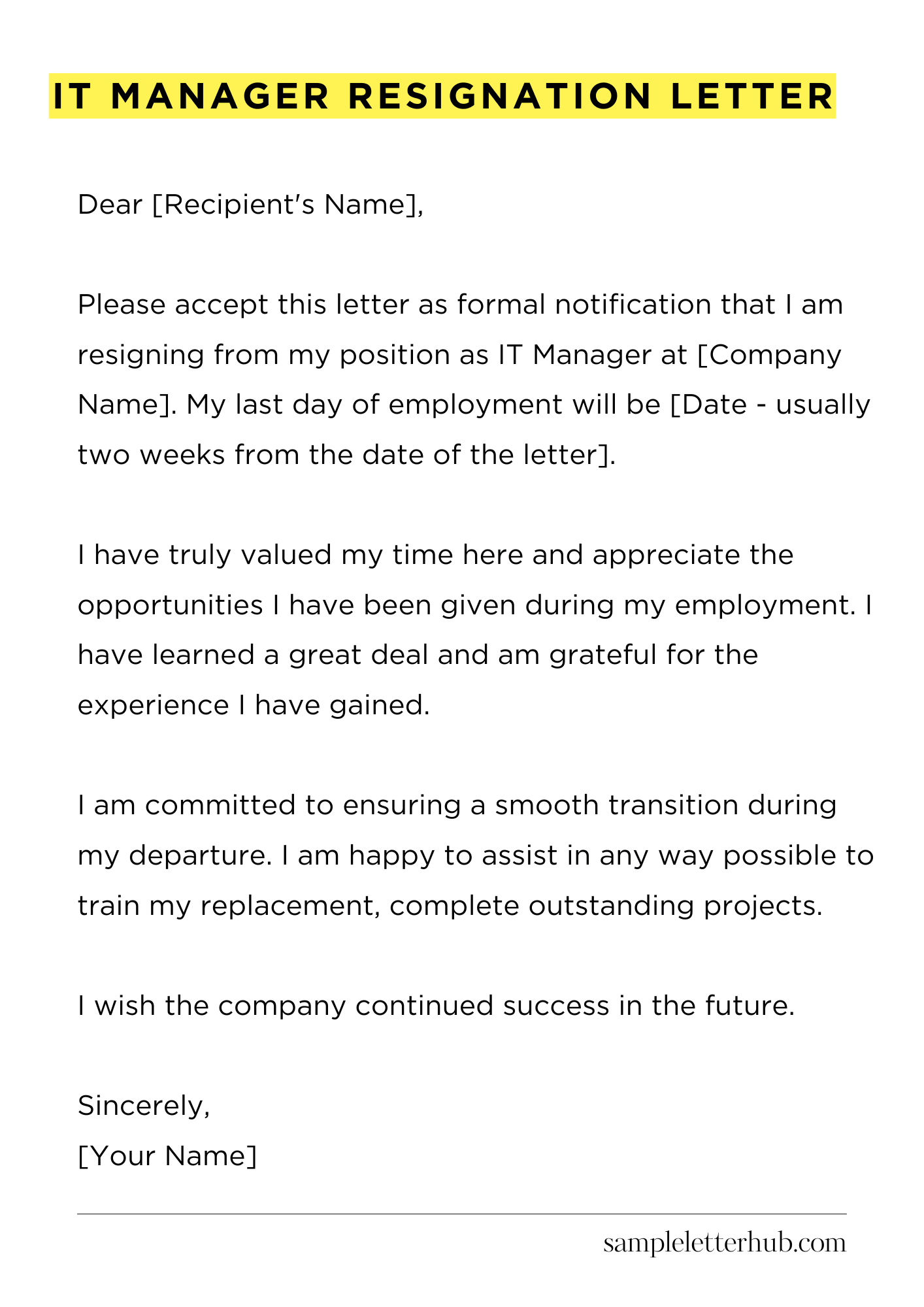
Dear [Recipient’s Name],
Please accept this letter as formal notification that I am resigning from my position as IT Manager at [Company Name]. My last day of employment will be [Date – usually two weeks from the date of the letter].
I have truly valued my time here and appreciate the opportunities I have been given during my employment. I have learned a great deal and am grateful for the experience I have gained.
I am committed to ensuring a smooth transition during my departure. I am happy to assist in any way possible to train my replacement, complete outstanding projects, and transfer my knowledge and responsibilities.
I wish the company continued success in the future.
Sincerely,
[Your Name]
How to Write an IT Manager Resignation Letter
Knowing When It’s Time to Go
Alright, let’s get real. Being an IT Manager can be demanding, to put it mildly. You’re the go-to person for everything tech-related, from fixing printers to navigating complex cybersecurity threats. You might be feeling the urge to move on. Perhaps you’ve found a better opportunity, or maybe the current work environment just isn’t cutting it anymore.
Whatever the reason, deciding to leave is a big step. Before you even think about putting pen to paper (or fingers to keyboard), you’ve already likely wrestled with your decision. This is a critical moment in your career.
So, now what? It’s time to resign. The resignation letter is a formal document that officially announces your departure. And let’s be honest, it needs to be done right. Don’t underestimate its importance. It’s a reflection of your professionalism. It is your last official communication. Think of it as a bridge, not a burnt one, but one that ensures a smooth transition.
The Anatomy of a Great Resignation Letter
A good resignation letter is concise, clear, and courteous. Forget the novel. No need to detail every single grievance or glowing achievement. Keep it simple. You have to focus on the essential information. The following elements are essential:
- Your Intent: Clearly state your intention to resign.
- Effective Date: Specify your last day of employment. Make sure it aligns with your contract or company policy.
- Gratitude: A brief expression of appreciation for the opportunity.
- Offer of Assistance: A willingness to help with the transition, if possible.
- Professional Closing: Use a formal closing, like “Sincerely” or “Best regards.”
Crafting the Perfect Letter: A Step-by-Step Guide
Let’s break down the process. First, start with the basics. Your name, address, and the date at the top. Then, address the letter to your direct supervisor or the appropriate HR representative. Now, get to work. State your intent to resign from your position as IT Manager. Mention your last day.
Something like, “Please accept this letter as formal notification that I am resigning from my position as IT Manager, effective [Date].” Next, express your gratitude for the opportunity to work at the company. Keep it brief and sincere. It’s about leaving on good terms.
Think, “I am grateful for the opportunities I’ve been given during my time here.” Or, “Thank you for the experience I’ve gained.”
Consider offering your assistance with the transition. This shows professionalism and helps to ensure a smoother handover. You could write, “I am happy to assist with the transition of my responsibilities during my remaining time here.”
Don’t forget the closing! Use a formal closing, like “Sincerely” or “Best regards,” followed by your name. Proofread carefully. Check for typos and grammatical errors. A polished letter demonstrates your professionalism.
Things to Avoid at All Costs
There are some things you should absolutely avoid in your resignation letter. First, steer clear of negativity. Don’t complain about your boss, your colleagues, or the company.
This is not the time to air your grievances. It’s always the better option to maintain a respectful tone, even if you’ve had a bad experience. Avoid overly dramatic language. Keep it professional. Don’t include personal details that aren’t relevant to your resignation. Avoid burning bridges.
You never know when you might need a reference or cross paths with former colleagues again. Do not make any demands or threats. Focus on the positive aspects of your experience, and move on.
Final Touches and Delivery
Before you send it, proofread again. Seriously. Then, make sure you know the proper channels for submitting your letter. In some companies, you give it directly to your supervisor. In others, it goes to HR. Find out the correct procedure. Consider whether you want to deliver it in person or electronically.
If you have a good relationship with your supervisor, a face-to-face conversation might be appropriate before handing over the letter. If not, email is perfectly acceptable. Keep a copy of your resignation letter for your records.
This is your proof. Following these steps will help you leave your current position in the best possible light. Good luck with your next adventure!
FAQs about IT Manager resignation letter
What is the primary purpose of an IT Manager resignation letter?
The primary purpose of an IT Manager resignation letter is to formally notify the employer of the employee’s intention to leave their position. It serves as an official record of the resignation, the effective date of departure, and can be used to express gratitude, provide context, and outline any handover plans.
What key information should be included in an IT Manager resignation letter?
A well-crafted IT Manager resignation letter should include: a clear statement of resignation, the date of resignation, the effective date of the last day of employment, a brief expression of gratitude for the opportunity (optional), details regarding the handover process and any outstanding tasks, and the employee’s contact information. Ensure a professional tone throughout the letter.
How much notice should an IT Manager provide in their resignation letter?
The notice period depends on the employment contract or local regulations. Typically, IT Managers are expected to provide at least two weeks’ notice, but some contracts may stipulate a longer period, such as one month or more. Review the employment contract to determine the appropriate notice period.
Should an IT Manager explain the reasons for leaving in their resignation letter?
While not mandatory, briefly explaining the reason for leaving can be beneficial. Reasons can include pursuing another opportunity, relocating, or personal circumstances. Keep the explanation concise and professional. Avoid negativity, and focus on the future.
How should an IT Manager handle the handover process in their resignation letter?
The resignation letter should briefly address the handover process. Indicate willingness to assist in the transition, offer to train a replacement, and outline any outstanding projects or responsibilities that need to be addressed before departure.
Providing a smooth handover helps maintain a positive relationship with the employer and ensure a seamless transition of IT operations.
Related:
Resignation letter due to rude boss
Resignation letter moving to another state
Resignation letter due to illness of family member
Resignation letter due to study