


An IT Business Analyst resignation letter is a formal document. It notifies your employer of your departure. The purpose is to officially end your employment. It also helps maintain a professional relationship.
Planning your exit can feel overwhelming. Don’t worry, we’re here to help. We’ve compiled various templates. Examples of resignation letters for IT Business Analysts are included. These will make writing your own letter easy.
You’ll find adaptable samples. They cover different scenarios. Whether you’re moving to a new role or pursuing other opportunities, you can use these samples. This article will help you craft a letter that suits your needs.
It Business Analyst Resignation Letter
Below is a sample of a It Business Analyst Resignation Letter:
[Your Name]
[Your Address]
[Your Phone Number]
[Your Email Address]
[Date]
[Recipient’s Name]
[Recipient’s Title]
[Company Name]
[Company Address]
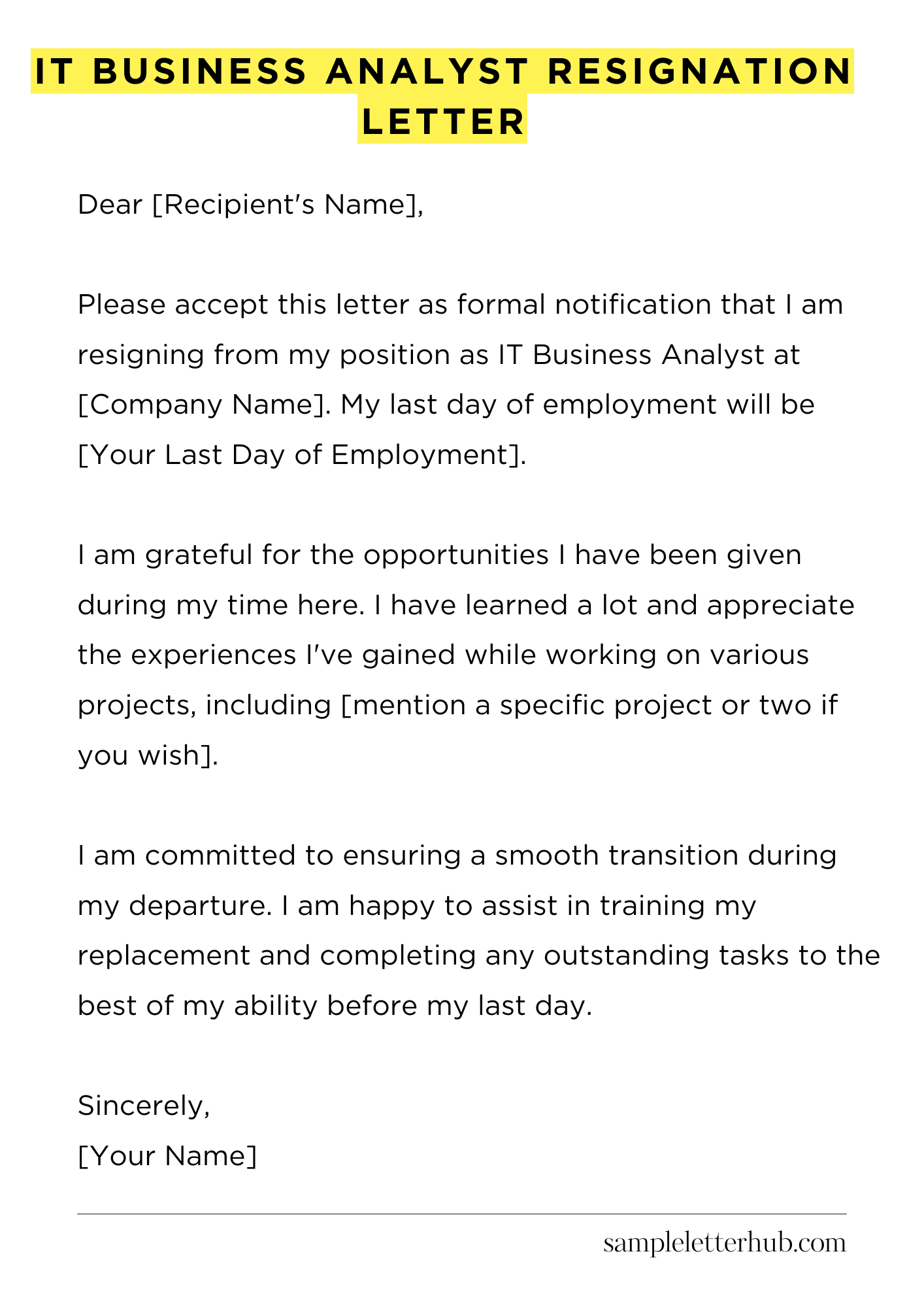
Dear [Recipient’s Name],
Please accept this letter as formal notification that I am resigning from my position as IT Business Analyst at [Company Name]. My last day of employment will be [Your Last Day of Employment].
I am grateful for the opportunities I have been given during my time here. I have learned a lot and appreciate the experiences I’ve gained while working on various projects, including [mention a specific project or two if you wish].
I am committed to ensuring a smooth transition during my departure. I am happy to assist in training my replacement and completing any outstanding tasks to the best of my ability before my last day.
I wish you and the company all the best in the future.
Sincerely,
[Your Name]
How to Write an IT Business Analyst Resignation Letter
Why a Proper Resignation Matters
So, you’re moving on! That’s great. Leaving a job is a big deal and requires thought. It’s a professional courtesy to offer your notice. Resigning properly, particularly as an IT Business Analyst, is super important.
Your letter impacts your professional reputation. Think about it: bridges you burn now can’t be crossed later. A well-crafted resignation letter ensures a smooth transition. It also protects your future career opportunities. You want to leave a good impression, right?
Key Elements to Include
Here’s the deal: clarity is king. Your resignation letter needs to be clear and concise. First, start with the basics. Include your name, the date, and the recipient’s name and title. Next, state your intention to resign and the effective date of your departure. Keep it direct. Don’t beat around the bush.
You can express gratitude for the opportunities you’ve been given. Briefly mention any key projects you worked on, if you feel it’s relevant. A simple “Thank you for the opportunities I’ve had to contribute to X project” works great! Also, if you’re available to assist with the transition, offer your help.
Crafting the Right Tone
Now, let’s talk tone. This is NOT the time to air grievances. Maintain a professional and positive tone. Even if you’re unhappy, your letter should be polite. Avoid negativity, even in veiled comments.
Refrain from listing everything you disliked. Keep it professional. Use respectful language and avoid emotional outbursts. Instead, show professionalism. Focus on your future plans, not past issues.
Structuring Your Letter: A Simple Template
Structure is your friend! Here’s a basic template you can adapt:
- Heading: Your name, address, and the date.
- Salutation: “Dear [Manager’s Name],”
- Body (Paragraph 1): State your resignation, your title, and the effective date. For instance, “Please accept this letter as formal notification that I am resigning from my position as IT Business Analyst, effective [Date].”
- Body (Paragraph 2): Briefly express gratitude and optionally highlight key contributions. “Thank you for the opportunities I have been given during my time here. I have enjoyed the experience.”
- Body (Paragraph 3): Offer assistance with the transition, like, “I am committed to ensuring a smooth handover of my responsibilities and am happy to assist in training my replacement.”
- Closing: Use a professional closing. “Sincerely,” or “Regards,” followed by your name and signature.
Final Review and Considerations
Before you hit “send,” review! Proofread your letter carefully for any errors in grammar or spelling. Ensure all the dates and names are accurate. Get a second pair of eyes to read it over, if possible.
Consider your company’s policies regarding resignation. Some companies have specific requirements. It’s also a good idea to keep a copy of your letter for your records. Remember, your resignation letter is a reflection of your professionalism. Make sure it’s a good one.
FAQs about IT Business Analyst Resignation Letter
What is the typical format for an IT Business Analyst resignation letter?
The standard format includes a clear and concise statement of resignation, the effective date of departure, a brief expression of gratitude for the opportunity, and any necessary information regarding the handover of responsibilities.
It’s usually written as a formal business letter with your contact information, the recipient’s contact information, a professional salutation (e.g., “Dear [Manager’s Name]”), the body, a professional closing (e.g., “Sincerely”), and your typed name.
What key information should be included in an IT Business Analyst resignation letter?
Essential details encompass your unequivocal intent to resign, the specific date your employment will end, a brief thank you to the employer, and sometimes a concise explanation of the reason for leaving (though this is optional). If applicable, the letter should also reference the transition process and offer assistance with the handover of tasks.
Should I provide a reason for resigning in my IT Business Analyst resignation letter?
While not mandatory, it’s generally a professional courtesy to briefly state the reason for leaving. You can keep it simple, such as “to pursue another opportunity” or “to focus on personal development.”
Avoid negative comments about the company or colleagues. However, in certain scenarios, like when seeking feedback on a specific issue, it might be beneficial to be more specific, provided it’s done professionally.
How far in advance should I submit my IT Business Analyst resignation letter?
The standard practice is to give at least two weeks’ notice, as dictated by your employment contract or local regulations. However, for higher-level positions or projects requiring extensive handover, more notice (e.g., a month or more) is often expected. Always refer to your employment agreement for specific stipulations regarding notice periods.
What should I do after submitting my IT Business Analyst resignation letter?
After submitting your letter, be prepared to discuss your departure with your manager. Follow through with the handover process diligently, including completing outstanding tasks, documenting procedures, and training your replacement. Maintain a professional demeanor throughout the transition period, and fulfill any exit requirements, such as returning company property.
Related:
Resignation letter due to rude boss
Resignation letter moving to another state
Resignation letter due to illness of family member
Resignation letter due to study