

An Inventory Control resignation letter is a formal document. It is written by an employee. The employee is leaving their inventory control job. The letter informs the employer of their departure. It also usually states the last day of employment.
Are you looking to leave your current inventory role? Writing a resignation letter can be tricky. We’ve got you covered. This article offers several letter templates. We’ll share various examples. You can adapt them to your specific situation.
Need a simple template? Looking for something more detailed? We provide options for different scenarios. These samples make writing your own letter easy. Say goodbye to guesswork. Craft the perfect resignation letter with ease.
Inventory Control Resignation Letter
Below is a sample of a Inventory Control Resignation Letter:
[Your Name]
[Your Address]
[Your Phone Number]
[Your Email Address]
[Date]
[Employer’s Name]
[Company Name]
[Company Address]
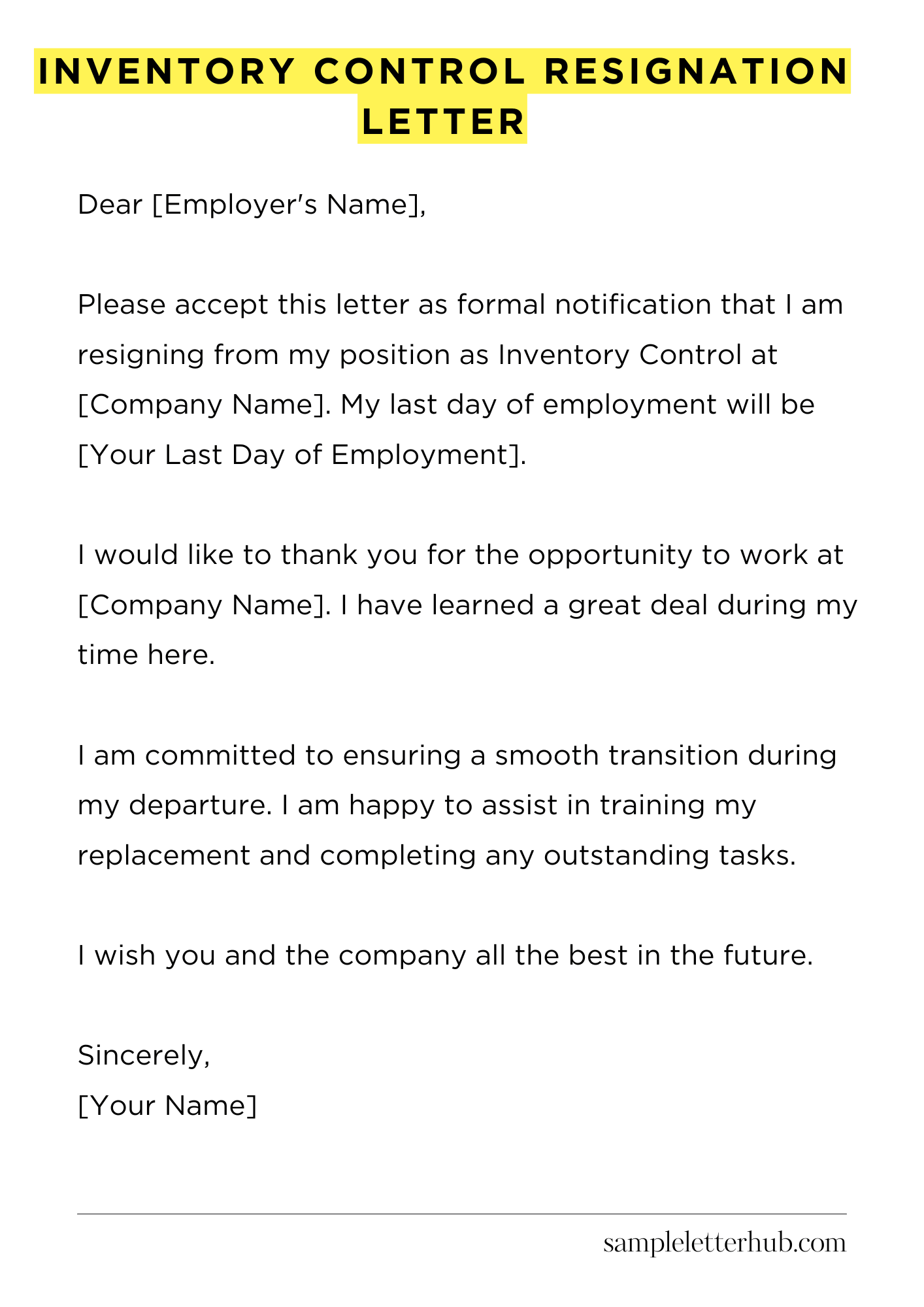
Dear [Employer’s Name],
Please accept this letter as formal notification that I am resigning from my position as Inventory Control at [Company Name]. My last day of employment will be [Your Last Day of Employment].
I would like to thank you for the opportunity to work at [Company Name]. I have learned a great deal during my time here.
I am committed to ensuring a smooth transition during my departure. I am happy to assist in training my replacement and completing any outstanding tasks.
I wish you and the company all the best in the future.
Sincerely,
[Your Name]
How to Write an Inventory Control Resignation Letter
Leaving a job is a big decision. It’s a step that requires careful planning, especially when it comes to crafting your resignation letter. When you’re in a role like Inventory Control, your departure needs to be handled with extra care and consideration. This is because your work involves vital company assets.
1. Get Started: The Basics First
Your resignation letter is a formal document. Start with the basics. Include your name, address, the date, and the recipient’s name and title. Keep it simple. Make sure it is clear who you are, and who you are writing to. Address your direct supervisor or the appropriate HR representative. Always put the date on your letter. This is very important. Think of this as the first impression.
Next, state your intention clearly. This is the main reason for the letter. State you are resigning from your position as Inventory Control (or whatever your specific title is) at [Company Name]. Also, specify your last day of employment.
Aim to provide a two-week notice, if possible, although this can vary depending on company policy or your own personal circumstances. Be respectful and professional. This ensures a clean break.
2. Show Gratitude: A Touch of Appreciation
Saying thank you is always the right thing to do. Express your gratitude for the opportunity to work at the company. Briefly mention any positive experiences or things you learned during your time there.
This not only adds a professional touch, but it also leaves a positive lasting impression. Even if the job wasn’t perfect, finding something to appreciate reflects well on you. This approach is highly recommended. Positive sentiments can go a long way.
3. The Handover: Minimizing Disruption
Inventory Control is crucial. Your departure has the potential to leave a gap. Address this head-on. Offer your assistance in the transition. Suggest you are willing to train your replacement.
Offer to help with any pending tasks. State your commitment to a smooth handover process. Be specific. This proactive approach demonstrates your professionalism and commitment to the company’s success. This is crucial.
Consider mentioning specific tasks you’ll help with: completing inventory counts, updating records, or transferring essential knowledge. It’s smart to include a sentence about providing contact information for any follow-up questions, if that’s something you are comfortable with. Think of this step as a bridge for the incoming employee.
4. Keep it Simple: Tone and Language
The tone of your letter should be professional and respectful. Avoid any negativity or complaints. This isn’t the place to air grievances. Maintain a positive and courteous attitude throughout the letter. Keep the language clear, concise, and easy to understand. Avoid jargon or overly complex sentences.
The goal is to convey your message clearly and professionally. Use a formal tone. Remember, this is a record. Do not ramble. Stick to the essentials.
5. Finalize and Follow Up: Proofread and Deliver
Proofreading is essential. Carefully check your letter for any errors in grammar, spelling, and punctuation. Ask a friend or colleague to review it for you too. This is always a great idea. Make sure the letter is formatted correctly and easy to read. Print a hard copy and keep a copy for your records.
The final step is to deliver your letter according to company policy. This is important. You should typically submit it to your supervisor and HR department. Be sure to follow up to ensure it has been received and acknowledged. This shows your attention to detail. Leaving a great final impression can often go a long way.
FAQs about Inventory Control Resignation Letter
What information should I include in my Inventory Control resignation letter?
Your resignation letter should clearly state your intent to resign, the effective date of your resignation, and a brief expression of gratitude for the opportunity to work at the company. You may also include a sentence expressing your willingness to assist with the transition. It’s generally a good practice to keep the letter concise and professional.
How much notice should I give when resigning from an Inventory Control position?
The standard notice period is typically two weeks, though this can vary depending on your employment contract or company policy. Review your employment agreement or employee handbook to determine the required notice period.
Providing ample notice allows your employer time to find a replacement and ensures a smoother transition. If you are a high level professional, you may give 30 to 60 days’ notice.
Should I provide a reason for my resignation in the letter?
It’s not usually necessary to provide a detailed explanation for your departure in the resignation letter. A simple statement such as “I am pursuing other opportunities” or “I have accepted a new position” is often sufficient.
However, if you are leaving due to specific issues, you may choose to address them with your manager separately, though this is not a requirement of the resignation letter. Also remember that the resignation letter is a formal document.
Can I use a template for my Inventory Control resignation letter?
Yes, using a template is perfectly acceptable. There are many templates available online that you can customize to fit your situation. Ensure the template is appropriate for your location and company culture. Remember to personalize the letter with your specific details, such as the date, your name, and your supervisor’s name.
What should I do after submitting my resignation letter?
After submitting your resignation letter, follow up with your manager to discuss your transition plan and any remaining tasks. Be prepared to train your replacement and wrap up any outstanding projects.
Maintain a professional attitude throughout the transition period, and ensure you complete all assigned responsibilities before your last day. Also, collect your letter and ask your manager for a copy too.
Related:
Resignation letter due to rude boss
Resignation letter moving to another state
Resignation letter due to illness of family member
Resignation letter due to study