

An Intervention Specialist resignation letter is a formal document. It informs your employer of your intention to leave your job. The letter is your official notice. It states your last day of employment.
Are you an Intervention Specialist planning to resign? Writing the perfect letter can feel daunting. We’ve got you covered. We’ll provide a variety of templates. You can use them to craft your own resignation letter.
These samples offer different approaches. Choose the style that best suits your needs. Make your departure as smooth as possible. We aim to make the process easy.
Intervention Specialist Resignation Letter
Below is a sample of a Intervention Specialist Resignation Letter:
[Your Name]
[Your Address]
[Your Phone Number]
[Your Email Address]
[Date]
[Hiring Manager Name] (If known, otherwise use title)
[Hiring Manager Title]
[Organization Name]
[Organization Address]
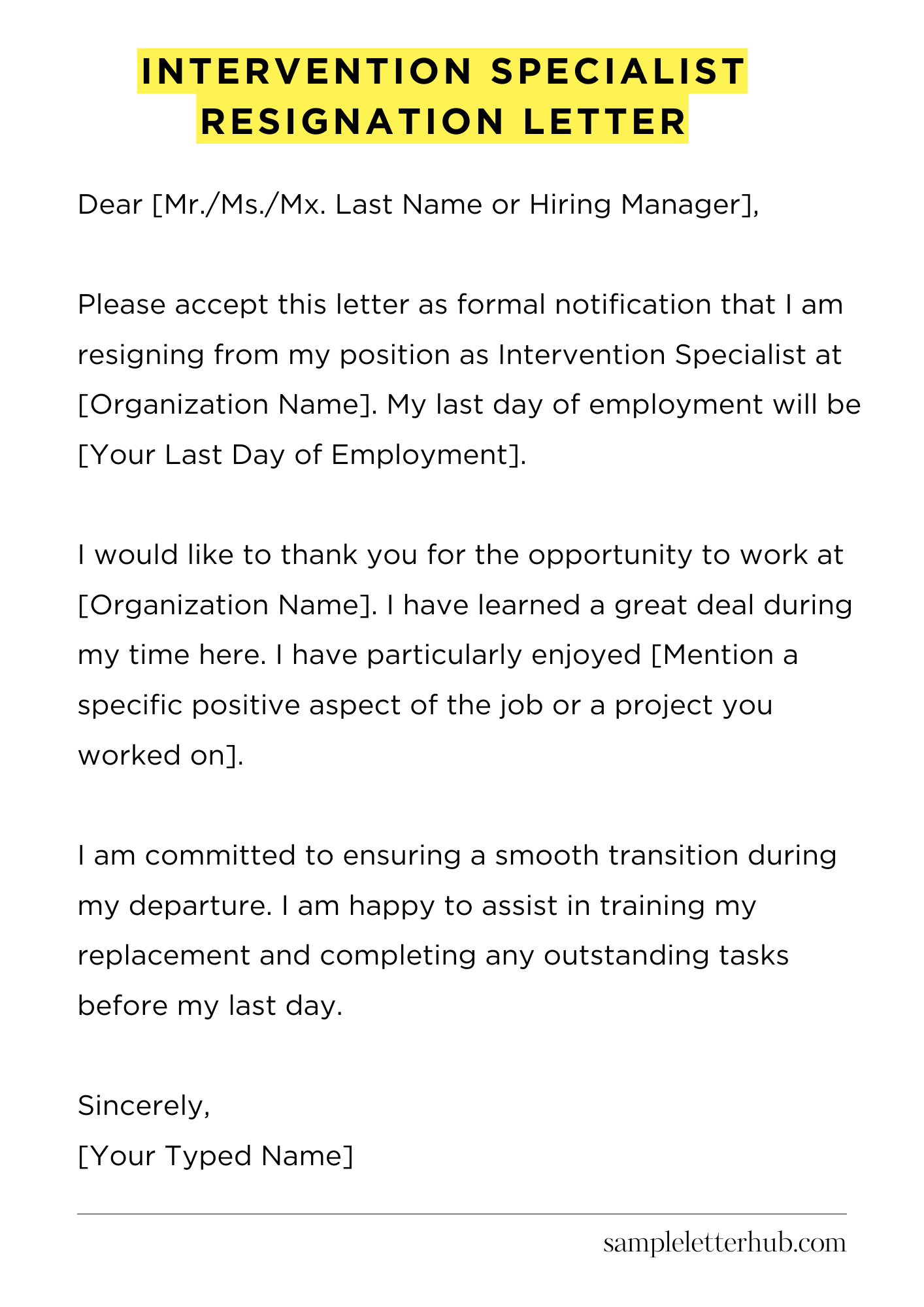
Dear [Mr./Ms./Mx. Last Name or Hiring Manager],
Please accept this letter as formal notification that I am resigning from my position as Intervention Specialist at [Organization Name]. My last day of employment will be [Your Last Day of Employment].
I would like to thank you for the opportunity to work at [Organization Name]. I have learned a great deal during my time here. I have particularly enjoyed [Mention a specific positive aspect of the job or a project you worked on].
I am committed to ensuring a smooth transition during my departure. I am happy to assist in training my replacement and completing any outstanding tasks before my last day. Please let me know how I can be of help.
I wish you and [Organization Name] all the best in the future.
Sincerely,
[Your Typed Name]
How to Write an Intervention Specialist Resignation Letter
Resigning from any job can be daunting, but crafting a well-written resignation letter is a crucial step. It is especially important for intervention specialists, who often work with vulnerable students. This guide provides a straightforward approach to writing a professional and effective resignation letter, ensuring a smooth transition.
1. Begin with a Clear Statement of Intent
Your letter needs to clearly state your intention to resign. This should be the very first thing you communicate. Avoid ambiguity; get straight to the point.
For example, start with a line like: “Please accept this letter as formal notification that I am resigning from my position as an Intervention Specialist at [School/District Name], effective [Your Last Day of Employment].” This is clear, concise, and leaves no room for misunderstanding.
The date is vital! Make sure you are aware of your school or district’s policy regarding resignation notice periods. Two weeks is a common courtesy, but always check your employment contract or employee handbook.
2. Express Gratitude and Acknowledge Your Experience
Even if your time at the school hasn’t been perfect, it is always a good idea to express gratitude for the opportunity. This shows professionalism and respect. You can acknowledge the positive aspects of your time there.
Consider something like: “I am grateful for the opportunity to have worked as an Intervention Specialist at [School/District Name] for the past [Number] years/months.”
Then you can add a sentence about your experience: “I have truly valued the experiences and the opportunity to support students in [mention specific area, e.g., reading intervention, behavioral support].” Avoid overly negative statements; keeping things positive is key.
3. Provide a Brief Explanation (Optional, but Often Recommended)
While you aren’t obligated to explain why you’re leaving, a brief, professional explanation can be helpful. This is particularly relevant if you are moving on to something different within the education field.
Keep it brief and focused on the future. You could say: “I am resigning to pursue a new opportunity that aligns more closely with my long-term career goals.”
Or even: “I have accepted a position that will allow me to [briefly mention reason, e.g., focus on family commitments].” Avoid going into a lot of detail about any issues you may have had, as this can easily lead to negativity.
4. Offer Assistance with Transition and Documentation
Offer your support in facilitating a smooth transition. This demonstrates your commitment to the students and the school.
You might include statements such as: “I am happy to assist in the transition process in any way I can.” “I am available to provide training, document the resources I have utilized, or assist in any way that facilitates the handover of my responsibilities, and am committed to ensuring a smooth continuation of services for my students.”
Think about what you would want the next person to know!
5. Conclude with a Professional Closing
End your letter on a positive and professional note. This reinforces your positive attitude and leaves a good impression.
Use a standard closing, such as: “Sincerely,” or “Respectfully,” followed by your typed name. Sign the letter above your typed name. Include your contact information (phone number and email address) in case they need to reach you for anything.
Finally, it would be beneficial to add: “I wish the school and its staff, and especially its students, continued success.” This closes your letter on a high note and shows that you care about your students and colleagues. Always proofread your letter before submitting it. Good luck!
FAQs about Intervention Specialist resignation letter
How do I start my intervention specialist resignation letter?
Begin your letter with a formal salutation (e.g., “Dear [Principal’s Name]” or “Dear [Superintendent’s Name]”). Clearly state your intention to resign from your position as an Intervention Specialist. Include the effective date of your resignation. This date is crucial as it signifies your last day of employment. Keep the opening concise and professional.
What should I include in the body of my intervention specialist resignation letter?
The body of the letter should briefly express your gratitude for the opportunity to work at the school or district. You can mention specific positive experiences or skills gained. Acknowledge your commitment to ensuring a smooth transition.
Offer assistance in training your replacement or completing any outstanding tasks. Keep this section factual and positive. Avoid excessive personal details or negative comments about the job or colleagues.
What information should be included regarding the handover process in the resignation letter?
Indicate your willingness to assist in the handover process. This can include training your replacement, providing documentation, or answering questions. Specify the timeframe during which you can be available for the handover.
Offer to provide necessary materials or resources that will facilitate a seamless transition for the intervention programs. This demonstrates professionalism and commitment to your students’ well-being.
What is the proper format for an intervention specialist resignation letter?
Your resignation letter should be formatted as a formal business letter. Use a professional font (e.g., Times New Roman, Arial) and a standard font size (10-12 points). Include your contact information (name, address, phone number, email) at the top or at the end. Use a clear and concise language.
Proofread carefully for any grammatical errors or typos before submitting it. Be sure to keep it under one page.
Do I need to explain the reason for my resignation in the letter?
You are not obligated to disclose the specific reason for your resignation in the letter. It is acceptable to keep the reason brief, such as stating you are pursuing other opportunities or personal reasons. If you choose to provide a reason, keep it professional and avoid negativity. Focus on the positive aspects of your tenure and express your gratitude.
The primary goal is to be clear about your departure and ensure a professional and respectful exit.
Related:
Resignation letter due to rude boss
Resignation letter moving to another state
Resignation letter due to illness of family member
Resignation letter due to study