

An Insurance Settlement Disagreement Letter is a formal way to tell an insurance company you’re not happy with their settlement offer. You use it when you believe the amount offered doesn’t fairly cover your losses. This letter explains why you disagree. Its purpose is to negotiate a better settlement.
This article is your guide to crafting the perfect insurance settlement disagreement letter! We’ve got you covered. We’ll share several templates. These are samples and examples. They are designed to help you. Writing an insurance claim dispute letter doesn’t have to be hard. We’ll simplify the process.
Our goal is to help you. These letter samples are easy to use. Just adapt them to your specific situation. This will ease your stress. You can easily communicate your concerns. You’ll be ready to advocate for yourself.
[Your Name/Your Company Name]
[Your Address]
[Your Phone Number]
[Your Email Address]
[Date]
[Insurance Company Name]
[Insurance Company Address]
Subject: Disagreement with Insurance Settlement Offer – Policy Number [Your Policy Number]
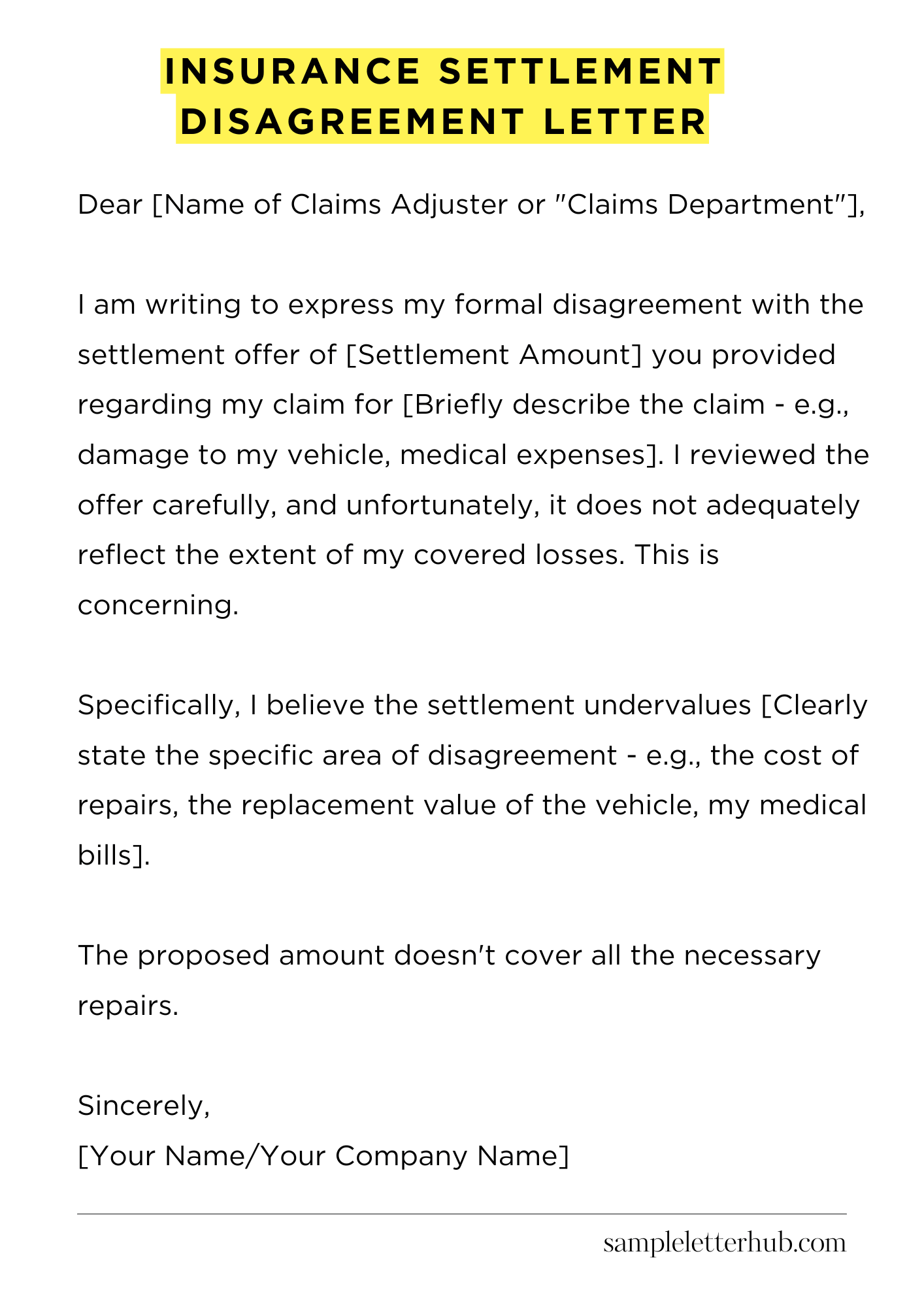
Dear [Name of Claims Adjuster or “Claims Department”],
I am writing to express my formal disagreement with the settlement offer of [Settlement Amount] you provided regarding my claim for [Briefly describe the claim – e.g., damage to my vehicle, medical expenses]. I reviewed the offer carefully, and unfortunately, it does not adequately reflect the extent of my covered losses. This is concerning.
Specifically, I believe the settlement undervalues [Clearly state the specific area of disagreement – e.g., the cost of repairs, the replacement value of the vehicle, my medical bills].
The proposed amount doesn’t cover all the necessary repairs. Attached to this letter, you will find [List any supporting documents you are including – e.g., repair estimates, medical bills, appraisals]. These documents will support my claim.
Furthermore, the initial assessment seems to overlook [Further detail your specific reasons for disagreement – be clear and concise. Provide facts.]. This is crucial to consider. I believe the accurate assessment should be much higher.
I have incurred considerable expenses related to this claim. These expenses are directly linked to the covered incident. I request that you reconsider the settlement offer based on the information provided in this letter and the attached documentation. I need you to evaluate all the attached information.
I am seeking a settlement of [Desired Settlement Amount]. This amount would allow me to fairly and reasonably resolve this matter. I trust that you will review my request thoroughly.
I look forward to your prompt response and a revised settlement offer. I would like to resolve this quickly.
Sincerely,
[Your Name/Your Company Name]
How to Write an Insurance Settlement Disagreement Letter
1. Initiate the Process: Formal Commencing
The genesis of your letter requires precision. You’re initiating a formal process. Begin by obtaining all the salient details. Secure the claim number, the insurance company’s name, and the adjuster’s full designation. This information is your anchor. Document the date of the incident and any relevant policy details. Don’t delay.
2. Subject Line: Explicit Categorization
The subject line serves as the first impression. It should be perspicuous and unambiguous. Use phrases such as “Disagreement with Settlement Offer – Claim Number [Insert Number]” or “Appeal of Settlement – Policy [Insert Policy Number]”. This upfront clarification expedites processing. Ensure it reflects your core intent.
3. Salutation and Introduction: Establishing Rapport
Address the adjuster or appropriate personnel with courtesy. “Dear [Adjuster’s Name]” is generally apt. The introduction requires a concise statement. State that you are writing to dispute the settlement offer you received on [Date]. Briefly recount the circumstances of the claim and your dissatisfaction. Maintain a professional tone.
4. Articulating Disagreement: The Core Argument
This is where the substance lies. Systematically outline your points of disagreement. Detail each element of the settlement you find inadequate. Refer to supporting documentation such as medical records, repair estimates, or witness statements. Provide specific examples of how the offer undervalues your losses. Your arguments must be robust and supported.
5. Presenting Your Justification: Substantiating Your Claim
Now you need to validate your assertions. Clearly explain why you believe the settlement is insufficient. Mention relevant policy provisions or legal precedents, if applicable. Include copies of any documentation that corroborates your position. Be thorough. Highlight discrepancies between the offer and your actual damages.
6. The Demand and Request: Formulating a Resolution
This section explicitly defines your desired outcome. State the settlement amount you are seeking. Justify this figure with the evidence you have provided. Request a reconsideration of the offer and a prompt response. Indicate a timeframe within which you expect a reply. Be pragmatic.
7. Concluding and Correspondence: Finality and Follow-up
Conclude with a professional closing, such as “Sincerely” or “Respectfully”. Include your full name, address, phone number, and email address. Retain a copy of the letter and all supporting documents for your records.
Consider sending the letter via certified mail with a return receipt requested. Follow up if you don’t hear back within the specified timeframe. Your diligence is crucial.
FAQs about Insurance Settlement Disagreement Letter
What is an Insurance Settlement Disagreement Letter?
An Insurance Settlement Disagreement Letter is a formal document used to express dissatisfaction with an insurance company’s proposed settlement offer. It outlines the reasons why the policyholder believes the offer is inadequate and details the specific damages or losses that were not properly considered or compensated for.
When Should I Send an Insurance Settlement Disagreement Letter?
You should send a disagreement letter when you believe the insurance company’s settlement offer does not fairly reflect your losses. This typically applies if the offer undervalues your property damage, medical expenses, lost wages, or other covered losses. It is crucial to send the letter before accepting the initial offer, as acceptance usually means waiving your right to further claims.
What Information Should I Include in a Settlement Disagreement Letter?
A comprehensive disagreement letter should include: your policy information (policy number, claim number), a clear statement of disagreement with the offer, a detailed explanation of why you disagree (e.g., specific damages not covered, incorrect valuation), supporting documentation.
What Happens After I Send a Disagreement Letter?
After receiving your letter, the insurance company will review your information and documentation. They may respond with a revised offer, request additional information, or deny your claim. The next steps can involve negotiation, mediation, or, if a resolution cannot be reached, litigation. Keep records of all communications and responses.
Do I Need a Lawyer to Write an Insurance Settlement Disagreement Letter?
While you are not legally required to have a lawyer, seeking legal advice from an attorney can be beneficial, especially for complex cases or high-value claims. A lawyer can ensure your letter is well-drafted, protects your rights, and effectively presents your case. They can also represent you in negotiations or legal proceedings if necessary.
Related:
Resignation letter due to rude boss
Resignation letter moving to another state
Resignation letter due to illness of family member
Resignation letter due to study