

Let’s talk about insurance renewal negotiation request letters. It’s a formal way to ask your insurance company for a better deal. The goal? To lower your insurance premium costs. You can save money on your auto insurance, home insurance, or any other type of insurance policy.
Writing the perfect letter can feel tricky. Don’t worry, we’ve got you covered. We’ll provide you with various Insurance Renewal Negotiation Request Letter samples. These templates will help you craft a persuasive and effective letter.
Ready to save on your insurance renewal? This article has the resources you need. Use our samples as a springboard for your own letter. Good luck negotiating your insurance!
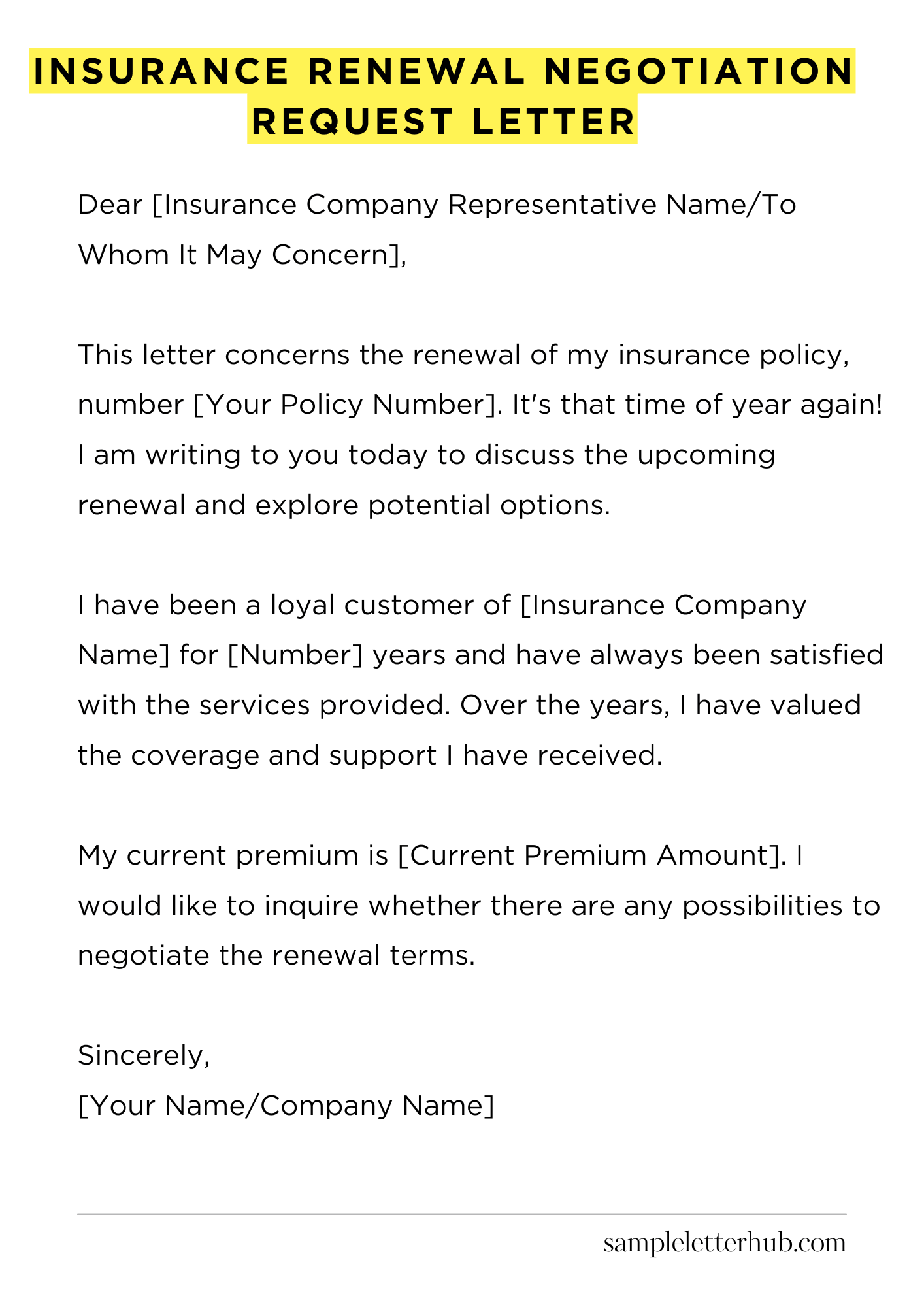
[Your Name/Company Name]
[Your Address]
[Your Phone Number]
[Your Email Address]
[Date]
[Insurance Company Name]
[Insurance Company Address]
Subject: Insurance Policy Renewal – Policy Number [Your Policy Number] – Negotiation Request
Dear [Insurance Company Representative Name/To Whom It May Concern],
This letter concerns the renewal of my insurance policy, number [Your Policy Number]. It’s that time of year again! I am writing to you today to discuss the upcoming renewal and explore potential options.
I have been a loyal customer of [Insurance Company Name] for [Number] years and have always been satisfied with the services provided. Over the years, I have valued the coverage and support I have received. However, I am currently reviewing my budget and exploring ways to optimize my expenses.
My current premium is [Current Premium Amount]. I would like to inquire whether there are any possibilities to negotiate the renewal terms. Are there any discounts available that I may qualify for, such as those related to a good driving record or bundling with other insurance policies? Perhaps there’s an adjusted coverage option that might suit my current needs.
I am particularly interested in understanding if there are any cost-effective options available without significantly compromising the level of protection I currently have. I would also appreciate information on any new policies or features that might be a better fit for my current circumstances. Your expert insight is welcome.
I am committed to maintaining my insurance coverage and would prefer to remain a customer of [Insurance Company Name]. I am open to discussing this matter further at your earliest convenience. Please feel free to contact me by phone or email. Thank you for your time and consideration.
I look forward to hearing from you soon.
Sincerely,
[Your Name/Company Name]
How to Write Insurance Renewal Negotiation Request Letter
Negotiating your insurance renewal can feel like navigating a legal labyrinth. The ability to articulate your needs and present a compelling argument, however, can result in significant savings and a more favorable policy. This guide provides a detailed roadmap to assist you in crafting an effective insurance renewal negotiation request letter.
1. Pre-Letter Amelioration: Laying the Groundwork
Before you even begin to draft your letter, preliminary groundwork is crucial. Scrutinize your current policy documentation with a critical eye. Determine what areas need adjustment – are you seeking reduced premiums, broadened coverage, or perhaps the removal of superfluous add-ons?
Assemble evidence that supports your claims. This might include a history of claim-free driving, home security system installation, or professional certifications that reduce your risk profile. Prepare a comparative analysis of competitor’s quotes; this serves as persuasive ammunition.
2. The Salutation: A Formal Overture
Begin your letter with a formal and respectful salutation. Address the letter to the appropriate individual at the insurance company, typically the underwriter or claims adjuster assigned to your account.
Use the person’s name; it creates a sense of personal connection and demonstrates that you have done your due diligence. For example, “Dear Mr./Ms. [Last Name],” or “To the Claims Department” (if a named individual is unknown).
3. The Introductory Parley: State Your Intentions
The opening paragraph sets the tone for your negotiation. Clearly and concisely state the purpose of your letter: to request a review of your current insurance policy’s renewal terms.
Specify your policy number and the insurance type (home, auto, etc.). Express your continued interest in being a client but indicate that you seek improved terms. This initial statement serves as a potent declaration of your objectives.
4. Substantiating Your Exigencies: Presenting the Case
This is where you present your arguments. Use a logical and organized structure. Detail all the reasons why you merit better terms. Include a narrative of your favorable history – claim-free years, proactive risk mitigation measures, and any other factors that would justify a premium reduction or improved coverage.
If you have obtained quotes from competing insurers, reference them here, emphasizing the lower premiums or superior benefits they offer. Be as specific as possible; quantify your points with data and evidence.
5. The Desideratum and the Concluding Plea: Explicit Demands and a Call to Action
Clearly articulate your specific requests. Do you want a lower premium, a higher coverage limit, or the inclusion of specific benefits? State your requests in precise terms.
End the letter with a polite but firm call to action. Specify a reasonable timeframe within which you expect a response. Reiterate your commitment to maintaining a positive relationship with the insurer, but also indirectly hint at the possibility of switching providers if your needs are not met. Thank the recipient for their time and consideration.
6. Letter Embellishment: The Nuances of Presentation
Ensure your letter is impeccably presented. Use a professional font and layout. Proofread carefully for any grammatical errors or typos. Keep the letter concise and to the point; avoid unnecessary jargon. Your letter should be easy to read and understand. Maintain a professional and respectful tone throughout.
7. Post-Submission: Following Up and Maintaining Diligence
After sending your letter, follow up with the insurer if you do not receive a response within the specified timeframe. Prepare to negotiate.
Stay firm on your key demands while remaining open to reasonable compromises. Document all communications carefully, including dates, times, and the names of the people you spoke with. This meticulous record-keeping can prove invaluable throughout the negotiation process.
FAQs about Insurance Renewal Negotiation Request Letter
Here are some frequently asked questions regarding Insurance Renewal Negotiation Request Letters:
What is an Insurance Renewal Negotiation Request Letter, and why is it important?
An Insurance Renewal Negotiation Request Letter is a formal written communication sent to your insurance provider to request a re-evaluation of your policy’s premium before your renewal date.
It’s important because it allows you to potentially lower your insurance costs by highlighting changes in your circumstances, comparing quotes, or negotiating favorable terms. This can lead to significant savings on your insurance premiums.
What information should I include in my Insurance Renewal Negotiation Request Letter?
Your letter should include your policy number, the date, and your contact information. Also, highlight any changes in your situation that might warrant a lower premium, such as improvements in your credit score, updated security measures (e.g., home security systems), or completion of a defensive driving course.
Include any comparative quotes you’ve obtained from other insurers to demonstrate the prevailing market rates. It’s also helpful to express your satisfaction with the insurer’s services to encourage a positive response.
When should I send my Insurance Renewal Negotiation Request Letter?
It’s generally recommended to send your letter at least 30-60 days before your policy renewal date. This allows sufficient time for the insurance provider to review your request, assess your situation, and potentially provide a revised premium quote before the renewal takes effect. Sending the letter early ensures that you have time to explore other insurance options if the negotiation is unsuccessful.
What are the possible outcomes of sending a Negotiation Request Letter?
The insurance company may respond in several ways. They might offer a reduced premium based on your request and any supporting information you’ve provided.
They may maintain the original premium if your request isn’t sufficient to warrant a change. They could potentially request additional information or documentation. In some cases, they might suggest adjustments to your coverage or other policy terms to lower your costs. Finally, the insurer might decide not to renew your policy, which means you would need to seek coverage elsewhere.
What if my negotiation request is denied, or I’m unhappy with the proposed terms?
If your negotiation request is denied, or you’re dissatisfied with the revised terms, consider these options. Firstly, review the offered premium to ensure you understand the terms.
Contact your provider again, perhaps with additional supporting information or clarifying your concerns. Secondly, obtain quotes from other insurance providers to see if you can find a more competitive offer.
If you find a better offer, you can switch providers at your policy’s renewal date. If the negotiations do not meet your expectations, be ready to move forward and switch your policy to another insurer.
Related:
Resignation letter due to rude boss
Resignation letter moving to another state
Resignation letter due to illness of family member
Resignation letter due to study