

Ever paid too much for your insurance? Sometimes, you might be eligible for a premium return. This happens when your insurance policy terms change or you’ve overpaid. You need an Insurance Premium Return Request Letter to get your money back. The letter formally asks the insurance company to refund the extra premium you paid.
Need to write this letter but don’t know where to start? Don’t worry! We’ve got you covered. This article offers ready-made templates and examples for your Insurance Premium Return Request Letter. We’ll provide different sample letters. You can easily adapt them to your specific situation.
These sample letters are crafted to save you time. They’re designed to be clear and effective. You can quickly create your own Insurance Premium Return Request Letter. Get your insurance premium refund without any hassle.
[Your Name/Company Name]
[Your Address]
[Your Phone Number]
[Your Email Address]
[Date]
[Insurance Company Name]
[Insurance Company Address]
Subject: Request for Premium Return
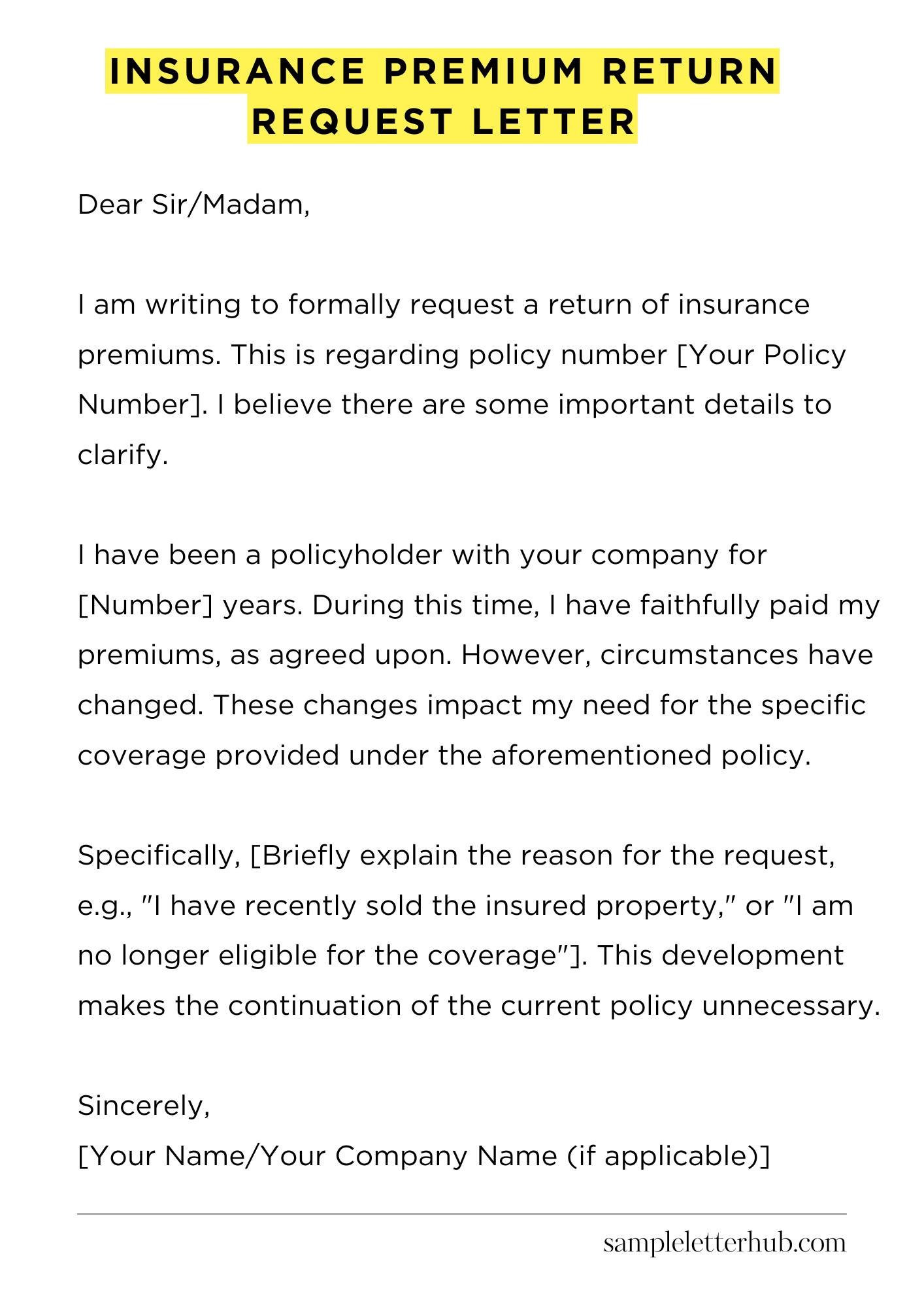
Dear Sir/Madam,
I am writing to formally request a return of insurance premiums. This is regarding policy number [Your Policy Number]. I believe there are some important details to clarify.
I have been a policyholder with your company for [Number] years. During this time, I have faithfully paid my premiums, as agreed upon. However, circumstances have changed. These changes impact my need for the specific coverage provided under the aforementioned policy.
Specifically, [Briefly explain the reason for the request, e.g., “I have recently sold the insured property,” or “I am no longer eligible for the coverage”]. This development makes the continuation of the current policy unnecessary. Therefore, keeping in line with the terms and conditions.
I kindly request you to process a refund for the remaining premium amount. I would appreciate it if you could specify the exact amount eligible for a return. Please provide details on how the refund will be issued.
I have enclosed [Mention any supporting documents, e.g., “a copy of the sale deed,” or “relevant documentation”]. These documents further support my request. This should help to speed up the process.
Please let me know if you require any further information from my side. I look forward to your prompt attention to this matter. Thank you for your time and assistance.
Sincerely,
[Your Name/Your Company Name (if applicable)]
How to Write Insurance Premium Return Request Letter
Sometimes, circumstances change, and you find yourself in a situation where you need a portion, or even the totality, of your insurance premium back. You’ll need to formally request this, and that requires crafting a well-structured letter. Follow these steps to ensure your missive is clear, concise, and compelling, increasing your chances of a successful reimbursement.
1. Salutation and Recipient Identification
Begin with a proper salutation. Address the letter to the appropriate department or individual within the insurance company. This might be the “Claims Department,” the “Customer Service Manager,” or a specific agent’s name, if known. Accuracy here is paramount. Use “Dear Mr./Ms./Mx. [Last Name]” if possible. If you are unsure, investigate before sending the letter.
2. Policy & Personal Information: The Foundation
In the opening paragraph, immediately provide crucial identifying information. State your full name, address, and contact details. Then, unequivocally specify your insurance policy number. Include the date the policy commenced and, if applicable, the date it was terminated or is slated for termination.
This ensures the recipient can swiftly locate your file. If you have any additional unique identifiers, like a claim number or a reference code, include those as well.
3. Clearly Articulate the Reimbursement’s Rationale
This is the core of your argument. Explicitly state why you’re requesting a premium return. Be transparent and provide a detailed explanation. This is where you lay out your case.
Are you cancelling the policy? Have you experienced a change in circumstances that renders the policy unnecessary? Do you believe you were overcharged? Provide supporting evidence, dates, and any relevant documentation. For instance, if you are moving out, the policy is no longer needed. State the reason clearly.
4. Pinpoint the Exact Amount and Method of Repayment Desired
Specify the precise amount of premium you are seeking to reclaim. If requesting a partial refund, clearly indicate the period for which you are requesting reimbursement, or explain how you calculated the amount owed.
State your preferred method of repayment. Will you take a cheque, bank transfer, or another method? Provide all necessary details, such as bank account information, if relevant. Always verify these details for accuracy.
5. Supporting Documentation & Appendices
If applicable, list any documentation you’re including with your letter. This might be a copy of your policy documents, proof of cancellation, or any other relevant evidence that buttresses your claim.
This bolsters your case and validates your request. Consider using the format “Enclosed are the following documents:” followed by a bulleted list. Always keep a copy of everything you send.
6. A Polite & Direct Closing: The Exit
Conclude your letter with a polite but firm closing. Reiterate your request for a premium return. Express your willingness to provide any further information required. Thank the recipient for their time and consideration.
You might say, “Thank you for your prompt attention to this matter.” Include your name and your signature above your typed name. This is where you reiterate your requirements.
7. Delivery & Follow-Up
Send your letter via a tracked delivery method, such as certified mail. This provides proof of delivery. Keep a copy of the letter and all supporting documents. If you don’t receive a response within a reasonable timeframe (usually 2-4 weeks), follow up with a phone call or a subsequent letter.
Maintain a record of all your communications, including dates and names of any individuals you speak with. Persistence and a well-documented trail often prove beneficial in these situations. Ensure you know the timelines for requesting a refund with the company and act accordingly.
FAQs about Insurance Premium Return Request Letter
Here are some of the most frequently asked questions regarding insurance premium return request letters, designed to provide clarity on the process and associated considerations.
What is an insurance premium return request letter, and when is it necessary?
An insurance premium return request letter is a formal written document submitted to an insurance provider to request a refund of previously paid premiums.
This letter is typically necessary in various situations, including policy cancellation before the term end, overpayment of premiums, or in cases where the insurance coverage was never activated or not required. The specific circumstances under which a return is eligible will depend on the terms and conditions outlined in the insurance policy.
What information should be included in an insurance premium return request letter?
A comprehensive request letter should include the policyholder’s full name, policy number, contact information, and the reason for the premium return request.
Additionally, the letter should state the specific amount of the premium to be refunded, the preferred method of receiving the refund (e.g., check, bank transfer), and provide any supporting documentation that clarifies the situation.
How do I submit an insurance premium return request letter?
The method of submission can vary depending on the insurance provider. Common methods include mailing the letter to the designated address, submitting it electronically through the company’s online portal or email.
It is advisable to retain a copy of the letter and any supporting documents, as well as proof of submission (e.g., tracking information for mailed letters or a confirmation email for electronic submissions), for your records. Check the insurance policy document for the correct procedures.
How long does it typically take to receive a refund after submitting a request letter?
The processing time for a premium refund can vary significantly based on the insurance provider’s policies, the complexity of the request, and the volume of requests they are currently handling.
Generally, it may take anywhere from a few weeks to a few months to receive the refund. It is recommended to contact the insurance company directly to inquire about the status of the refund request if you haven’t received it within a reasonable timeframe, after submitting the request.
What happens if my premium return request is denied?
If your premium return request is denied, the insurance provider is obligated to provide an explanation or justification for the denial. Review the reason for denial carefully, which is included in a rejection letter.
If you disagree with the decision, you may have options, such as contacting the insurance company’s customer service department to discuss the matter further, or going through the company’s internal dispute resolution process.
As a last resort, you might consider external avenues for dispute resolution, depending on your local regulations, such as filing a complaint with a regulatory body or seeking legal counsel.
Related:
Resignation letter due to rude boss
Resignation letter moving to another state
Resignation letter due to illness of family member
Resignation letter due to study