

Dealing with the wrong insurance policy can be frustrating. Sometimes, you get charged for a policy you didn’t even want. An insurance premium refund letter for wrong policy issue is your tool. Its purpose? To get your money back! It formally requests a refund of the premium paid.
Need to draft a premium refund letter? We’ve got you covered! This article provides samples and templates. These examples will help you. They’ll guide you to write your own letter. Writing a refund letter becomes much easier this way.
We’ll break down different scenarios. Each sample letter is clear and concise. You can adapt them to your specific situation. Our goal? To simplify the process of getting that insurance premium refund.
[Your Name/Company Name]
[Your Address]
[Your Phone Number]
[Your Email Address]
[Date]
[Insurance Company Name]
[Insurance Company Address]
Subject: Request for Premium Refund – Incorrect Policy Issued
Dear Sir/Madam,
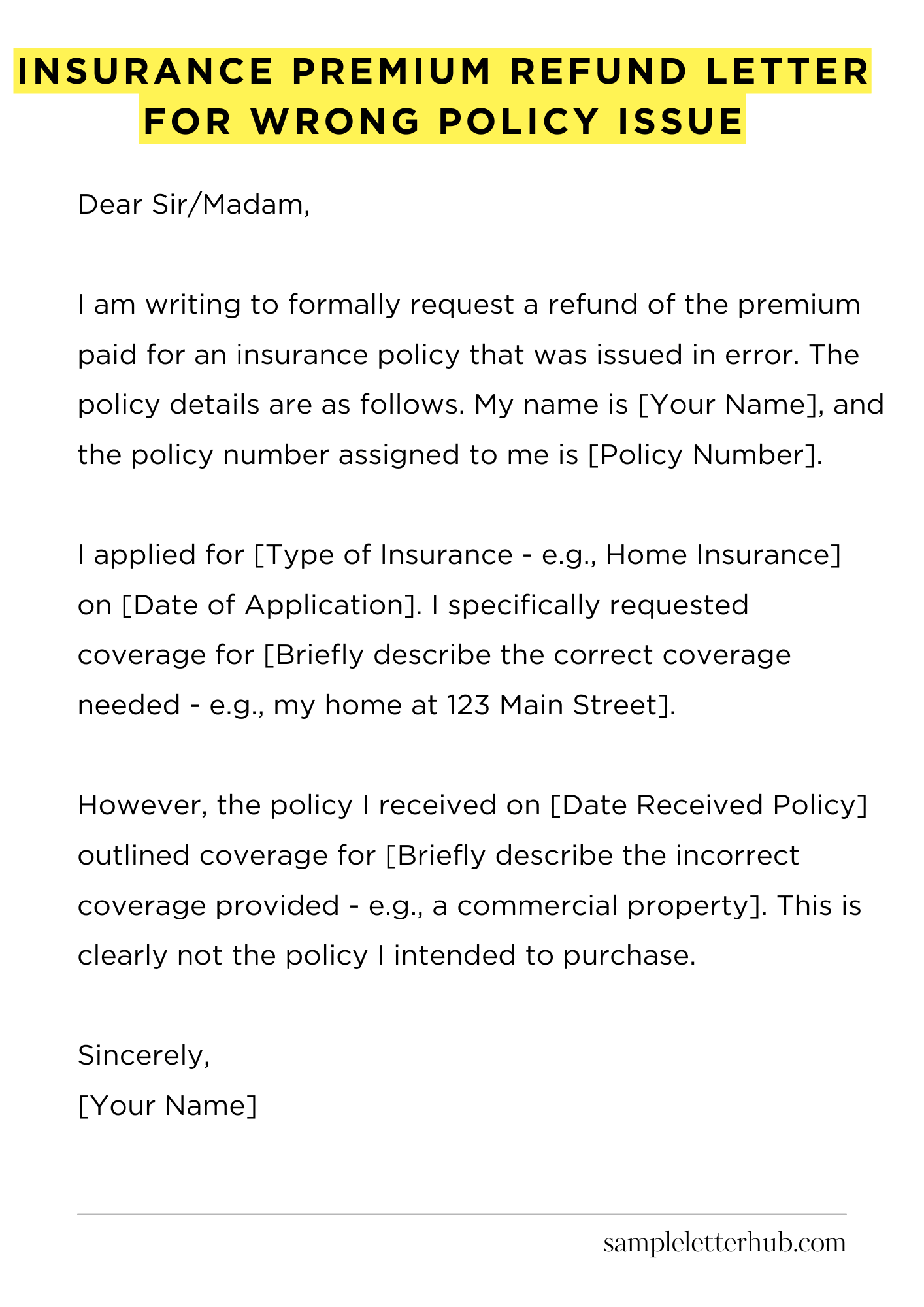
I am writing to formally request a refund of the premium paid for an insurance policy that was issued in error. The policy details are as follows. My name is [Your Name], and the policy number assigned to me is [Policy Number].
I applied for [Type of Insurance – e.g., Home Insurance] on [Date of Application]. I specifically requested coverage for [Briefly describe the correct coverage needed – e.g., my home at 123 Main Street].
However, the policy I received on [Date Received Policy] outlined coverage for [Briefly describe the incorrect coverage provided – e.g., a commercial property]. This is clearly not the policy I intended to purchase.
After reviewing the policy documents, it became immediately apparent that the issued policy was not suitable for my needs. The terms and conditions simply did not reflect what I discussed with your representative during the application process.
I contacted your customer service department on [Date of Contact] to report the issue. The contact person was [Name of Customer Service Representative, if known].
I am therefore requesting a full refund of the premium I paid for the incorrect policy. I have not made any claims under this policy and, as it is inappropriate for my needs, I have not utilized it.
I understand that refunds may take some time to process, and I would appreciate it if you could inform me of the expected timeframe for the refund.
I look forward to your prompt attention to this matter and a swift resolution. Thank you for your time and consideration.
Sincerely,
[Your Name]
How to Write Insurance Premium Refund Letter for Wrong Policy Issue
Sometimes, the intricate dance of insurance policies leads to a misstep. You might find yourself ensnared in a policy that’s not quite the right fit. This necessitates a formal request: a letter of demand for a premium refund. Crafting a cogent letter is paramount to ensuring your reimbursement. Let’s delineate the steps.
1. Identify the Culprit – Pinpointing the Discrepancy
Before you commence penning your plea, meticulously examine the discrepancy. Exactly what transpired? Did you receive the incorrect policy?
Are the coverage parameters misaligned with your requirements? Is there a glaring error in the policy’s particulars? Document these transgressions with exacting precision. The more forensic your analysis, the stronger your case.
2. Gather the Armamentarium – Assembling Your Documentation
Your missive will be significantly fortified by supporting documentation. Compile all relevant paperwork.
This includes, but isn’t limited to, your original policy documents, any communication detailing your initial application or requests, and receipts evidencing premium payments. Think of this as your evidential stockpile. These are your ‘proofs’ to fortify your case.
3. Structuring Your Overture – Crafting the Salutation and Introduction
Begin with a professional and respectful salutation. Address the letter to the appropriate department or individual at the insurance company. If you know the claims adjuster’s name, utilize it.
Your introduction should clearly state the purpose of the letter: to request a premium refund due to the incorrect policy issue. Keep it concise, stating the policy number and the date the policy went into effect.
4. Laying Bare the Transgression – Detailing the Issue and Your Expectations
Herein lies the crux of your argument. Clearly and concisely articulate the issue. Explain why the policy you received is incorrect, mismatched, or otherwise unsatisfactory. Refer to specific clauses, dates, and communications to bolster your claims. This is where you leverage.
5. The Closing Courtesies – Concluding with Politeness and Clarity
Conclude your letter with a polite but assertive tone. Reiterate your request for a full refund of the premium. Mention the documents enclosed for perusal.
Add a sentence expressing your hope for a swift resolution. Provide your contact information: address, telephone number, and email. This is essential for a timely resolution to your grievance.
6. The Art of Delivery – Dispatching Your Letter and Keeping Records
Send the letter via certified mail with a return receipt requested. This provides proof of delivery and ensures a paper trail. Keep a copy of the letter and all supporting documentation for your records. Consider this your defense against potential complications. In case of disputes, this is your undeniable evidence.
7. The Aftermath – Navigating the Response and Escalation
Await the insurer’s response. If they respond favorably, follow up to ensure the refund is processed promptly. If they reject your claim or propose an unsatisfactory resolution, meticulously review their reasoning.
If necessary, consider escalating the matter. This might involve contacting the company’s ombudsman or seeking assistance from your state’s insurance commission. Persistence, combined with preparedness, often yields positive results.
FAQs about Insurance Premium Refund Letter for Wrong Policy Issue
What is an insurance premium refund letter for a wrong policy issue?
An insurance premium refund letter for a wrong policy issue is a formal written request submitted to an insurance company to reclaim premium payments made for an insurance policy that was issued in error or does not meet the policyholder’s needs.
This typically occurs when the policy issued does not match the terms agreed upon, covers the wrong items or individuals, or was issued due to a mistake by the insurer or the agent.
What information should be included in a premium refund letter?
A well-crafted premium refund letter should contain several key pieces of information. It should start with the policyholder’s contact details, the insurance company’s address, and the date.
Crucially, it must include the policy number, a clear explanation of why the policy was issued incorrectly or why it’s no longer needed, the amount of the premium paid, and a specific request for a refund. Supporting documentation, such as copies of relevant communication or policy documents, should also be included.
How long does it typically take to receive a refund after sending the letter?
The time it takes to receive a refund can vary depending on the insurance company’s policies and the complexity of the situation. While some companies might process refunds within a few weeks, others might take longer.
It’s important to review the insurance company’s refund policy, which may be outlined in the policy documents. Following up with the insurance company a reasonable time after sending the letter, and keeping records of all communications, is recommended.
What supporting documents should I include with my refund letter?
The specific supporting documents needed will depend on the reason for the refund request. Generally, it’s beneficial to include a copy of the insurance policy, any correspondence related to the policy application or changes, and proof of premium payments (such as bank statements or receipts).
If the policy was issued incorrectly due to a misrepresentation, provide supporting evidence that contradicts the information used. Always retain copies of all documents submitted.
What steps can I take if my refund request is denied?
If your refund request is denied, the first step is to carefully review the denial letter to understand the reasons for the rejection. You may then consider contacting the insurance company’s customer service department to discuss the denial and provide any additional information or documentation.
If the matter remains unresolved, you can escalate the issue through the company’s internal complaint process. As a final resort, depending on the regulations and guidelines of your jurisdiction, you may have the option to file a complaint with the state’s insurance regulator or seek legal counsel.
Related:
Resignation letter due to rude boss
Resignation letter moving to another state
Resignation letter due to illness of family member
Resignation letter due to study