


An insurance policy cancellation letter is a formal document. Its purpose is to officially request the termination of your insurance policy. You send it to your insurance provider. This action stops your coverage. It also ceases your premium payments.
Are you looking to cancel your insurance? We’ve got you covered. This article offers various insurance policy cancellation letter samples. You’ll find templates for different insurance types. These are easy to adapt. Simply customize them to fit your specific needs. Writing this can be easy.
Need a sample insurance policy cancellation letter? Browse the examples below. We make it easy to craft the perfect letter. We provide templates. Use them to save time and effort. Say goodbye to confusing jargon.
[Your Name]
[Your Address]
[Your Phone Number]
[Your Email Address]
[Date]
[Insurance Company Name]
[Insurance Company Address]
Dear [Insurance Company Representative Name, or “Insurance Department”],
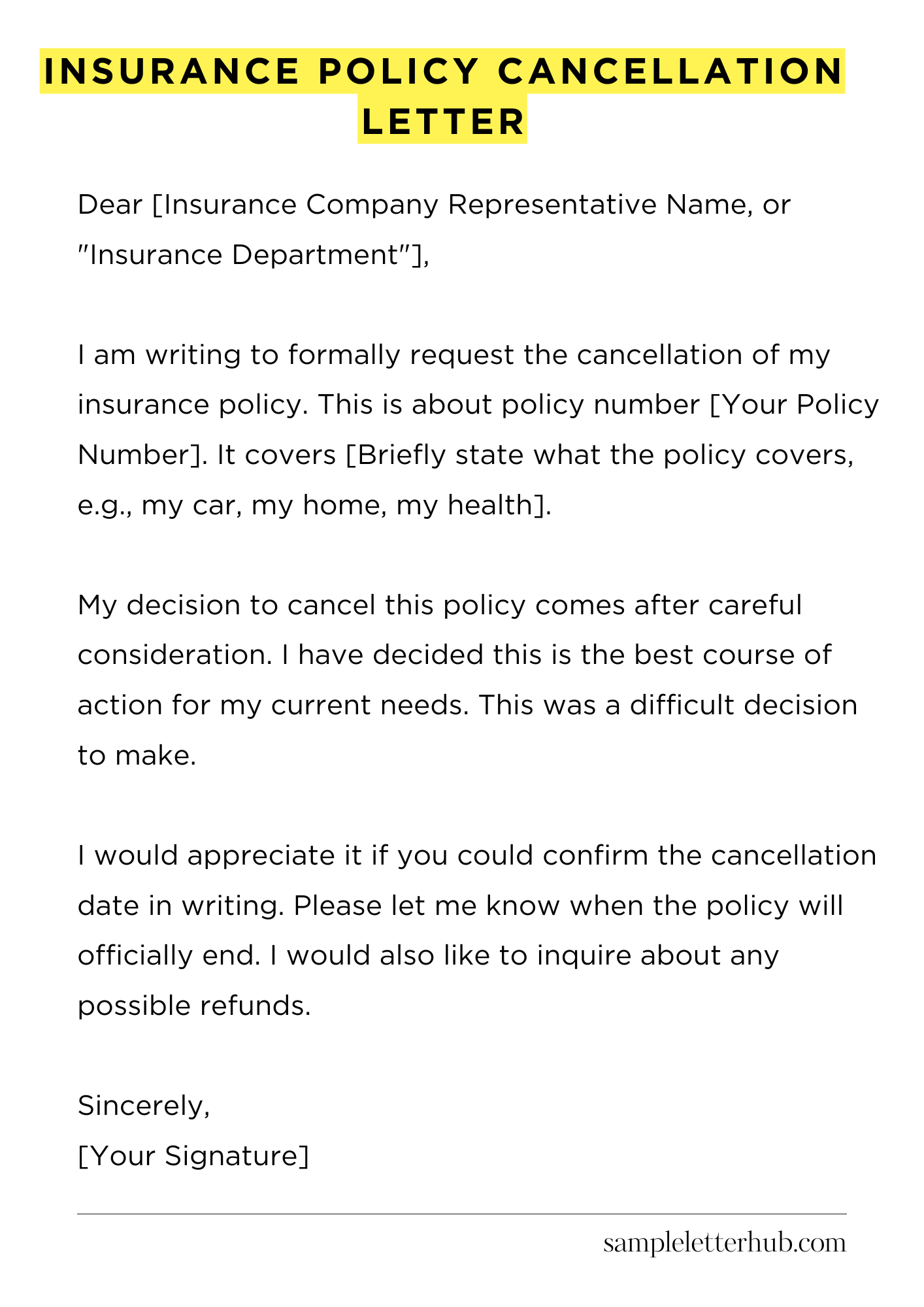
I am writing to formally request the cancellation of my insurance policy. This is about policy number [Your Policy Number]. It covers [Briefly state what the policy covers, e.g., my car, my home, my health].
My decision to cancel this policy comes after careful consideration. I have decided this is the best course of action for my current needs. This was a difficult decision to make.
I would appreciate it if you could confirm the cancellation date in writing. Please let me know when the policy will officially end. I would also like to inquire about any possible refunds. If a refund is due, kindly specify the amount and the expected processing time. Your quick attention to this matter would be greatly appreciated.
Please send all related correspondence to the address above. I look forward to receiving your confirmation and any refund details as soon as possible. Thank you for your understanding and assistance in this matter.
Sincerely,
[Your Signature]
How to Write Insurance Policy Cancellation Letter
Abruptly terminating an insurance policy? You’ll need a well-crafted cancellation letter. This missive serves as your official notice. It’s a crucial document that can save you future complications. Here’s a comprehensive guide to navigate the process.
1. Identify the Essential Preambles
Commence your letter with your full legal name and address. Include the current date. Following this, address the letter to the correct insurance provider, meticulously noting the specific department responsible for policy cancellations. This is where meticulousness truly pays off.
2. The Salutation and Policy Specifics
Start with a formal salutation. “Dear [Insurance Company Name] Cancellation Department,” is a prudent option. Next, definitively state your intention: “This letter serves as formal notification to cancel my insurance policy.” Immediately after, provide exhaustive details about the policy you intend to nullify.
Enumerate the policy number, the type of insurance (e.g., auto, home, life), and the effective dates of coverage. The more explicit you are, the less room there is for ambiguity.
3. Articulating the Reason for Revocation (If Applicable)
You’re not always obligated to furnish a reason. However, if the cause stems from a specific issue, or a dissatisfaction, or potentially the discovery of an improved policy elsewhere, it’s useful. Brevity is key.
Succinctly articulate the rationale. For example, “Due to…[insert reason]”. Avoid verbose explanations. Keep it clear and succinct. Your candor and reasoning will be appreciated, and it might even lead to a resolution.
4. Stating the Desired Cancellation Date
This is paramount. Clearly specify the exact date you want the cancellation to become effective. It could be immediately, or a future date. Be precise. Indicate “effective immediately” if you want the cancellation to take place right away. If you have any remaining premium to be paid, consider including a sentence about how you would like to have the remaining amount refunded.
5. Requests and Declarations
Formulate your requests. Explicitly request confirmation of the cancellation. Ask for written verification within a specified timeframe (e.g., “Please confirm this cancellation in writing within fourteen days.”).
Also, request information regarding any remaining premiums due, or any potential refund. If you are entitled to a refund, make a request for the mode of disbursement, whether it should be a check or a specific account. The more detail you provide, the better.
6. The Sign-off and Delivery Method
Conclude with a professional closing, such as “Sincerely” or “Respectfully”. Include your printed name, your signature, and the date signed. Send the letter via certified mail with return receipt requested.
This provides irrefutable proof of delivery. Retain a copy of the letter, the delivery confirmation, and any other relevant documentation for your records. This is invaluable in case of any future disputes.
7. Aftermath and Contingency
After sending the letter, meticulously follow up. If you don’t receive confirmation within the stipulated timeframe, contact the insurance company. Keep a record of all communications, including dates, times, and the names of the individuals you spoke with. Should any discrepancies arise, your meticulous records will prove invaluable.
By adhering to these steps, you’re well-equipped to navigate the complexities of insurance policy cancellation with finesse.
FAQs about Insurance Policy Cancellation Letter
What is an Insurance Policy Cancellation Letter, and why is it necessary?
An insurance policy cancellation letter is a formal written document that you, the policyholder, or the insurance company, use to officially terminate an existing insurance policy. It’s necessary because it provides a clear record of the cancellation, the effective date, and often the reason for the cancellation.
It protects both parties by establishing a legal and documented end to the insurance coverage, which can be crucial for resolving potential disputes.
What information should I include in an insurance policy cancellation letter?
Your cancellation letter should include essential details such as your full name, address, and policy number. Clearly state your intention to cancel the policy and the desired cancellation date. If you have a reason, such as finding a better policy, it’s advisable to include it, although it’s not always mandatory.
Specify how you wish to receive any potential refund, and include your signature for authentication.
How do I write an insurance policy cancellation letter?
Start by identifying yourself, including your name, address, and contact information. Then, state the date of the letter and the recipient’s information (insurance company’s name and address). Clearly state your intent to cancel the policy, specify your policy number and the desired cancellation date.
You can add a brief reason, and mention any refund instructions. Conclude the letter with your signature and printed name. Consider sending the letter via certified mail with a return receipt requested to provide proof of delivery.
What happens after I send an insurance policy cancellation letter?
Once the insurance company receives your letter, they should process the cancellation based on your request. You’ll likely receive a confirmation letter detailing the cancellation date and any applicable refund details.
The company will cease coverage on the specified date, so it’s essential to have new insurance in place to avoid a gap in coverage. Keep all the communication, including copies of your letter and any confirmations, for your records.
Can my insurance company cancel my policy, and how would they notify me?
Yes, insurance companies have the right to cancel your policy under certain circumstances, such as non-payment of premiums, misrepresentation of information, or significant changes in risk.
They must notify you in writing, typically via mail, specifying the reason for cancellation and the effective date. The notice period is determined by state laws and the type of policy. Review your policy’s cancellation terms for details.
Related:
Resignation letter due to rude boss
Resignation letter moving to another state
Resignation letter due to illness of family member
Resignation letter due to study