

Need to get money back from your insurance company? You might have overpaid. An Insurance Excess Payment Refund Request Letter is the way to do it. Its main job is to ask the insurance company for a refund. This letter explains why you think you are owed money.
Dealing with insurance companies can be tricky. Writing the perfect Insurance Excess Payment Refund Request Letter can be daunting. Lucky for you, we have you covered. This article offers helpful Insurance Excess Payment Refund Request Letter templates. We’ll show you different examples and samples.
These sample letters will make your life easier. Choose the one that suits your needs. Modify it to fit your specific situation. Crafting your Insurance Excess Payment Refund Request Letter has never been simpler!
[Your Name/Company Name]
[Your Address]
[Your Phone Number]
[Your Email Address]
[Date]
[Insurance Company Name]
[Insurance Company Address]
Subject: Request for Refund of Insurance Excess Payment – [Policy Number]
Dear [Insurance Company Representative Name or “Claims Department”],
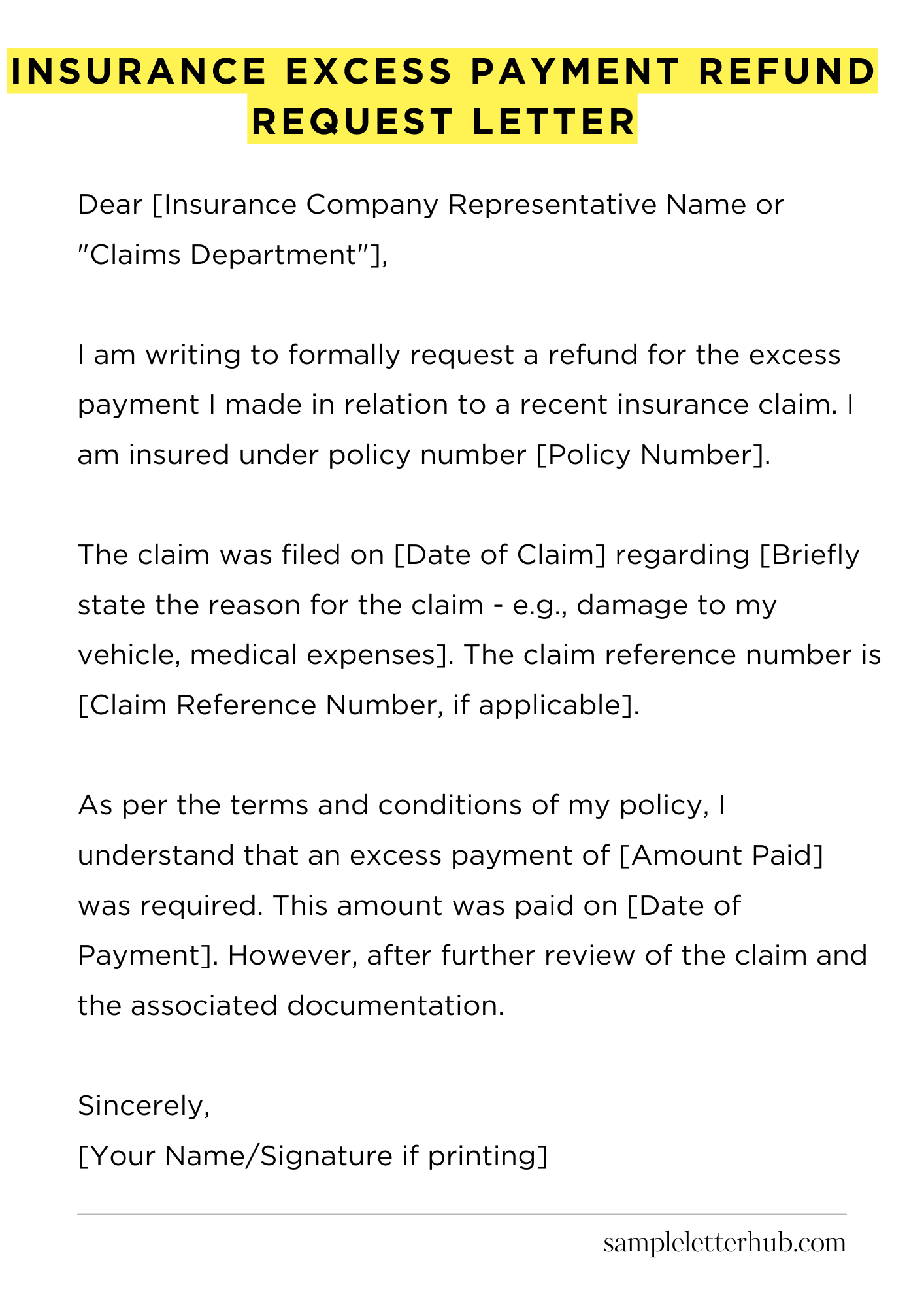
I am writing to formally request a refund for the excess payment I made in relation to a recent insurance claim. I am insured under policy number [Policy Number].
The claim was filed on [Date of Claim] regarding [Briefly state the reason for the claim – e.g., damage to my vehicle, medical expenses]. The claim reference number is [Claim Reference Number, if applicable].
As per the terms and conditions of my policy, I understand that an excess payment of [Amount Paid] was required. This amount was paid on [Date of Payment]. However, after further review of the claim and the associated documentation, I believe I am entitled to a refund of this excess payment.
[Clearly and concisely explain the reason for the refund request. This might involve citing specific policy clauses, providing additional information or evidence, or pointing out an error in the initial assessment of the claim.
Be specific. Provide any supporting documentation you can.] For example: “According to clause 12.3 of my policy, the excess is waived in situations where the damage is caused by a third party and they are identified. The responsible third party was identified and their insurance company, [Third Party Insurance Company Name], has accepted full responsibility for the damages.”
I have attached copies of [List any supporting documents you are including – e.g., the original claim documents, the third-party insurance confirmation, repair invoices]. These documents will support my request for reimbursement of the excess payment.
I would appreciate it if you could review my claim thoroughly, considering the information and documentation I have provided. Please process my refund request as quickly as possible.
Could you please confirm the process for receiving the refund and the expected timeframe for completion? I can be reached by phone at [Your Phone Number] or by email at [Your Email Address] if you require any further information or clarification.
Thank you for your time and attention to this matter. I look forward to your prompt response.
Sincerely,
[Your Name/Signature if printing]
How to Write Insurance Excess Payment Refund Request Letter
Navigating the labyrinthine world of insurance can be tricky. You’ve paid your excess, the claim is settled, but now you need that money back. Don’t fret, crafting a stellar refund request is your key to reimbursement. Let’s dissect the anatomy of an effective letter.
1. Commence with Congenial Salutations
Begin with a professional and respectful greeting. “Dear Claims Department,” or “To Whom It May Concern,” are both perfectly acceptable. It sets a formal tone right from the outset. Avoid overly familiar language. Remember, you’re not penning a casual note; you’re embarking on a formal inquiry.
2. Identify Your Policy Precisely
Immediately provide explicit details. Include your policy number, claim number, and date of the incident. This allows the recipient to swiftly access your records. The more specific your data, the more expeditious the process. Ambiguity can lead to administrative logjams.
3. Clearly Articulate Your Request
State your objective with crystal clarity. Formulate your sentences to leave no room for misunderstanding. “I am writing to request a refund of the excess payment I made regarding claim number [claim number],” is a good example. Succinctness is key here. Get straight to the point.
4. Enumerate the Supporting Evidence
This is where you bolster your argument. State the reasons for your refund request. Did the other party admit fault? Was your claim wholly approved? The onus is on you to offer substantial support. Attach copies of pertinent documents, such as the claim settlement statement or any relevant correspondence that substantiates your case.
5. Highlight the Pertinent Stipulations
If applicable, reference the specific clauses or stipulations within your insurance policy that warrant a refund. This demonstrates you’ve undertaken due diligence and know your rights. Showing awareness of the policy terms is a powerful move. You are now wielding the sword of knowledge.
6. Stipulate Desired Disbursement Details
Specify how you wish to receive the refund. Provide your bank account details, including the bank name, account number, and sort code. If a check is preferred, provide your mailing address. Ensure the provided information is accurate to avoid any delays in the refund process. Correctness is paramount here.
7. Conclude with Cordial Closings and Essential Signatories
End with a courteous closing like, “Sincerely,” or “Yours faithfully.” Sign the letter with your full legal name and include your contact information: phone number and email address.
Proofread meticulously before submitting. A well-crafted letter signifies professionalism and enhances the probability of a favorable outcome. Now you’ve armed yourself with the tools to request your money back.
FAQs about Insurance Excess Payment Refund Request Letter
What information should I include in the insurance excess payment refund request letter?
Your letter should clearly state your policy details (policy number, name of the insurer), the incident details (date, location, and brief description), the amount of the excess payment you are seeking to have refunded, and the reason for the refund request.
Include any supporting documentation, such as the claim reference number, a copy of the original payment receipt, and any relevant communication with the insurer (e.g., email threads). Always include your full name, address, and contact information.
What supporting documents do I need to include with the refund request letter?
The required supporting documents will depend on the reason for your refund request. Generally, you should include a copy of the payment receipt or bank statement showing the excess payment, the original claim documentation (if applicable), and any correspondence or agreements with the insurer.
If the refund is based on a third party being responsible, you might need to include details of the third party’s insurance or any relevant investigation reports.
How long does it typically take to receive a refund after submitting a request letter?
The timeframe for processing a refund can vary depending on the insurance company and the complexity of your request. It’s best to check your policy’s terms and conditions or the insurer’s website for information on processing times.
However, in most cases, you can expect to receive a response within 4 to 8 weeks. Keep records of your communication and follow up if you haven’t heard back within a reasonable timeframe.
What are the common reasons for an insurance excess payment refund?
Common reasons for an excess payment refund include situations where the other party is at fault (in a car accident, for example), and their insurer is covering the damages.
Other reasons may include cases where the damage is covered by a warranty or guarantee, the insurance company has overcharged the excess amount, the insurer has agreed to a waiver of the excess, or a calculation error. You’ll need to clearly state the specific reason in your letter.
What should I do if my refund request is denied?
If your refund request is denied, carefully review the reasons provided by the insurance company. You can then gather additional documentation or evidence to support your claim.
You may need to formally appeal the decision, following the insurer’s appeals process. If the appeal is unsuccessful, you might consider escalating the matter to an ombudsman or a relevant regulatory body that handles insurance complaints, or seek legal advice.
Related:
Resignation letter due to rude boss
Resignation letter moving to another state
Resignation letter due to illness of family member
Resignation letter due to study