

Need to update your insurance coverage? You might need an insurance coverage update request letter. This letter formally asks your insurance provider to change your policy. It’s a key tool for managing your insurance.
We understand writing letters can be tricky. Don’t worry, we’ve got you covered. We’ll share insurance coverage update request letter templates. Find various sample letters here. These samples will make the process easier.
Need to increase coverage? Want to add a driver? Our letter samples are ready. They help you craft the perfect letter. Use these to get the changes you need for your insurance!
[Your Name/Your Company Name]
[Your Address]
[Your Phone Number]
[Your Email Address]
[Date]
[Insurance Company Name]
[Insurance Company Address]
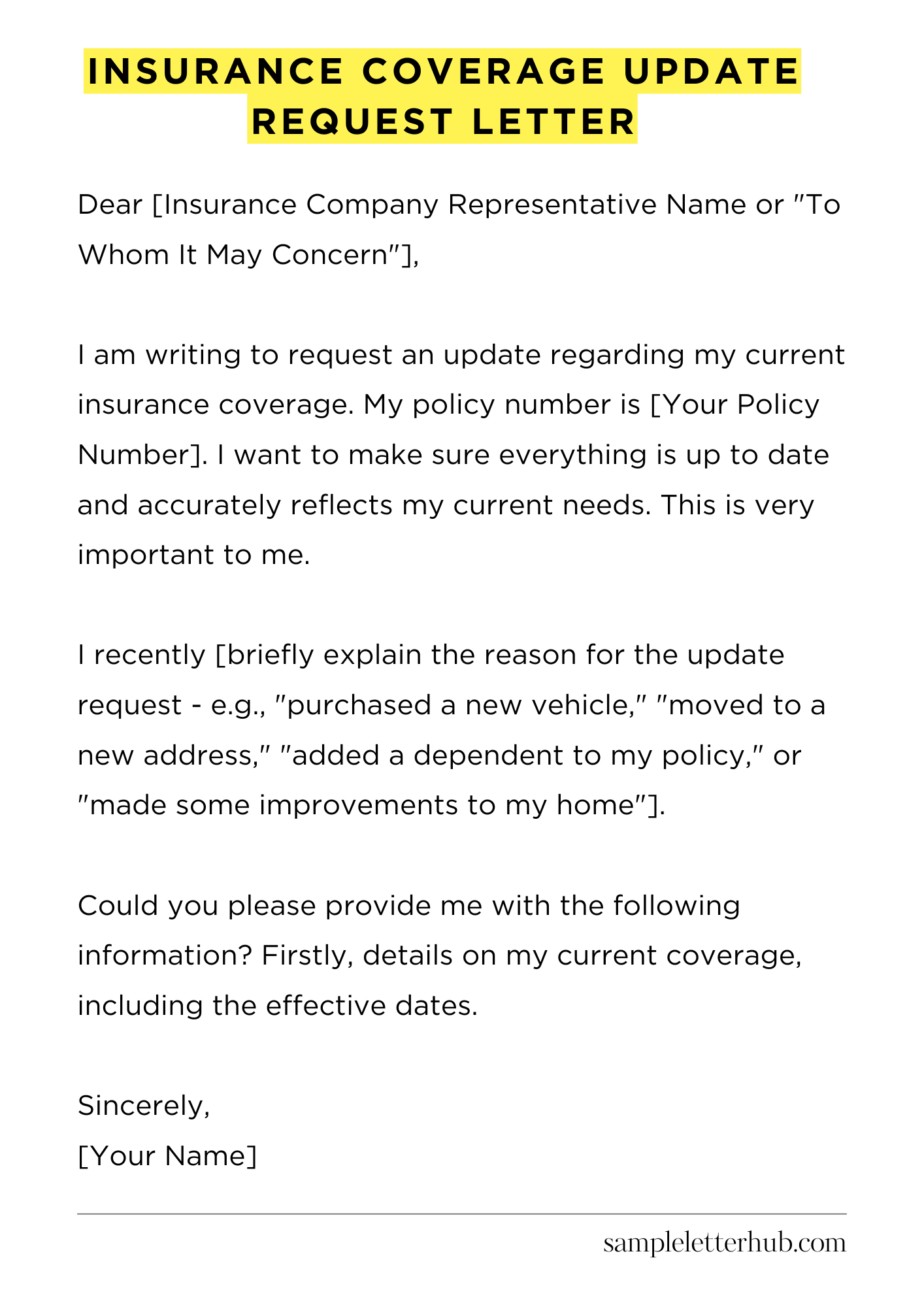
Dear [Insurance Company Representative Name or “To Whom It May Concern”],
I am writing to request an update regarding my current insurance coverage. My policy number is [Your Policy Number]. I want to make sure everything is up to date and accurately reflects my current needs. This is very important to me.
I recently [briefly explain the reason for the update request – e.g., “purchased a new vehicle,” “moved to a new address,” “added a dependent to my policy,” or “made some improvements to my home”]. Because of this change, I believe my current policy may need to be adjusted. It’s crucial that my policy remains relevant.
Could you please provide me with the following information? Firstly, details on my current coverage, including the effective dates. Secondly, an overview of the terms and conditions. Thirdly, information about any potential changes I may need to make.
I would also appreciate it if you could send me an updated copy of my policy documents. Please let me know if any further information is needed from my end. I am happy to cooperate fully.
You can reach me by phone at [Your Phone Number] or by email at [Your Email Address]. I look forward to hearing from you soon. I will be waiting for your reply.
Thank you for your time and attention to this matter. I appreciate your assistance.
Sincerely,
[Your Name]
How to Write Insurance Coverage Update Request Letter
Navigating the labyrinthine world of insurance can be daunting, but armed with the right tools, you can confidently address your coverage needs.
A well-crafted insurance coverage update request letter is a cornerstone of effective communication with your provider. It’s the key to ensuring your policy mirrors your current requirements. Here’s a pragmatic guide to help you compose a compelling letter.
1. Commence with Conciseness: The Salutation and Introduction
Begin your missive with a formal salutation. Address the appropriate department or individual; if unsure, a general “To Whom It May Concern” is acceptable. Briefly state your purpose in the opening paragraph. Clearly identify yourself, your policy number, and the specific changes you are requesting. This will provide immediate clarity.
2. Articulate the Alterations: Detailing Your Desires
This is where precision is paramount. Clearly delineate the specific coverage modifications you desire. Are you seeking to add a new driver? Need to boost your liability limits? Be exceedingly specific.
Provide all pertinent details, such as the date of birth, driver’s license number, or vehicle identification number (VIN) for added clarity and to aid in processing. Avoid ambiguity; vagueness can lead to processing delays.
3. Provide Justification: Substantiating Your Supplications
Your request should not exist in a vacuum. Offer succinct justifications for your request. Explain the rationale behind the alterations. For instance, if you’re adding a teen driver, mention that the young person has recently obtained a driving license.
If you’re updating property coverage, include the value of recent home renovations. This provides the insurer with context and reinforces the need for adjustment.
4. Assemble Supporting Documentation: Augmenting Your Arguments
Supporting documentation can significantly bolster your request. Gather any necessary paperwork. Include copies of any documents that validate your assertions, such as a copy of a driver’s license or a vehicle registration.
Ensure you have the supporting documentation to validate your request. Always retain copies of all sent and received communications for your records.
5. Express a Desire for Action: Proclaiming a Call to Action
Conclude your letter with a clear call to action. Explicitly request the insurer to process your request. State the date by which you would like the changes to be effective. Provide contact information, including your phone number and email address. Express your willingness to provide further information if required.
6. The Art of the Outro: The Formal Farewell
Conclude your letter with a professional closing. Use a formal sign-off, such as “Sincerely,” or “Respectfully,” followed by your full name and signature (if sending a hard copy). Include your contact information below your signature for added convenience. Double-check your contact details for accuracy to ensure swift and smooth communication.
7. Polishing the Prose: Review and Revision
Before dispatching your letter, meticulously review it. Check for any grammatical errors, typographical mistakes, and factual inaccuracies. Ensure that your request is unequivocally understood.
Read the letter aloud to identify any awkward phrasing or unclear sentences. Consider having a second set of eyes review it for clarity. Precision is paramount; a well-edited letter demonstrates your professionalism and reinforces your credibility.
FAQs about Insurance Coverage Update Request Letter
What is the purpose of an Insurance Coverage Update Request Letter?
The primary purpose of an Insurance Coverage Update Request Letter is to formally communicate with your insurance provider, seeking modifications to your current insurance policy.
This could involve adding or removing coverage, changing policy details like the insured address or vehicles, or simply updating information to ensure accuracy. The letter serves as a written record of your request, providing clarity and documentation for both you and the insurance company.
What information should be included in an Insurance Coverage Update Request Letter?
A comprehensive Insurance Coverage Update Request Letter should include your full name, address, and policy number for identification. It should clearly state the specific changes you are requesting, such as adding a driver, modifying coverage limits, or updating your address.
Provide relevant dates, vehicle information (if applicable), and any supporting documentation that might be needed. Additionally, it’s advisable to include a request for confirmation or acknowledgment of the changes, along with a timeframe for the update to be processed.
How should an Insurance Coverage Update Request Letter be formatted?
An effective Insurance Coverage Update Request Letter should adhere to a professional business letter format. Start with your contact information, followed by the date, and the insurance company’s address. Clearly state the purpose of the letter in the subject line (e.g., “Request for Insurance Coverage Update”).
Use a formal tone, concise language, and avoid ambiguity. Proofread carefully for errors before sending, and consider sending it via certified mail with a return receipt to confirm delivery.
How long does it typically take to process an Insurance Coverage Update Request?
The processing time for an Insurance Coverage Update Request can vary depending on the insurance company, the complexity of the request, and the specific policy involved.
Generally, you can expect a response within a few business days to a few weeks. It’s important to allow sufficient time for processing and to follow up with the insurance provider if you don’t receive a response within the expected timeframe. The confirmation letter or updated policy documentation will indicate the effective date of the changes.
What are the potential consequences of not updating your insurance coverage?
Failing to update your insurance coverage when changes occur can have significant consequences. It could result in denial of claims if your policy doesn’t accurately reflect your current situation, leading to financial loss. For example, not adding a new driver or vehicle can prevent coverage in an accident.
Furthermore, providing incorrect information or failing to inform your insurance provider about important changes may lead to policy cancellation or legal issues. It’s crucial to maintain accurate and up-to-date insurance information to ensure continuous protection.
Related:
Resignation letter due to rude boss
Resignation letter moving to another state
Resignation letter due to illness of family member
Resignation letter due to study
Resignation letter due to long commute