


An insurance company reconsideration letter is exactly what it sounds like. It’s a formal request you send to your insurance company. The goal? To get them to reconsider a prior decision. This could be about a denied claim, coverage dispute, or even policy cancellation. It is your way to fight back.
We know it can be a headache to craft the perfect reconsideration letter. That’s why we’re here to help. This article is your one-stop shop. We will provide templates, examples, and samples of these important letters.
Consider this your cheat sheet to clear communication. We break down the process. We provide ready-to-use letters. You will find different scenarios covered. You’ll be writing your insurance claim reconsideration letter with confidence in no time!
[Your Name/Your Company Name]
[Your Address]
[Your Phone Number]
[Your Email Address]
[Date]
[Insurance Company Name]
[Insurance Company Address]
Subject: Reconsideration of Claim – Policy Number [Your Policy Number]
Dear [Claims Department/Specific Contact Person, if known],
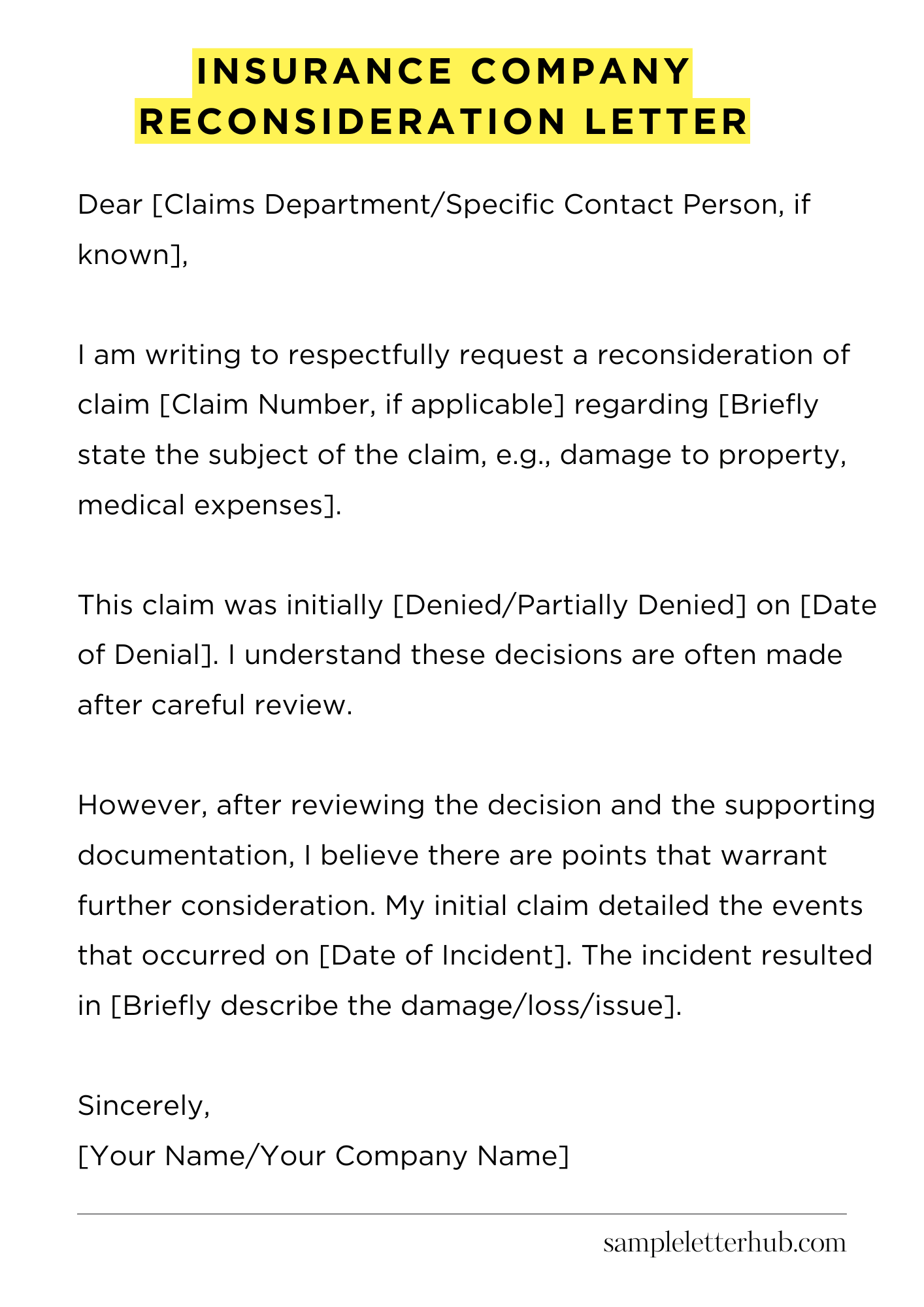
I am writing to respectfully request a reconsideration of claim [Claim Number, if applicable] regarding [Briefly state the subject of the claim, e.g., damage to property, medical expenses]. This claim was initially [Denied/Partially Denied] on [Date of Denial]. I understand these decisions are often made after careful review.
However, after reviewing the decision and the supporting documentation, I believe there are points that warrant further consideration. My initial claim detailed the events that occurred on [Date of Incident]. The incident resulted in [Briefly describe the damage/loss/issue]. This, as you know, has caused a considerable amount of stress.
I have included with this letter additional documentation that I believe strengthens my case. This includes [List the documents you are including, e.g., photographs, repair estimates, medical reports, witness statements]. I have carefully compiled these documents to provide further clarity. I trust this new information will be helpful.
Specifically, I would like to draw your attention to [Mention a specific point from the initial denial and explain why it’s incorrect or needs clarification]. This is an important detail. The provided evidence strongly supports my assertion that [Explain why the claim should be covered]. I’ve taken every precaution.
I am confident that a thorough review of this new information will lead to a different outcome. I understand the complexities involved in claims processing. My hope is that, with these additional details, a more favorable decision can be reached.
I would appreciate it if you could reconsider my claim based on the enclosed information. Please let me know if you require any further documentation or clarification from my side. I’m readily available to help. I can be reached by phone or email at your convenience.
Thank you for your time and attention to this matter.
Sincerely,
[Your Name/Your Company Name]
How to Write an Insurance Company Reconsideration Letter
1. Initiate the Correspondence with a Formal Salutation
Begin your letter with a proper greeting. “Dear [Insurance Company Name] Review Department” is a solid choice. Avoid casual language. A respectful commencement establishes a professional tone from the very genesis of the letter. If you know the name of the claims adjuster, address it personally. This preemptively shows your attentive approach.
2. Explicitly State Your Purpose: Articulating the Core Issue
Clearly state your intention. This is the cornerstone. Succinctly explain that you are writing to request a reconsideration of a previously denied claim. Specify the policy number, date of denial, and any reference numbers associated with the original claim. This preliminary section is crucial; it establishes context and expedites the review process.
3. Present a Compelling Rationale: Unveiling Your Justification
This is where you marshal your argument. Provide a detailed explanation of why you believe the initial denial was incorrect. Substantiate your claims with irrefutable evidence.
This can encompass medical reports, expert opinions, policy excerpts, or any other pertinent documentation. Emphasize the relevant policy provisions and how they support your claim. Remember, thoroughness is key.
4. Assemble Supporting Documentation: The Arsenal of Proof
Meticulously gather all supporting documents. Photocopy everything and retain the originals for your records. Include medical records, bills, statements, photographs, or any other evidence that bolsters your claim.
Present the documents in a logical and organized manner. Categorize them and refer to them explicitly within the body of your letter. This minimizes the risk of ambiguity.
5. Decipher the Policy’s Nuances: Delving into the Fine Print
Thoroughly review your insurance policy. Scrutinize the fine print for any clauses that support your position. Quote relevant sections directly in your letter. Highlight any ambiguities or areas where the policy language might be open to interpretation in your favor. Understanding the nuances of the policy is a decisive edge.
6. Propose a Resolution and Proffer a Course of Action: Charting the Path Forward
Clearly state what resolution you are seeking. Do you want the claim paid in full, partially, or amended? State your expectations plainly. Include a specific request, such as a phone call or a written response. Providing a clear resolution directs the insurance company’s next steps and minimizes misinterpretation. This is crucial for a smooth and efficient resolution.
7. Conclude with a Professional Closing: Securing Your Forte
End your letter professionally. “Sincerely,” or “Respectfully,” are both acceptable closing salutations. Include your full name, address, phone number, and email address. Sign the letter and make a copy for your records. This ensures you maintain a record of your correspondence and allows the insurance company to easily contact you.
FAQs about Insurance Company Reconsideration Letter
What is an Insurance Company Reconsideration Letter?
An insurance company reconsideration letter is a formal written request sent to an insurance provider, typically to dispute a denied claim or request a review of a decision made by the insurer. It serves as an appeal, providing additional information or evidence to support the policyholder’s case and potentially overturn the initial decision.
When Should I Send a Reconsideration Letter?
You should send a reconsideration letter when your insurance claim has been denied, or if you disagree with the settlement amount offered. This is your opportunity to provide further documentation, clarify details, or address any concerns the insurer might have had during the initial assessment.
What Information Should I Include in a Reconsideration Letter?
A strong reconsideration letter should include your policy number, claim number, the date of the denial or unfavorable decision, a clear statement of what you are disputing, detailed explanations supporting your position, any supporting evidence (medical records, photos, witness statements, etc.), and a specific request (e.g., overturn the denial, increase the settlement).
Always be polite and professional.
How Long Does It Take to Get a Response to a Reconsideration Letter?
The time it takes to receive a response varies depending on the insurance company’s procedures and the complexity of your case. However, most insurance companies are required to respond within a reasonable timeframe, which is usually outlined in your policy or by state regulations. It’s often helpful to inquire about the expected turnaround time when submitting your letter.
What Happens if the Reconsideration is Denied?
If your reconsideration letter is denied, it doesn’t necessarily mean the end of the road. You often have the option to escalate your dispute. This may involve filing a formal complaint with your state’s insurance department, pursuing mediation, or, as a last resort, filing a lawsuit. Review your policy and local laws to understand the available options.
Related:
Resignation letter due to rude boss
Resignation letter moving to another state
Resignation letter due to illness of family member
Resignation letter due to study