

Need to submit extra paperwork for your insurance claim? You’ll likely need an insurance claim additional documents submission letter. This letter is your formal way of sending in requested documents to your insurance provider. Its main job is to clearly identify the claim and the attached documents.
We get it. Writing these letters can be a chore. That’s why we’ve got your back. We will provide you with insurance claim additional documents submission letter templates. Consider us your letter-writing sherpas! We provide examples and samples of these letters.
These samples will guide you. Crafting your letter becomes easy. Say goodbye to guesswork. Say hello to clear, concise insurance claim correspondence. Get ready to streamline your documents submission process.
[Your Name/Insurance Company Name (if applicable)]
[Your Address]
[Your City, Postal Code]
[Date]
[Insurance Company Name]
[Insurance Company Address]
[Insurance Company City, Postal Code]
Subject: Submission of Additional Documents for Claim [Claim Number: Your Claim Number]
Dear [Insurance Adjuster Name or “Claims Department”],
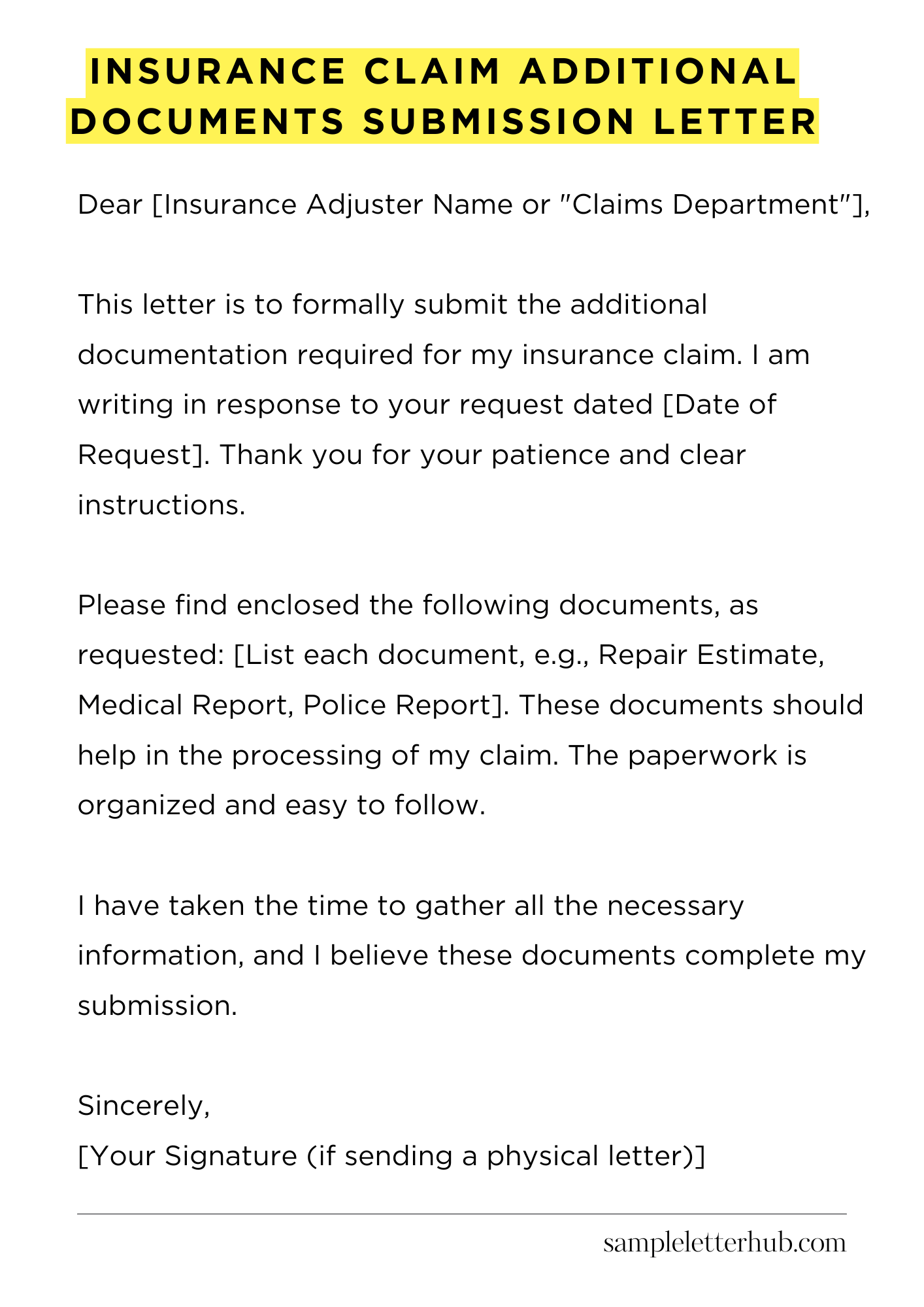
This letter is to formally submit the additional documentation required for my insurance claim. I am writing in response to your request dated [Date of Request]. Thank you for your patience and clear instructions.
Please find enclosed the following documents, as requested: [List each document, e.g., Repair Estimate, Medical Report, Police Report]. These documents should help in the processing of my claim. The paperwork is organized and easy to follow.
I have taken the time to gather all the necessary information, and I believe these documents complete my submission. Everything is accurate and up-to-date. I hope that these documents will allow you to quickly resolve my claim.
I understand the importance of a timely claim settlement and appreciate your efforts. Should you require any further information or clarification, please do not hesitate to contact me. You can reach me at [Your Phone Number] or [Your Email Address]. I am available to help in any way I can.
Thank you very much for your time and consideration. I look forward to your positive response.
Sincerely,
[Your Signature (if sending a physical letter)]
How to Write Insurance Claim Additional Documents Submission Letter
Submitting a claim for insurance coverage can often feel like navigating a bureaucratic labyrinth. Often, the initial documentation isn’t quite enough.
You will inevitably be asked to furnish additional information to buttress your claim. This is where a well-crafted letter comes into play. It’s your advocate, your declaration, your chance to meticulously demonstrate the validity of your request. This guide will help you produce a potent letter, increasing your prospects for a favorable resolution.
1. Commence with the Foundation: The Heading and Salutation
Begin with the essentials. At the apex of your letter, clearly state your full name, address, phone number, and email address. Below this, on the left side, include the date. On the right, directly under the date, write the name and address of the insurance company or the specific claims adjuster.
The salutation should be formal. “Dear Mr./Ms./Mx. [Last Name]” is generally appropriate. If you are unsure of the addressee’s name, use a general greeting like “Dear Claims Department.” This will establish decorum and demonstrate respect for the process.
2. The Subject Line: Precision is Paramount
The subject line is your digital handshake. Make it explicit and succinct. Include the insurance policy number, the claim number (if you have it), and a brief, descriptive phrase.
For instance, “Subject: Policy # ABC12345 – Claim # 67890 – Additional Documents Submission.” This immediate identification streamlines the process, ensuring the recipient quickly understands the letter’s purpose. This small detail can significantly expedite the processing of your submission.
3. Articulate the Core: The Body of the Letter
The body of your letter is where you will do the heavy lifting. Start by restating the purpose of your communication. Clearly state that you are submitting additional documentation as requested. Then, offer a concise explanation of the documents and their relevance to your claim. You must be specific.
This is not the time for vagueness. You have to clearly explain which documents are attached and why they are necessary to support your claim. Use brief, digestible paragraphs, making it easy for the claims adjuster to follow your arguments. Maintain a professional tone throughout the text.
4. Itemize for Clarity: The Document Listing
In a separate paragraph, construct a bulleted list to itemize each document you are submitting. This format enhances clarity and ensures that the claims adjuster doesn’t overlook anything. Include the document’s name and a brief description of its content. For example:
- Medical Report: Detailed findings and diagnosis from Dr. Smith.
- Repair Estimate: Cost breakdown for the damage to the vehicle.
- Photos: Photographic evidence of the accident damage.
This structured listing makes it easy for the recipient to cross-reference the submitted documents against their request.
5. Reinforce the Plea: The Concluding Statement
Reiterate your request, concisely. Express your hope for a positive resolution and a swift processing of your claim. Thank the claims adjuster for their time and consideration.
End with a professional closing, such as “Sincerely” or “Respectfully,” followed by your full name. This final touch leaves a professional impression.
6. Ensure Imperviousness: Proofreading and Review
Before dispatching your letter, meticulously proofread it. Check for any grammatical errors, typos, or factual inaccuracies. Review the content for clarity and accuracy.
It’s often beneficial to have a second pair of eyes review the letter. A fresh perspective can catch errors that you might have missed. Proofreading is your final opportunity to guarantee that your message is perfect.
7. Document Delivery: The Logistics of Submission
Decide the method of delivery. Consider sending your letter via certified mail with return receipt requested. This provides proof of delivery and acknowledgement, which can be invaluable if any dispute arises.
Retain a copy of your letter and all submitted documents for your records. This creates an organized audit trail, safeguarding you from potential complications. Keep it safe in case you require it later on.
FAQs about Insurance Claim Additional Documents Submission Letter
What is an “Insurance Claim Additional Documents Submission Letter” and why is it necessary?
An “Insurance Claim Additional Documents Submission Letter” is a formal communication sent to an insurance provider to submit documents that are needed to support an insurance claim.
It’s necessary because insurance companies often require specific documentation to verify the details of a claim, assess the validity of the claim, and determine the amount of compensation, if any, to be paid.
This could include documents like invoices, medical records, police reports, or any other paperwork relevant to the claim. The letter serves as a record of the submission and helps to ensure that the required information is provided efficiently and correctly.
What information should be included in an Insurance Claim Additional Documents Submission Letter?
A comprehensive Insurance Claim Additional Documents Submission Letter should include: your name and contact information (address, phone number, email), the insurance company’s name and address, the policy number associated with the claim, the claim number (if already assigned).
How should I submit the Insurance Claim Additional Documents and the letter?
The method of submission can vary depending on the insurance company’s policies. Generally, options include: mail, email, or an online portal. Always adhere to the insurance company’s specific instructions.
If submitting by mail, use certified mail with return receipt requested to maintain proof of delivery. If submitting electronically, ensure you retain copies of the email and attachments for your records. For online portals, follow the provided guidelines carefully.
What if I am missing a document listed in the request for additional documentation?
If you are unable to provide a document listed in the request for additional documentation, it is critical to contact the insurance company as soon as possible. Explain the situation and why the document is unavailable.
In some cases, the insurer may accept alternative documentation, or they may adjust their requirements. Provide as much relevant supporting information as you have, even if the requested document is missing. Open communication is key to avoid delays or potential claim denial.
How long will it take for the insurance company to process my claim after I submit the additional documents?
The processing time varies depending on the insurance company, the complexity of the claim, and the volume of claims being handled. However, most insurance companies aim to process claims promptly.
After submitting the additional documents, inquire about the expected processing timeframe. Keep records of all communications, including the submission letter and any replies you receive. If the process appears to be taking an unreasonably long time, follow up with the insurance company to check on the status of the claim.
Related:
Resignation letter due to rude boss
Resignation letter moving to another state
Resignation letter due to illness of family member
Resignation letter due to study