

Dealing with insurance overcharging can be a headache. An insurance cancellation letter for overcharging is a formal way to tell your insurance company you want to cancel your policy. The main goal? To stop paying those inflated insurance premiums. It’s your right to dispute unfair charges.
You’re not alone in this fight. This article equips you. We’ll provide ready-to-use sample insurance cancellation letters. These examples cover different scenarios. Whether it’s car insurance or home insurance, we’ve got you covered.
Our templates simplify the process. They make it easier to cancel insurance due to overcharging. You’ll find examples and guidance. Get ready to draft your own clear and effective insurance cancellation letter.
[Your Name]
[Your Address]
[Your Phone Number]
[Your Email Address]
[Date]
[Insurance Company Name]
[Insurance Company Address]
Subject: Cancellation of Insurance Policy and Dispute of Overcharging
Dear Sir or Madam,
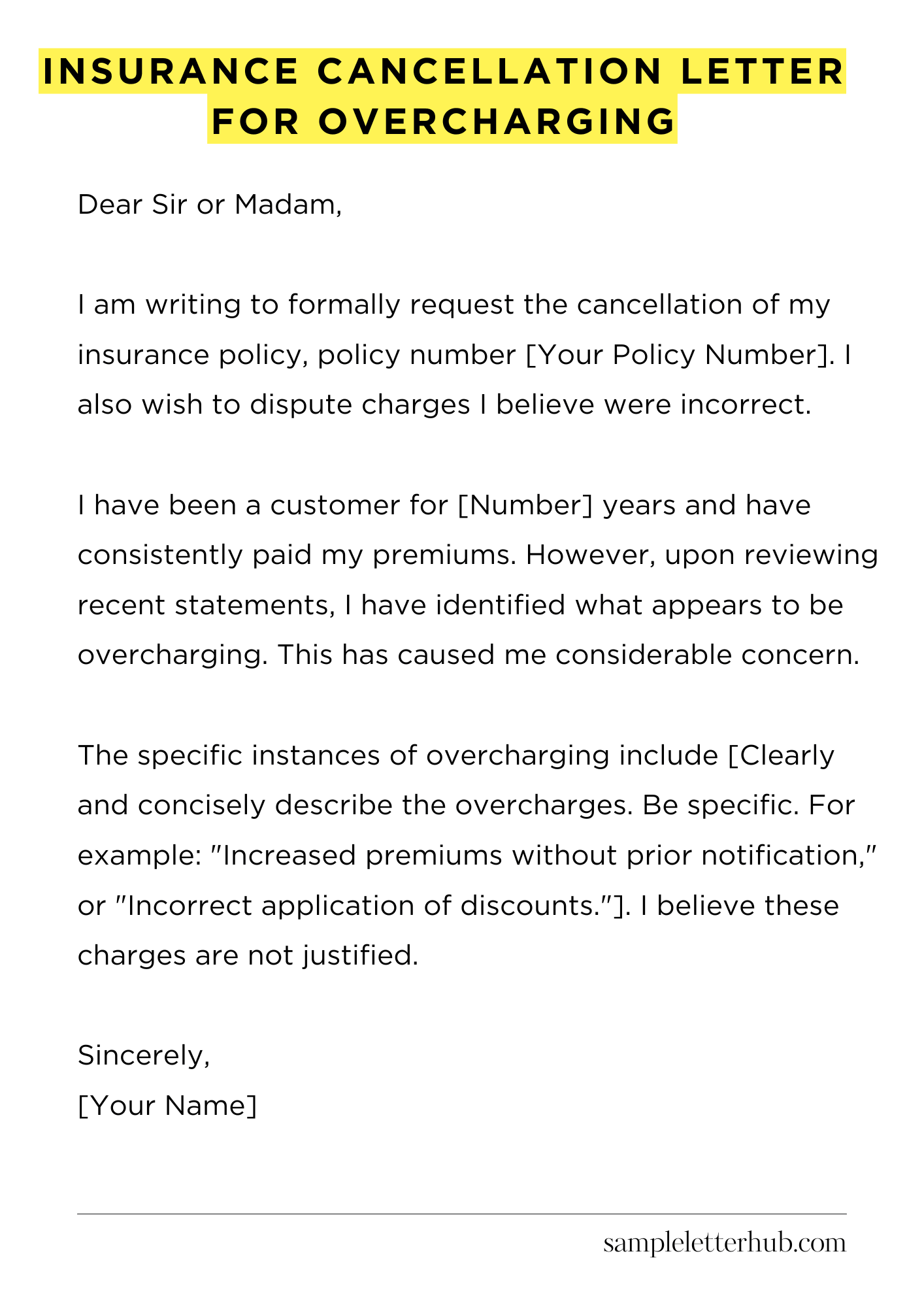
I am writing to formally request the cancellation of my insurance policy, policy number [Your Policy Number]. I also wish to dispute charges I believe were incorrect.
I have been a customer for [Number] years and have consistently paid my premiums. However, upon reviewing recent statements, I have identified what appears to be overcharging. This has caused me considerable concern.
The specific instances of overcharging include [Clearly and concisely describe the overcharges. Be specific. For example: “Increased premiums without prior notification,” or “Incorrect application of discounts.”]. I believe these charges are not justified. This has led to an inflated amount deducted from my account, as detailed in my attached statement.
I have attached copies of my bank statements and policy documents to support my claim. You can review this for verification.
I would like the cancellation to be effective immediately. Please confirm the cancellation date in writing.
Furthermore, I request a full refund of the overcharged amount. I expect this refund to be processed and credited to my account within [Number] business days.
I look forward to your prompt attention to this matter. I am available to discuss this further at your convenience. You can reach me at the phone number or email address listed above.
Thank you for your time and consideration.
Sincerely,
[Your Name]
How to Write Insurance Cancellation Letter for Overcharging
You’ve received your insurance bill, and something seems amiss. You’re being overcharged. Your course of action should be clear: you must pen a well-crafted insurance cancellation letter. This can be a daunting prospect, but with a bit of forethought, you can navigate this process with efficacy.
This guide will walk you through, step-by-step, the creation of a letter designed to not only cancel your policy but also to reclaim your unfairly levied funds.
1. Initiate: The Salutation and Recipient
Begin your missive with a formal salutation. Employ a professional tone; avoid informalities. Address the letter to the appropriate entity: typically, this is the underwriter or claims department, not merely a sales representative.
If the policy documentation is ambiguous, then conduct a modicum of preliminary research to ascertain the correct recipient. Be sure to include their official title. For example: “Dear Claims Adjuster,” or “To Whom It May Concern:”.
2. Proclaim Your Intent: The Core Statement
The first paragraph needs to be a concise and direct declaration of your intent. State clearly that you are writing to cancel your insurance policy due to overcharging. Include your policy number, as this is critical for identification. State the precise reason for the cancellation, clearly articulating your grievance. Use direct language. Avoid ambiguity or circumlocution.
3. Deconstructing the Overcharge: Explication of the Discrepancy
This is where you elucidate the crux of your complaint. Provide comprehensive details regarding the overcharge. Precisely cite the specific amount, detailing how it deviates from what you believe is accurate. Refer to any documentation – previous bills, policy agreements, or communications – that substantiates your claim.
This section is vital. Be factually accurate, and present your case in a logical sequence. The more clearly you lay out your case, the higher the prospects of a favorable outcome. Avoid emotional language; maintain an objective, dispassionate tone.
4. Documentation and the Evidential Arsenal: Compiling Your Support
Include copies of all supporting documentation. This may encompass premium notices, payment records, and any correspondence related to the policy. Explicitly state the documents you are enclosing. Do not send originals; keep those for your records. Organize everything meticulously for clarity. This is essential to fortify your case.
5. Demands and Imperatives: The Remediation Process
Clearly state what you seek as a remedy. Do you want a refund? Specify the precise amount. Stipulate a reasonable deadline for a response. Assert your right to legal recourse if the matter is not resolved satisfactorily within the established timeframe. Be assertive but polite.
6. The Conclusion and Formalities: Closure and Signatories
Conclude your letter with a formal closing. Employ a standard phrase such as “Sincerely,” or “Respectfully,” followed by your full legal name. Sign the letter manually, and type your name below the signature. If you want to include your contact details, include them below.
7. Delivery and Record Keeping: The Archival Process
Send the letter via certified mail, return receipt requested. This provides proof of delivery and acknowledgement. Retain a copy of the letter, along with all supporting documentation, and the postal receipt, for your records.
This serves as your evidence should you need to escalate the situation further. This step is an imperative safeguard against potential future disputes.
FAQs about Insurance Cancellation Letter for Overcharging
What is the primary purpose of an insurance cancellation letter due to overcharging?
The primary purpose of an insurance cancellation letter due to overcharging is to formally request the termination of an insurance policy because the insured party believes they have been charged incorrectly.
This letter serves as a legal record of the insured’s intention to cancel the policy based on a specific grievance and often includes supporting documentation to substantiate the claim of overcharging.
What specific details should be included in an insurance cancellation letter for overcharging?
An effective insurance cancellation letter for overcharging should contain key information. It must include the policyholder’s full name, address, and policy number. Crucially, it should detail the specific instances of overcharging, the amounts involved, and the dates of the incorrect charges.
The letter should clearly state the reason for cancellation (overcharging), the desired date of cancellation, and any supporting documentation (e.g., bank statements, billing statements). Finally, it’s essential to request a refund for the overcharged amount, if applicable, and provide instructions on how to receive the refund.
What supporting documentation is typically needed when canceling an insurance policy due to overcharging?
To strengthen the claim of overcharging, the cancellation letter should be accompanied by relevant supporting documentation.
This typically includes copies of insurance bills or statements that show the incorrect charges, bank or credit card statements demonstrating payments made, and any prior communication with the insurance company regarding the billing discrepancies.
Gathering this documentation provides concrete evidence to support the claim, increasing the likelihood of a successful cancellation and refund.
What are the potential consequences of canceling an insurance policy due to overcharging?
The consequences of canceling an insurance policy depend on various factors. If the overcharging claim is validated, the insured may receive a full or partial refund of the overcharged amount.
However, there might be implications if the cancellation leaves the policyholder uninsured. It’s crucial to understand any potential cancellation fees as outlined in the policy terms.
Additionally, canceling an insurance policy could affect coverage continuity. If a new policy is needed, the policyholder should ensure coverage overlaps to avoid a lapse in protection. Legal or regulatory actions may also be pursued depending on the extent of the overcharging and the insurance provider’s response.
How should the cancellation letter be delivered to the insurance company?
The cancellation letter should be delivered to the insurance company in a way that provides proof of receipt. Certified mail with return receipt requested is highly recommended.
This provides documented proof that the letter was received and when, which is crucial in case of disputes. Electronic methods, such as email, can be used but should be accompanied by a delivery confirmation and a request for a formal acknowledgment of receipt from the insurance company to ensure the message was received.
Related:
Resignation letter due to rude boss
Resignation letter moving to another state
Resignation letter due to illness of family member
Resignation letter due to study