

So, you sold your car! Now, you need an insurance cancellation letter after car sold. This letter is crucial. It tells your insurance company you no longer need coverage. Its main purpose is to officially stop your policy. This prevents unwanted charges and ensures a smooth transition.
Writing this letter doesn’t have to be a hassle. We understand. That’s why we’re here to help you. We have crafted different insurance cancellation letter after car sold templates. You will find several examples. These samples are here to simplify the process.
Our goal is to give you a head start. Use these insurance cancellation letter samples. Adapt them as needed. Writing this letter should be quick and stress-free. Let’s get started. Get ready to easily cancel your car insurance!
[Your Name]
[Your Address]
[Your Phone Number]
[Your Email Address]
[Date]
[Insurance Company Name]
[Insurance Company Address]
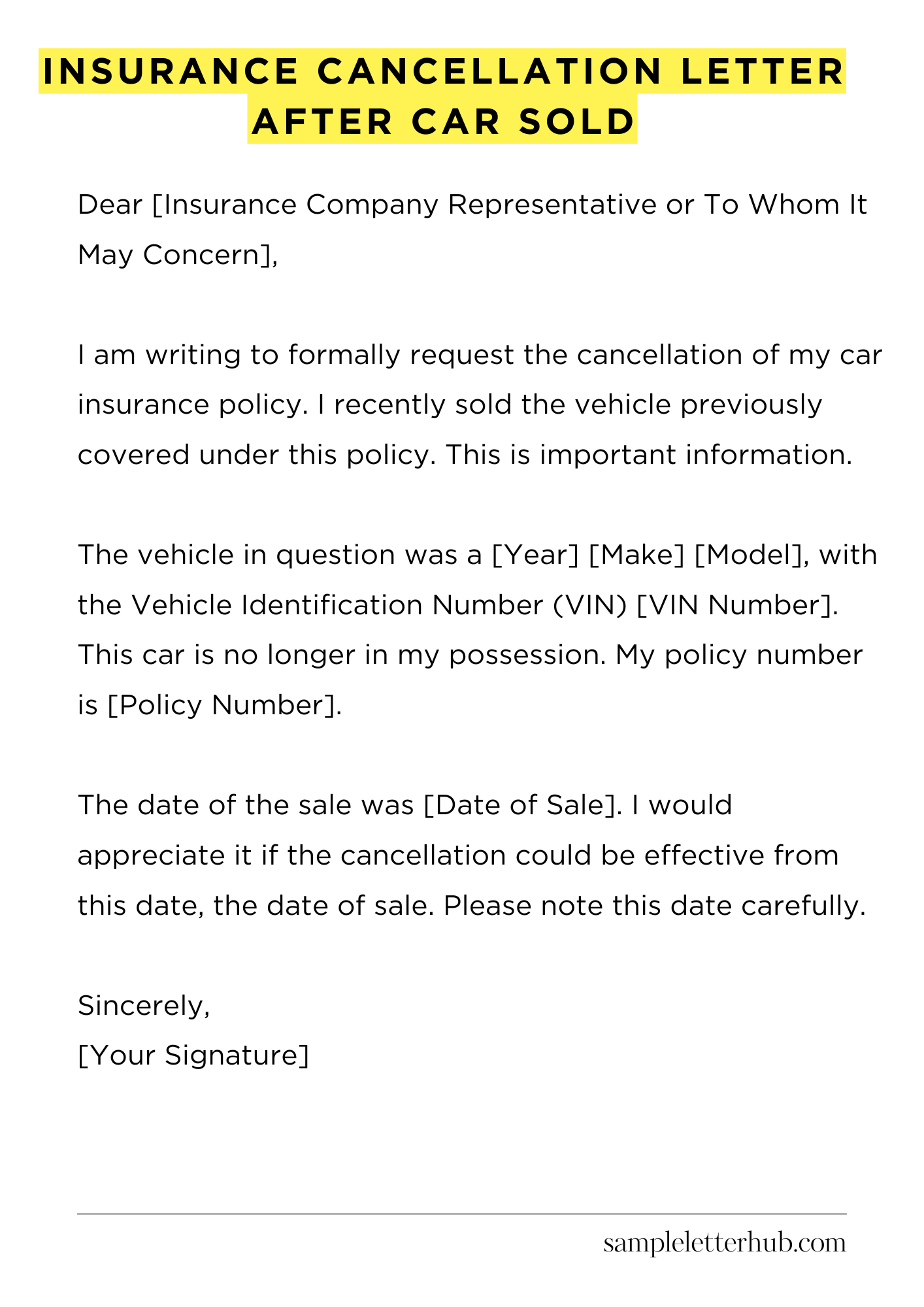
Dear [Insurance Company Representative or To Whom It May Concern],
I am writing to formally request the cancellation of my car insurance policy. I recently sold the vehicle previously covered under this policy. This is important information.
The vehicle in question was a [Year] [Make] [Model], with the Vehicle Identification Number (VIN) [VIN Number]. This car is no longer in my possession. My policy number is [Policy Number].
The date of the sale was [Date of Sale]. I would appreciate it if the cancellation could be effective from this date, the date of sale. Please note this date carefully.
Could you please confirm the cancellation in writing, along with details of any potential refund due? I would like to receive any refund by [Preferred Method of Refund, e.g., check, direct deposit]. Please send the confirmation to the address provided above. This is crucial for my records.
Thank you for your prompt attention to this matter. I look forward to receiving confirmation soon. I appreciate your assistance.
Sincerely,
[Your Signature]
How to Write Insurance Cancellation Letter After Car Sold
Selling your car is a significant life event, and one crucial follow-up is canceling your associated auto insurance policy. Failure to do so can result in unwarranted premium payments and potential legal entanglements. This guide provides a meticulous roadmap to ensure a hassle-free cancellation process.
1. Initiate the Preliminaries: Gearing Up for the Task
Before you even begin composing the letter, some preliminary steps are essential. First and foremost, you’ll need the policy number. Locate this critical piece of information on your insurance declarations page or any previous correspondence from your insurer. Gather details about the car sale.
This includes the date of the transaction and, if applicable, the new owner’s information. Furthermore, ascertain the insurer’s preferred communication method – is it via email, postal mail, or a dedicated online portal? Researching this beforehand will streamline the whole process.
2. Drafting the Correspondence: Constructing the Communication
Now, let’s proceed to the letter’s composition. Start with a formal salutation; use “Dear [Insurance Company Name] or the name of the representative to whom the communication is addressed.”
Then, clearly state your intent: to cancel your auto insurance policy. Include your policy number prominently. State the precise date of the vehicle’s sale. If available, the new owner’s name and contact information are a prudent inclusion.
3. The Body of the Letter: Articulating the Core Message
The body of your letter is where you expand upon the basics. Specify the date from which you desire the cancellation to be effective. Generally, this will coincide with the sale date.
Expressly request a refund for any unused premiums, if applicable. A polite yet assertive tone is paramount. You are not begging; you are informing. Make a decisive statement that the car is no longer under your ownership and therefore, the policy is superfluous.
4. Attaching Necessary Documentation: Fortifying Your Request
To fortify your request and expedite the process, enclose supporting documentation. A copy of the vehicle’s bill of sale is indispensable. This document serves as undeniable proof of the transfer of ownership. If your state requires it, include a notice of release of liability.
This will safeguard you from any potential legal implications arising from the vehicle’s subsequent use. Submitting this paperwork demonstrates diligence and eliminates potential ambiguity.
5. Review and Refine: Scrutinizing the Letter for Precision
Before dispatching your letter, take a moment for critical self-assessment. Proofread meticulously. Are there any grammatical errors or typos? Is the tone professional and clear?
Verify the accuracy of all dates, policy numbers, and other details. Ensure that all the aforementioned attachments are included. Consider getting a second pair of eyes to provide objective feedback. Accuracy is key to mitigating potential complications.
6. Delivery and Confirmation: Ensuring Safe Passage and Acknowledgement
Depending on the insurer’s preferred method, send the letter via certified mail with a return receipt requested. This provides definitive proof of delivery and acknowledgement.
If sending electronically, consider requesting a read receipt. If you are submitting online through a dedicated portal, save the confirmation for your records. This provides documented evidence of your actions. Keep all documentation – the letter, the receipt, and any confirmation you receive. Maintaining meticulous records will safeguard you against future disputes.
7. Follow-Up and Verification: Closing the Loop and Confirming Cancellation
Allow a reasonable timeframe for the insurance company to process your request. If you haven’t received confirmation or a refund within the stipulated period, initiate a follow-up.
Contact the insurance company directly, referencing your previous communication and providing the tracking information from your certified mail. Confirm the cancellation date and the status of any potential refund. This proactive approach ensures a final and successful resolution to your request.
FAQs about Insurance Cancellation Letter After Car Sold
Why is it necessary to send an insurance cancellation letter after selling a car?
Sending an insurance cancellation letter is crucial to officially notify your insurance provider that you no longer own the vehicle. This prevents unwanted charges, potential liability issues, and ensures you receive any due refunds for unused premiums.
It provides a documented record of the policy termination date, protecting you from future claims related to the sold vehicle.
What information should be included in an insurance cancellation letter?
An effective cancellation letter should include your full name, address, and policy number. Clearly state the vehicle’s details (make, model, and VIN) and the date of sale. Indicate the desired effective date of cancellation, often the date of the sale, and provide the buyer’s information if required by your insurance provider. Finally, request confirmation of cancellation in writing.
How do I send the insurance cancellation letter, and what is the best method?
You can typically send the letter via certified mail, email, or through the insurance company’s online portal if available. Certified mail provides proof of delivery. Email is convenient but ensure you receive a read receipt or confirmation of receipt.
Check your insurance policy for their preferred method of communication and follow their instructions to ensure the cancellation is processed correctly and efficiently.
Will I receive a refund after canceling my car insurance after the car is sold?
Yes, you are generally entitled to a refund for the unused portion of your insurance premium. The refund amount will be calculated from the effective date of cancellation until the end of the policy term.
The insurance company will usually issue the refund to you after the cancellation is processed. The specifics, such as the method of refund (check, electronic transfer), are detailed in your insurance policy.
How long does it take for the insurance cancellation to be processed?
The processing time can vary depending on the insurance company’s policies and procedures. In most cases, it takes a few days to a couple of weeks to finalize the cancellation. However, ensure you receive written confirmation of the cancellation from your insurance provider, which confirms the effective date. Keep this confirmation for your records.
Related:
Resignation letter due to rude boss
Resignation letter moving to another state
Resignation letter due to illness of family member
Resignation letter due to study