

An instructional coach resignation letter is a formal document. It announces your departure from your role. Its purpose is to officially inform your employer about your resignation. It also communicates your last day of employment.
So, you’re looking to move on from your instructional coaching position? You’re in the right place! We understand the need for a well-crafted resignation. That’s why we’ve prepared examples. We’ll give you different templates to get you started.
We have various samples and formats. You can adapt them to your specific situation. This article makes your resignation process easier. Craft your letter with confidence!
Instructional Coach Resignation Letter
Below is a sample of a Instructional Coach Resignation Letter:
[Your Name]
[Your Address]
[Your Phone Number]
[Your Email Address]
[Date]
[Principal’s Name]
[School Name]
[School Address]
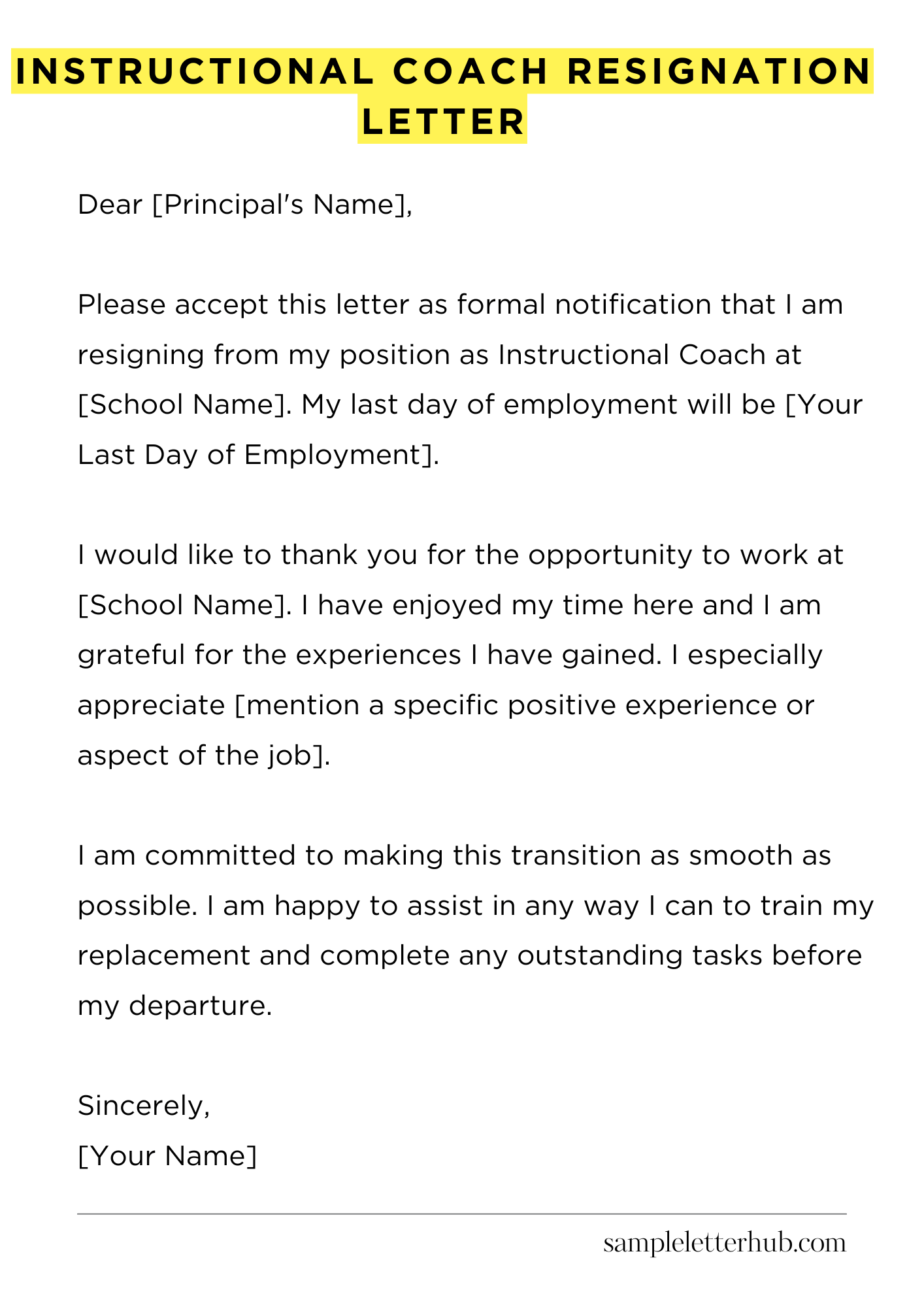
Dear [Principal’s Name],
Please accept this letter as formal notification that I am resigning from my position as Instructional Coach at [School Name]. My last day of employment will be [Your Last Day of Employment].
I would like to thank you for the opportunity to work at [School Name]. I have enjoyed my time here and I am grateful for the experiences I have gained. I especially appreciate [mention a specific positive experience or aspect of the job].
I am committed to making this transition as smooth as possible. I am happy to assist in any way I can to train my replacement and complete any outstanding tasks before my departure.
I wish you and [School Name] all the best in the future.
Sincerely,
[Your Name]
How to Write an Instructional Coach Resignation Letter
1. Why You Need a Resignation Letter (And Why It Matters)
So, you’ve made the decision. You’re moving on from your role as an instructional coach. Congratulations! Now it’s time to handle the official business – the resignation letter.
This isn’t just a formality. It’s an important document. It’s your opportunity to leave a lasting impression. Think of it as your final professional statement in this position.
A well-crafted letter can pave the way for a positive future. It ensures a smooth transition for everyone involved. A poor one, on the other hand, could create unnecessary tension. Make the smart choice and write it properly.
2. The Essential Ingredients: What to Include
Don’t overthink it, but don’t undershoot either. A solid resignation letter should be concise, professional, and clear. First, you’ll want a clear and direct statement of your intent.
State that you are resigning from your position as Instructional Coach. Next, specify your last day of employment. This is crucial for planning purposes. Then, show appreciation.
Thank your supervisor or the school district for the opportunity. Briefly mention any positive experiences or growth you had. Avoid dwelling on negatives. Keep it professional. Finally, consider offering assistance with the transition. Offering to help with training or documentation is a nice gesture.
3. Structure for Success: Formatting Your Letter
Presentation matters. Your resignation letter should look clean and professional. Start with your contact information. Include your name, address, phone number, and email.
Then, add the date. Next, address the letter to your direct supervisor or the appropriate administrator. Use a professional salutation like “Dear Mr./Ms. [Last Name]”.
Keep the body of the letter brief and to the point. Use clear language and avoid jargon. Close with a formal closing, such as “Sincerely” or “Respectfully,” followed by your full name. Proofread meticulously! Typos and grammatical errors undermine your professionalism.
4. Crafting the Tone: Staying Professional and Positive
This is not the time for venting or settling scores. Maintain a professional tone throughout the letter. Focus on the positives, even if your experience wasn’t entirely perfect.
Avoid negative comments about the school, colleagues, or administration. If you have specific reasons for leaving, it’s generally best to keep them brief and general (e.g., “to pursue new opportunities” or “to focus on personal commitments”).
Maintain a tone of gratitude. This leaves a good final impression. Think about how you want to be remembered. Remember, you might need a reference in the future.
5. Beyond the Basics: Adding Value and Saying Goodbye
Consider offering your help with the transition. This is a classy move that can be very helpful to your former colleagues. You might offer to assist in training your replacement or preparing documentation.
If appropriate, you could also provide a brief summary of your key accomplishments in the role. Finally, express your best wishes for the future of the school or district. A brief, positive closing statement can be very impactful. Always remember to keep a copy of your letter for your records. Then, submit it and move forward with confidence.
FAQs about Instructional Coach resignation letter
Here are five frequently asked questions regarding instructional coach resignation letters, providing concise and informative answers to guide you.
What essential information should I include in my Instructional Coach resignation letter?
Your resignation letter should clearly state your intent to resign, the effective date of your resignation, and your formal position. It’s also customary to express gratitude for the opportunity and mention any required handover plans. Optional elements include a brief, positive statement about your experience and well wishes for your colleagues and the school.
How far in advance should I submit my Instructional Coach resignation letter?
Typically, a minimum of two weeks’ notice is standard practice, but it’s essential to check your employment contract or school district’s policy. Providing more notice, such as a month, can be beneficial, especially if your role involves complex projects or significant responsibilities.
Should I provide a reason for resigning in my resignation letter?
While not mandatory, it’s generally acceptable to briefly state a reason for your departure if you choose. Keep it concise and positive, focusing on future opportunities or personal circumstances. Examples include pursuing a new career, relocating, or seeking personal growth. Avoid negative comments about the school or colleagues.
What is the appropriate tone for an Instructional Coach resignation letter?
Maintain a professional and respectful tone throughout the letter. Express gratitude for the opportunities you’ve been given, and focus on leaving a positive impression. Avoid negativity or complaints, and keep the language clear, concise, and formal.
How should I handle the handover of my responsibilities as an Instructional Coach?
Your resignation letter should briefly acknowledge your willingness to assist with a smooth transition. Be prepared to create a handover document outlining ongoing projects, responsibilities, and contacts. Collaborate with your supervisor to ensure the transition of your duties is seamless and consider offering training or support to your replacement if applicable.
Related:
Resignation letter due to rude boss
Resignation letter moving to another state
Resignation letter due to illness of family member
Resignation letter due to study