

Ready to move on from your inside sales role? You’ll need an Inside Sales Representative resignation letter. This letter formally informs your employer of your departure. It officially ends your employment.
Crafting the perfect resignation letter can be tricky. It needs to be professional and clear. No worries, though! We’ve got you covered.
We’ve compiled several templates and examples. Use them as inspiration. Customize them to fit your situation. Get ready to write a letter that says it all.
Inside Sales Representative Resignation Letter
Below is a sample of a Inside Sales Representative Resignation Letter:
[Your Name]
[Your Address]
[Your Phone Number]
[Your Email Address]
[Date]
[Hiring Manager Name] (If known, otherwise use title)
[Hiring Manager Title]
[Company Name]
[Company Address]
Dear [Mr./Ms./Mx. Last Name or Hiring Manager Title],
Please accept this letter as formal notification that I am resigning from my position as Inside Sales Representative at [Company Name], effective two weeks from today, [Your Last Day of Employment].
I would like to thank you for the opportunity to work at [Company Name]. I have learned a great deal during my time here and appreciate the experience I have gained.
I am committed to ensuring a smooth transition during my departure. I am happy to assist in training my replacement and completing any outstanding tasks to the best of my ability.
I wish you and [Company Name] all the best in the future.
Sincerely,
[Your Signature]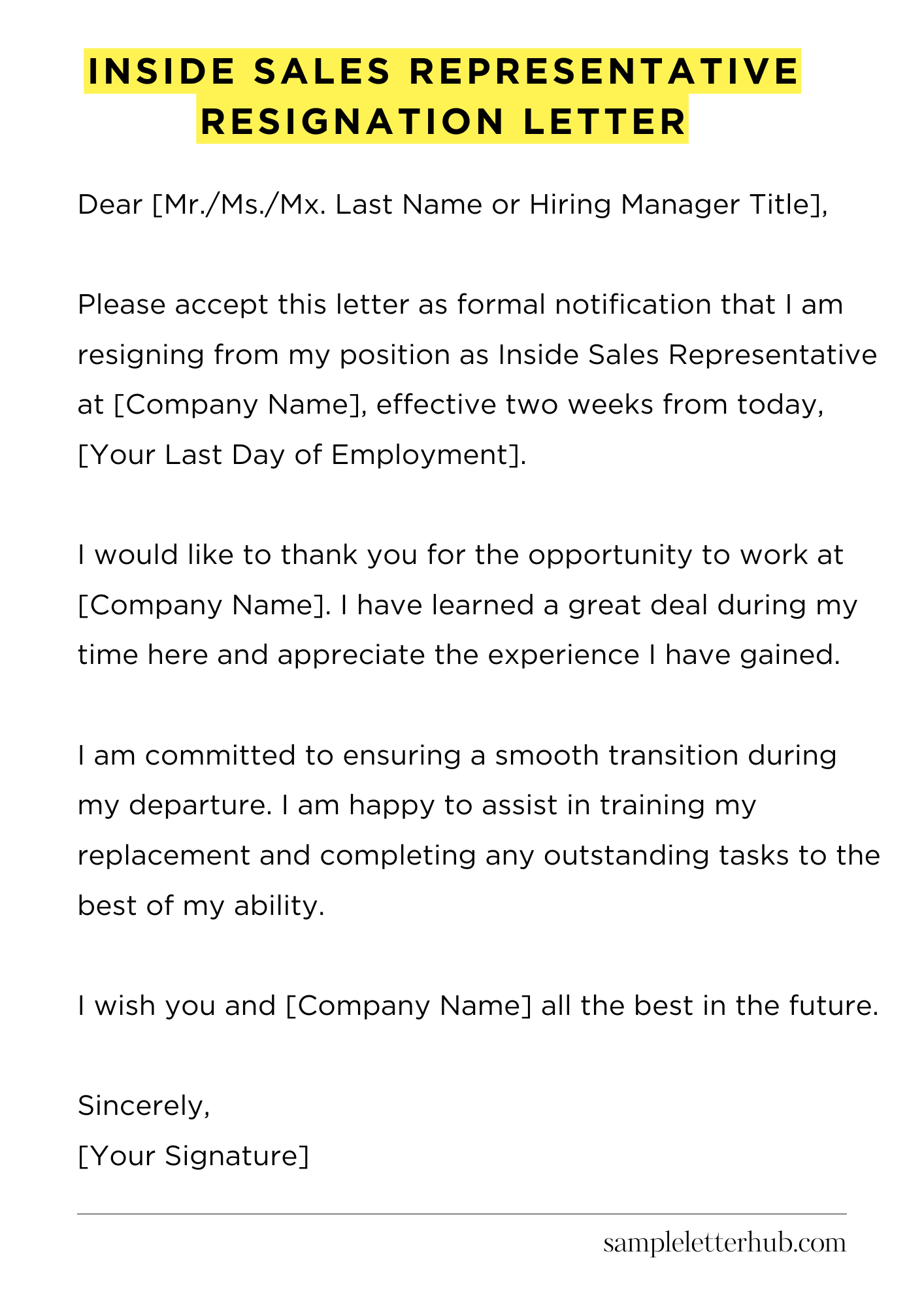
How to Write Inside Sales Representative Resignation Letter
Resigning from a job is a big step. As an Inside Sales Representative, you’ve likely spent a considerable amount of time building relationships and hitting targets.
When it’s time to move on, crafting a professional resignation letter is essential. This letter serves as your formal notice and helps maintain a positive relationship with your employer. Let’s break down how to write a resignation letter that leaves a good impression.
1. The Core Components: What to Include
Every effective resignation letter should include a few key elements. First, state your intention to resign clearly. You need to make it obvious. The next important part is the effective date of your resignation. This is the date your employment officially ends. Be sure to reference any employment agreements regarding notice periods.
Generally, two weeks’ notice is standard. Next, express your gratitude for the opportunity. Briefly acknowledge any experience or skills gained during your tenure. Finally, keep it brief and professional. Don’t go into lengthy explanations or negative commentary.
2. Structure is Key: Formatting Your Letter
Good formatting goes a long way. Start with your contact information, followed by the date, and then the recipient’s information. Use a formal business letter format. A friendly salutation, like “Dear [Manager’s Name],” is best. The body of the letter should be concise, around three to four paragraphs max.
Keep your language clear and to the point. Proofread carefully before sending to avoid any errors. Simple font like Arial or Times New Roman works perfectly.
3. Content Creation: Writing the Perfect Sentences
Now, let’s look at crafting the actual sentences. Begin with a clear statement of your resignation, mentioning your job title. For example: “Please accept this letter as formal notification that I am resigning from my position as Inside Sales Representative, effective [Date].” Next, express your appreciation.
You might write, “Thank you for the opportunity to have worked at [Company Name] for the past [Number] years/months.” Keep it genuine. Briefly mention any positive experiences or skills you’ve developed. Avoid sharing too many details about your new job. Keep the focus on the company you are leaving.
4. Dos and Don’ts: Maintaining Professionalism
There are a few things to avoid in your resignation letter. Do not include negative comments about your current employer, colleagues, or reasons for leaving that could damage your professional reputation. Don’t burn bridges. Don’t get emotional. Keep your letter factual and focused on the essentials.
Do offer to help with the transition. You can include a statement like, “I am happy to assist with the transition of my duties during my remaining time here.” Always maintain a positive and professional tone. Remember, you never know when your paths might cross again.
5. Finalizing and Delivering: The Last Step
Before submitting, proofread everything. Check for grammatical errors, spelling mistakes, and ensure the tone is appropriate. Once you are satisfied with the content, print the letter. Deliver it to your manager in person if possible. In this age of digital media, always retain a copy for your records.
Consider sending a digital copy via email, too. This provides another record of your communication. Following these steps helps ensure a smooth and respectful departure.
FAQs about Inside Sales Representative resignation letter
How do I start an Inside Sales Representative resignation letter?
Begin your letter by clearly stating your intention to resign from your position as an Inside Sales Representative. Include the date you are writing the letter and the date your resignation will be effective. Address the letter to your direct supervisor or the appropriate HR representative. Keep the tone professional and respectful.
What essential information should I include in my resignation letter?
Your resignation letter should include your official resignation date, your current job title (Inside Sales Representative), and a concise and professional statement of your decision to leave. You might also want to briefly express your gratitude for the opportunity to work at the company, but this is optional. Contact information (email) for any further communication.
Should I provide a reason for my resignation in the letter?
You are not obligated to provide a detailed reason for your resignation. However, you can offer a brief explanation if you wish. This could be as simple as “pursuing other opportunities” or “seeking a new career path.” Avoid negative comments about your current employer or colleagues. If you are comfortable, you can share a reason, but it is not essential.
How can I express my gratitude in my resignation letter?
Expressing gratitude is a good practice. You can thank your employer for the opportunity to work at the company and for the experience you gained. You might acknowledge any specific skills you developed or positive experiences you had. Keep the sentiment genuine and concise. This can help maintain a positive relationship with your former employer.
Is it necessary to offer assistance during the transition period?
Offering to assist with the transition is a professional courtesy. You can state your willingness to help train your replacement, transfer your accounts, or provide any other relevant information to ensure a smooth handover.
This demonstrates professionalism and a commitment to ensuring a positive experience for both the company and your colleagues. This can also leave a good lasting impression.
Related:
Resignation letter due to rude boss
Resignation letter moving to another state
Resignation letter due to illness of family member
Resignation letter due to study