

An Information Systems Manager resignation letter is a formal document. It announces your departure from your current role. This letter is your official notice to your employer.
Leaving a job can be tricky. Writing the right resignation letter is important. We’ve got you covered. This article offers sample letters.
Need to resign? Our samples provide a great starting point. Use these templates. Customize them to fit your situation. Craft your letter with confidence!
Information Systems Manager Resignation Letter
Below is a sample of a Information Systems Manager Resignation Letter:
[Your Name]
[Your Address]
[Your Phone Number]
[Your Email Address]
[Date]
[Hiring Manager Name] (If known, otherwise use title)
[Hiring Manager Title]
[Company Name]
[Company Address]
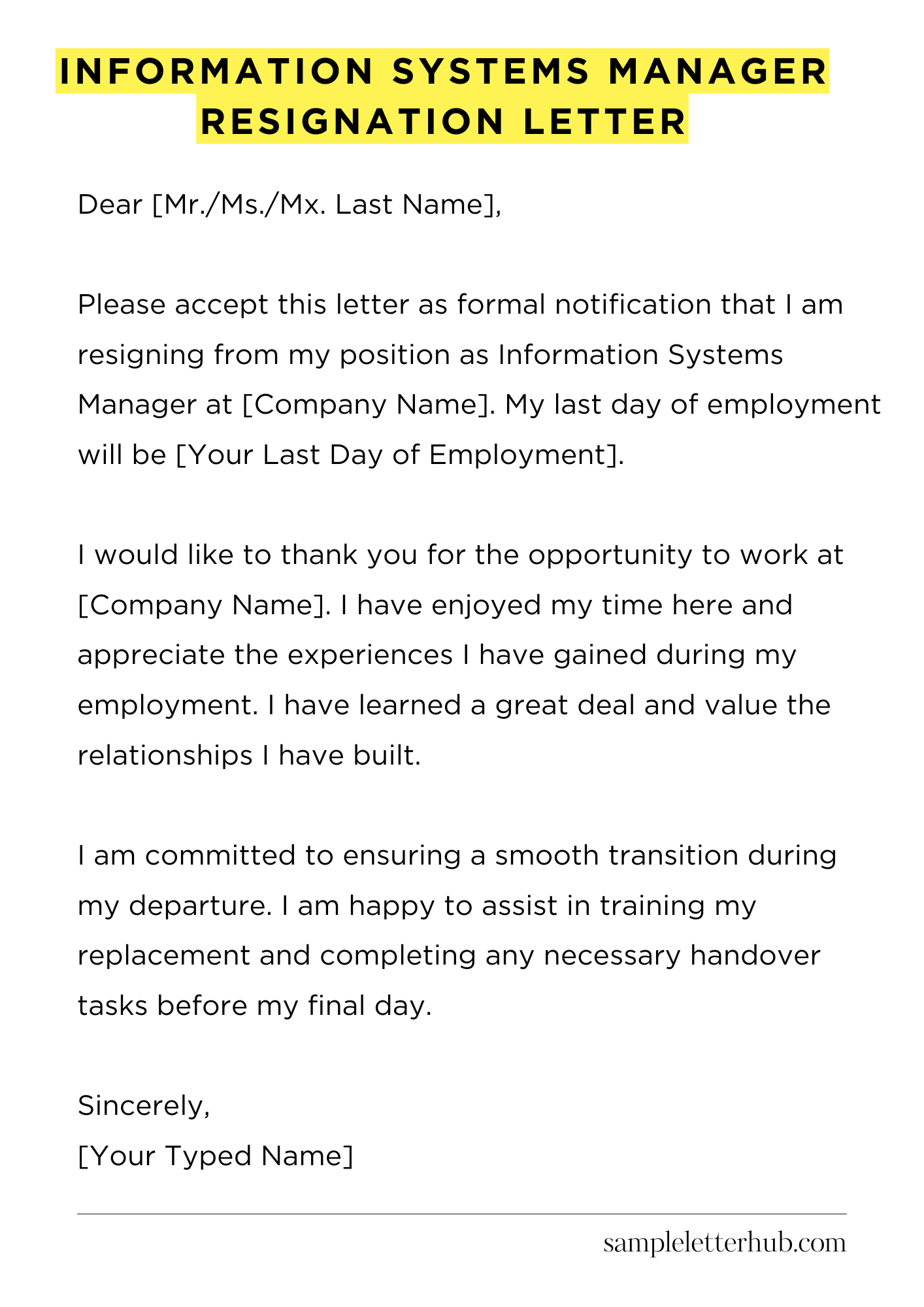
Dear [Mr./Ms./Mx. Last Name],
Please accept this letter as formal notification that I am resigning from my position as Information Systems Manager at [Company Name]. My last day of employment will be [Your Last Day of Employment].
I would like to thank you for the opportunity to work at [Company Name]. I have enjoyed my time here and appreciate the experiences I have gained during my employment. I have learned a great deal and value the relationships I have built.
I am committed to ensuring a smooth transition during my departure. I am happy to assist in training my replacement and completing any necessary handover tasks before my final day. I am also available to answer any questions you may have.
I wish you and [Company Name] all the best in the future.
Sincerely,
[Your Typed Name]
How to Write an Information Systems Manager Resignation Letter
So, you’ve made the decision: It’s time to move on from your role as an Information Systems Manager. That’s great! Now, you need to handle the crucial step of writing a resignation letter. Don’t worry; it doesn’t have to be a complicated process.
A well-crafted letter can leave a positive lasting impression. Here’s a simple guide to help you write a professional and effective resignation letter.
1. Get Started with the Basics: Formatting and Essentials
First things first, let’s get the format right. Use a standard business letter format. Include your contact information at the top. The date is also important and should follow your contact details. Next, address the letter to your immediate supervisor, typically the Director or Vice President of IT, or as the company requires.
The core of your letter should include a clear and direct statement of your resignation. State your intention to leave, and crucially, specify your last day of employment. This is important for a smooth transition. Keep it concise.
For example: “Please accept this letter as formal notification that I am resigning from my position as Information Systems Manager, effective [Your Last Day of Employment].”
2. Express Your Gratitude: Show Appreciation
Even if you’re leaving, show some appreciation! It’s always a good idea to express gratitude for the opportunities you’ve been given during your time with the company. A short acknowledgment of your experiences can go a long way.
Consider something like: “I am grateful for the opportunities I have been provided during my time at [Company Name]. I have learned a lot and value the experience I have gained.” This demonstrates professionalism and leaves a positive impression.
3. Offer Assistance: Support the Transition
One way to show your commitment is to offer assistance during the transition period. This can be especially important in an IT management role. IT departments have a lot to manage.
This will show you’re taking your responsibilities seriously. You might offer to help train your replacement, document key processes, or assist with any ongoing projects to the best of your ability.
For example: “I am committed to ensuring a smooth handover of my responsibilities and am happy to assist in any way possible during the transition.” This is valuable!
4. Keep it Positive and Professional: Maintaining Professionalism
This is not the time to air grievances. Keep your tone positive and professional throughout the letter. Avoid any negative comments about your colleagues, the company, or your reasons for leaving. Your resignation letter is a final professional statement and should reflect positively on you.
Even if you have had negative experiences, it’s best to remain professional. Focus on your future and the reasons for your departure, without dwelling on the negatives.
5. Proofread and Finalize: The Final Touches
Before you send it, proofread your letter carefully. Check for any grammatical errors, spelling mistakes, or typos. Ask a friend or colleague to review it as well, just for a fresh pair of eyes. This is important because you want to make a good impression.
Finally, sign and date the letter. You can then deliver it in person to your supervisor, if possible. You can also send it via email. Once you’ve done this, you have completed the process of writing an effective resignation letter.
FAQs about Information Systems Manager resignation letter
How much notice should an Information Systems Manager give when resigning?
The standard notice period for an Information Systems Manager typically aligns with employment contracts or local labor laws. This generally ranges from two weeks to a month, but can vary depending on the company’s size, the employee’s tenure, and the specific terms outlined in their employment agreement.
It is crucial to review the employment contract for the precise requirements. Providing ample notice allows for a smooth transition, knowledge transfer, and minimizes disruption to ongoing projects and operations.
What key information should be included in an Information Systems Manager resignation letter?
An effective resignation letter should include: a clear statement of resignation (e.g., “I am writing to formally resign from my position as Information Systems Manager”), the effective date of resignation, a brief and professional expression of gratitude for the opportunity (optional), a concise explanation for leaving.
Should an Information Systems Manager provide a reason for resigning in their letter?
While not mandatory, providing a reason for resignation is optional. If you choose to include a reason, it’s advisable to keep it brief, professional, and positive. Focus on future opportunities or personal circumstances, rather than dwelling on any negative experiences.
Avoid making disparaging remarks about the company or colleagues. Common reasons cited include pursuing new career opportunities, career advancement, or a better work-life balance.
How should an Information Systems Manager handle the handover of responsibilities?
An Information Systems Manager should proactively prepare for a smooth handover. This involves documenting key processes, systems, and projects. Creating a comprehensive handover plan that outlines ongoing projects, access credentials, and contact information of key vendors and personnel is beneficial.
Offer to train a replacement or assist with the transition process. This ensures continuity and minimizes disruption to the IT infrastructure.
What are the legal considerations for an Information Systems Manager when resigning?
Legal considerations depend on the specific employment contract and local labor laws. Review the employment contract for clauses related to notice periods, non-compete agreements (if applicable), and confidentiality agreements.
Ensure compliance with all contractual obligations. Understand the company’s policies regarding intellectual property and the return of company property. Seek legal advice if there are any doubts or concerns regarding the terms of employment or the resignation process.
Related:
Resignation letter due to rude boss
Resignation letter moving to another state
Resignation letter due to illness of family member
Resignation letter due to study