

An India Visa Invitation Letter is a document. It is a formal letter. It is often required when applying for an Indian visa. The letter’s main purpose is to invite someone to India. It also provides details about the visit.
Planning a trip to India? Need an invitation letter? You’re in the right place. We’ve got you covered. This article is your guide. We will share different templates. You can use these to create your own letter.
These templates will help you. They are easy to adapt. Create a perfect invitation letter. No stress, just simple steps.
India Visa Invitation Letter
[Your Name/Company Name]
[Your Address]
[Your Phone Number]
[Your Email Address]
[Date]
Visa Officer
Embassy of India
[Embassy Address]
Subject: Invitation Letter for [Applicant Name] – Visa Application
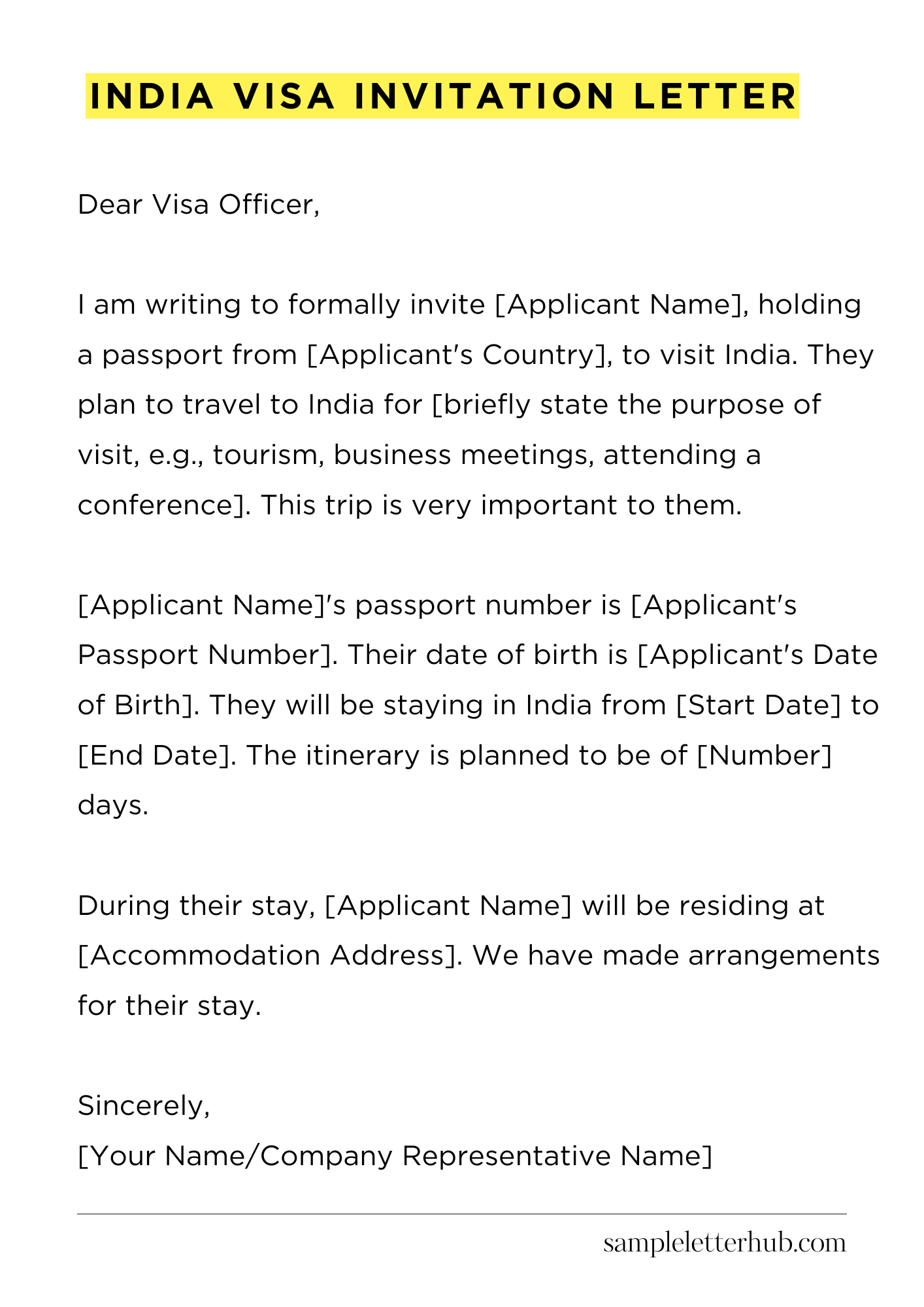
Dear Visa Officer,
I am writing to formally invite [Applicant Name], holding a passport from [Applicant’s Country], to visit India. They plan to travel to India for [briefly state the purpose of visit, e.g., tourism, business meetings, attending a conference]. This trip is very important to them.
[Applicant Name]’s passport number is [Applicant’s Passport Number]. Their date of birth is [Applicant’s Date of Birth]. They will be staying in India from [Start Date] to [End Date]. The itinerary is planned to be of [Number] days.
During their stay, [Applicant Name] will be residing at [Accommodation Address]. We have made arrangements for their stay. [He/She/They] will be responsible for all their travel expenses, as well as their personal expenses. [Applicant Name] is a reliable and trustworthy person. They are looking forward to visiting India.
[If applicable: Briefly describe your relationship with the applicant, e.g., “I am a colleague of Mr./Ms. [Applicant Name] and we are working together on a project,” or “I am a friend of Mr./Ms. [Applicant Name] and I am inviting them to visit me in India.”]
We kindly request you to grant [Applicant Name] a visa to allow them to enter India. We would be very grateful if you would consider this request favorably. Please feel free to contact me if you require any further information.
Thank you for your time and consideration.
Sincerely,
[Your Name/Company Representative Name]
How to Write India Visa Invitation Letter
Decoding the Enigma: The Indian Visa Invitation Letter
Embarking on a journey to the vibrant tapestry of India often necessitates the composition of a crucial document: the India visa invitation letter.
This letter, steeped in legal import, serves as a formal entreaty, vouchsafing for the applicant’s bona fides and intended sojourn. But how does one navigate the labyrinthine process of crafting such a missive with efficacious precision?
The Anatomy of an Invitation: Essential Components
First, you must furnish the full legal name, date of birth, and the address of the inviter. You, as the inviter, must present a compelling case for the visit.
Why should the embassy grant this visa? Now, the applicant’s details come. Provide a lucid exposition of the applicant’s identity, encompassing their full name (as it appears on their passport), date of birth, nationality, and passport number.
Furthermore, delineate the precise purpose of their visit. Is it for tourism, to attend a wedding, or perhaps to partake in a business confabulation? Clarity is paramount.
A Chronicle of Dates: Travel Itinerary and Duration
Specify the exact dates of the intended sojourn, from arrival to departure. Also, illuminate the proposed itinerary, mentioning key cities or regions the applicant intends to explore. Be specific. Vagueness is the enemy of acceptance. The duration of stay should be explicitly stated. Is it a fleeting fortnight or an extended sojourn of several months?
Assumption of Responsibility: A Pledge of Support
Here’s the crux. The inviter must formally acknowledge their assumption of financial responsibility for the applicant’s stay. This constitutes a safeguard against the applicant becoming a burden on the Indian state. Furthermore, a declaration affirming the applicant’s adherence to Indian laws and regulations is de rigueur.
The Formalities: Language, Tone, and Formatting
Employ a formal tone. Eschew colloquialisms and maintain a professional register throughout the letter. The language should be clear, concise, and devoid of ambiguity.
Structure the letter logically, with distinct paragraphs delineating each key element. Proofread meticulously to expunge any grammatical errors or typographical faux pas. It should be a paragon of precision.
Corroborating Evidence: Supporting Documents
To bolster the veracity of your invitation, append supporting documents. This may include a copy of your PAN card, Aadhaar card, or any other government-issued identification.
Proof of your residential address, such as a utility bill or property deed, can further solidify your claim. Similarly, provide copies of the applicant’s passport and any previous Indian visas they may have possessed.
The Denouement: Submission and Anticipation
Once the letter is meticulously crafted and all supporting documents collated, transmit the dossier to the applicant. They, in turn, must furnish it to the relevant Indian embassy or consulate as part of their visa application.
Now, a period of patient anticipation ensues, as the wheels of bureaucratic process grind inexorably towards a decision. With a well-composed invitation letter, the odds of a favorable outcome are significantly augmented. This document serves as your advocate, a voice speaking on behalf of your invitee, paving the way for their ingress into the splendors of India.
FAQs about India Visa Invitation Letter
Here are the top 5 frequently asked questions about India Visa Invitation Letters, designed to provide clarity and assist applicants in preparing their documentation.
These questions cover common concerns regarding the purpose, requirements, and validity of invitation letters for Indian visa applications.
What is an India visa invitation letter and when is it required?
An India visa invitation letter is a formal letter from a host in India inviting a foreign national to visit the country. It is typically required when applying for a Tourist Visa, Business Visa, or Conference Visa. The letter serves as supporting documentation to demonstrate the purpose of the visit and the relationship between the applicant and the host.
What information should be included in an India visa invitation letter?
An India visa invitation letter should include the following information:
- Host’s full name, address, contact number, and email address
- Host’s profession or occupation
- Copy of host’s identification document (e.g., Passport, Aadhaar card, PAN card)
- Applicant’s full name, date of birth, and passport number
- Purpose of the visit (e.g., tourism, business meeting, conference)
- Duration of the stay (start and end dates)
- Relationship between the host and the applicant
- Statement of responsibility for the applicant’s well-being during their stay
- Signature of the host
Does an invitation letter guarantee visa approval for India?
No, an invitation letter does not guarantee visa approval. While it serves as supporting documentation and strengthens your application, the final decision rests with the Indian embassy or consulate. The visa officer will assess all aspects of your application, including your travel history, financial stability, and the genuineness of your intentions.
Can a family member write the invitation letter for a tourist visa to India?
Yes, a family member who is an Indian citizen or a legal resident of India can write an invitation letter for a tourist visa. The letter should clearly state the relationship between the host and the applicant (e.g., brother, sister, parent, child) and include a copy of the host’s identification document to verify their residency or citizenship status.
Is a notarized invitation letter required for an India visa?
Generally, a notarized invitation letter is not mandatory for an India visa application. However, depending on the specific circumstances of your case or the requirements of the Indian embassy or consulate where you are applying, it may be beneficial to have the letter notarized.
It is always best to check the latest visa guidelines and requirements published by the Indian embassy or consulate in your country.
Related:
Resignation letter due to rude boss
Resignation letter moving to another state
Resignation letter due to illness of family member
Resignation letter due to study