

A Human Resources Director resignation letter is a formal document. It announces your departure from the company. Its main purpose is to officially inform your employer of your intention to leave. This letter also outlines your last day of employment.
Writing this type of letter can feel daunting. We’re here to help. We’ll provide you with various letter samples. These are designed specifically for HR Directors. You will find different formats and styles.
Use these examples to craft your own resignation letter. Simplify the process. Make it easier to communicate your message effectively.
Human Resources Director Resignation Letter
Below is a sample of a Human Resources Director Resignation Letter:
[Your Name]
[Your Address]
[Your Phone Number]
[Your Email Address]
[Date]
Human Resources Director
[Company Name]
[Company Address]
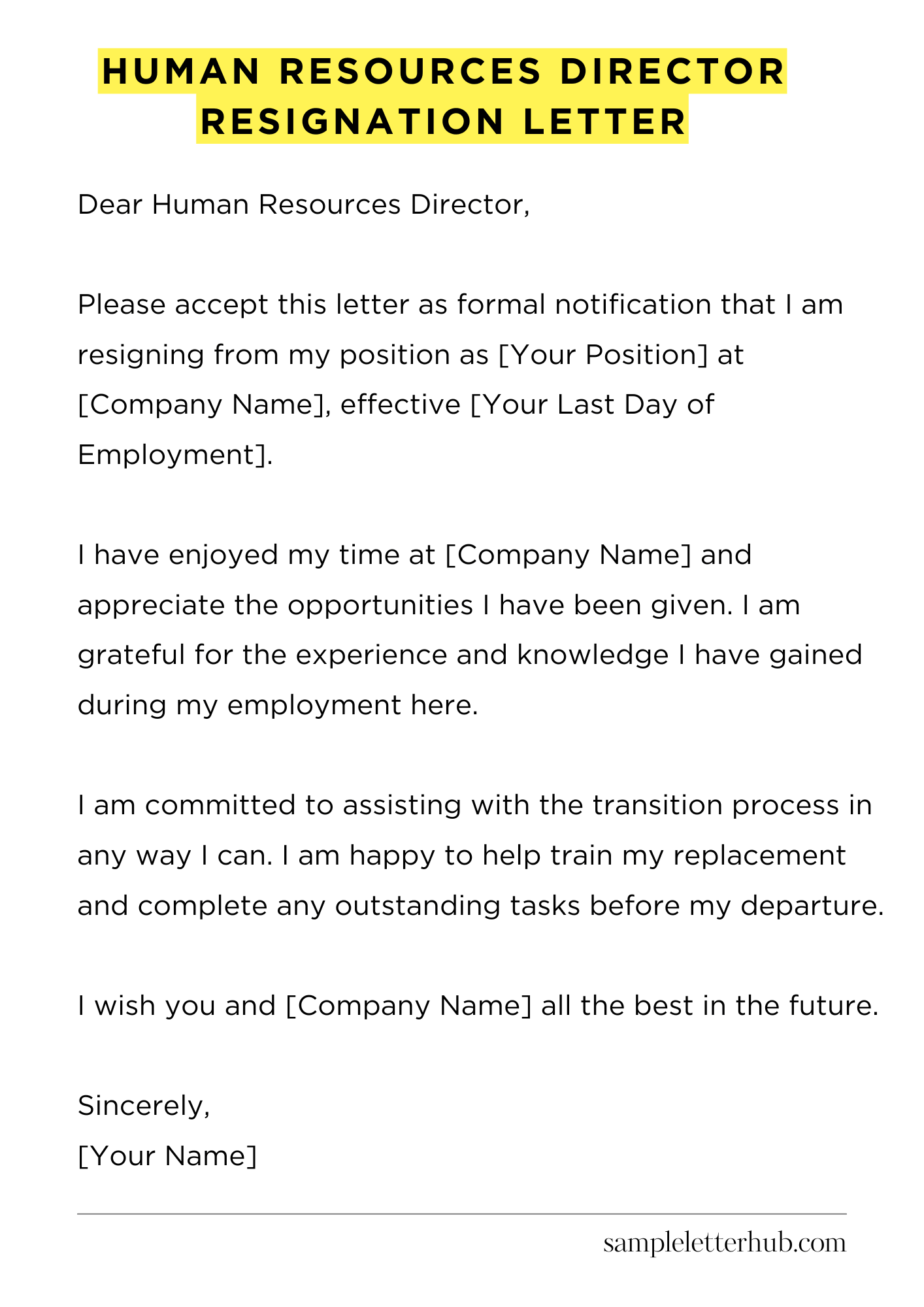
Dear Human Resources Director,
Please accept this letter as formal notification that I am resigning from my position as [Your Position] at [Company Name], effective [Your Last Day of Employment].
I have enjoyed my time at [Company Name] and appreciate the opportunities I have been given. I am grateful for the experience and knowledge I have gained during my employment here.
I am committed to assisting with the transition process in any way I can. I am happy to help train my replacement and complete any outstanding tasks before my departure.
I wish you and [Company Name] all the best in the future.
Sincerely,
[Your Name]
How to Write a Human Resources Director Resignation Letter
1. Grasping the Basics: Why Your Letter Matters
Resigning from a Human Resources Director position is a significant step. You’ve likely invested time, effort, and passion into your role. But now, it’s time to move on. This is where a well-crafted resignation letter comes into play. It’s more than just a formality; it’s a professional statement. It’s your final opportunity to make a positive impression.
Think of it this way: your resignation letter is your legacy, the last official document you’ll leave behind. This document reflects your professionalism and integrity. It also paves the way for a smooth transition. Done right, your letter can help maintain positive relationships with your former colleagues. It is crucial for future networking opportunities.
2. Essential Components: What to Include
So, what exactly *should* you put in this crucial letter? Begin with the basics. Start by stating your intent to resign, and make it clear from the get-go. Include the effective date of your resignation. Be specific; this eliminates any confusion.
Next, express your gratitude for the opportunity. Briefly acknowledge the experience you’ve gained, and maybe even a highlight or two. However, keep it concise. Avoid excessive detail or negativity.
Briefly mention your reasoning for leaving. A brief, neutral reason is often sufficient. If you’re willing, offer assistance during the transition. Suggesting you’re available to help can demonstrate your commitment to a smooth handover.
3. Formatting and Tone: Maintaining Professionalism
The format of your letter is just as important as the content. Use a standard business letter format. Include your contact information at the top. Next, include the date and the recipient’s information. Choose a professional font, such as Times New Roman or Arial, and use a standard font size, usually 12 points.
The tone is paramount. Keep it professional. Maintain a positive and respectful tone. Avoid any negative comments about your employer or colleagues. Refrain from gossip, even if you feel it’s warranted. Clarity and conciseness are key. Get straight to the point.
Proofread meticulously. Grammar and spelling errors can undermine your credibility. Have a friend or colleague review your letter before you send it. This step is often overlooked, but it is super helpful!
4. Tailoring the Letter: Addressing Specific Situations
Your letter will likely be unique. You might want to consider specific circumstances. If you’re leaving for a new job, you do not need to share all the details. However, it’s generally acceptable to briefly mention your new role without going into specifics. Keep it positive.
If you’re leaving due to personal reasons, a simple explanation is sufficient. You don’t need to provide detailed reasons. Keep the explanation brief. If you were working as a remote employee, indicate the way to communicate. Keep it professional.
5. After the Letter: Beyond the Submission
Once you’ve submitted your letter, your work isn’t entirely done. Prepare for the transition. Be ready to answer questions. Make yourself available to help with the handover process. Offer to train your replacement.
Finally, remember to thank your colleagues and supervisors. Maintain those positive relationships. It’s important for your future career. Your last impression can leave a lasting impact. Your reputation matters. Your career does too.
FAQs about Human Resources Director Resignation Letter
What is the primary purpose of a Human Resources Director’s resignation letter?
The primary purpose of a Human Resources Director’s resignation letter is to formally notify the employer of their intention to leave the position. It serves as an official record of the resignation, the effective date, and often, a brief expression of gratitude or acknowledgment.
What key elements should be included in a Human Resources Director’s resignation letter?
A comprehensive Human Resources Director’s resignation letter should include: a clear statement of resignation, the effective date of resignation, a concise reason for leaving (optional but often included), an expression of gratitude to the company and/or colleagues, an offer to assist with the transition, and the director’s contact information for future correspondence.
It is also common to include a brief, positive closing.
How much notice should a Human Resources Director give when resigning?
The amount of notice required typically depends on the employment contract or company policy. However, as a general guideline, Human Resources Directors usually provide at least four weeks’ notice, or more, to allow for a smooth transition. The specific terms outlined in the employment contract should be followed.
Should a Human Resources Director provide a reason for their resignation in the letter?
While not mandatory, providing a brief and professional reason for resignation is often considered standard practice. It can help the employer understand the circumstances surrounding the departure.
The reason can be as simple as stating “to pursue other opportunities” or “to focus on personal commitments”. It is recommended to keep the reason brief and positive. Avoid overly negative or detailed explanations, and focus on the future.
What is the best way to handle the transition process after submitting the resignation letter?
After submitting the resignation letter, a Human Resources Director should be prepared to assist with a smooth transition. This involves collaborating with the employer to identify a successor, providing necessary information and documentation, training the new hire (if applicable), completing any outstanding projects, and ensuring all HR-related tasks are properly managed.
Open communication and a professional demeanor are crucial throughout the transition period.
Related:
Resignation letter due to rude boss
Resignation letter moving to another state
Resignation letter due to illness of family member
Resignation letter due to study