

An HR Officer resignation letter is a formal document. It informs the employer of your intention to leave your job. The letter officially marks the end of your employment. It is a crucial step in the resignation process.
This article makes the process easy. We will provide you with examples. You’ll find templates for various situations. They are designed to assist you. Creating your own resignation letter is easy now!
We understand that crafting the right words can be tricky. Don’t worry, we’ve got you covered. This is the resource you need. Feel confident writing your letter!
Hr Officer Resignation Letter
Below is a sample of a Hr Officer Resignation Letter:
[Your Name]
[Your Address]
[Your Phone Number]
[Your Email Address]
[Date]
[HR Officer’s Name]
[HR Department]
[Company Name]
[Company Address]
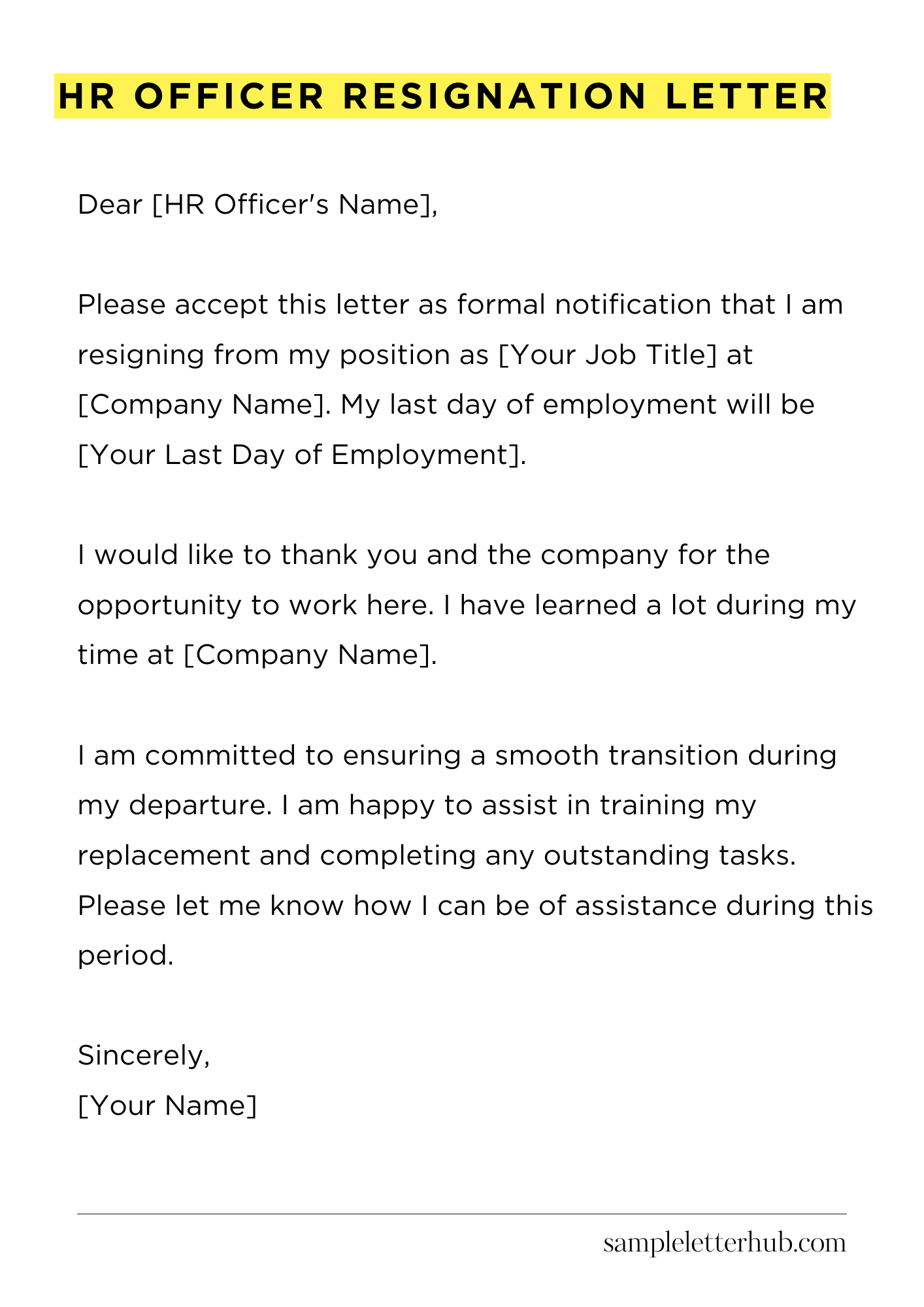
Dear [HR Officer’s Name],
Please accept this letter as formal notification that I am resigning from my position as [Your Job Title] at [Company Name]. My last day of employment will be [Your Last Day of Employment].
I would like to thank you and the company for the opportunity to work here. I have learned a lot during my time at [Company Name].
I am committed to ensuring a smooth transition during my departure. I am happy to assist in training my replacement and completing any outstanding tasks. Please let me know how I can be of assistance during this period.
I wish the company continued success in the future.
Sincerely,
[Your Name]
How to Write an HR Officer Resignation Letter
Resigning from any job can be a big step. It’s even more significant when you’re an HR Officer. You’re the one usually guiding others through this process! Writing a professional and well-crafted resignation letter is crucial.
It ensures a smooth transition and leaves a positive impression, regardless of your reasons for leaving. Consider it your last official act as a member of the company, and one that reflects your professionalism.
1. Get Started: The Basics
First things first, let’s address the fundamental components. A resignation letter should be concise and direct. Start with your contact information. Include your name, address, phone number, and email address.
Then, add the date. Next, address the letter to the appropriate person, usually your direct supervisor or the HR Manager. Keep it formal and respectful. You should also start with a formal salutation like “Dear [Manager’s Name]”.
Keep your sentences short, and to the point. State your intent clearly and unequivocally: “I am writing to formally resign from my position as HR Officer, effective [Your Last Day of Employment].” This is the core of the letter. Don’t beat around the bush; be clear!
2. Express Gratitude (and Keep it Short!)
Expressing gratitude is always a good practice, even if your experience hasn’t been ideal. This adds a layer of professionalism. Even if things went south, it’s a good idea to maintain positive tone. A simple phrase like, “I would like to express my gratitude for the opportunities I have been given during my time here” is sufficient.
You can also mention specific experiences that have helped you grow and developed your skills. However, it’s best to keep this brief; don’t make it the focus of your letter.
Consider something along the lines of, “I have truly valued my time here and appreciate the experience I’ve gained”. Don’t overdo it. The key is to be sincere, but not effusive. This is not the time to write a novel about your career. Keep it simple and sweet.
3. Provide Context (If Necessary, But Tread Lightly)
While you are not obligated to explain your reasons for leaving, you *can* provide a very brief, neutral explanation if you feel it’s necessary. This could be to highlight your next career step or personal matters, whatever the case may be. It is not necessary, but can be a way to maintain good relationships.
Example: “I am leaving to pursue a new opportunity in [Your New Field]” or “This decision is based on personal reasons.” Avoid negativity. Don’t complain about your boss, your colleagues, or the company. Keep the tone professional. A simple, polite phrase is usually enough.
4. Offer Assistance With the Transition
This is a critical part, particularly for an HR Officer. Offer your assistance in facilitating a smooth handover. Offer to train your replacement and help with any pending tasks.
Demonstrate a commitment to supporting the company during the transition period. This shows that you are dedicated to your work and demonstrates your respect. It also makes you look good and keeps a positive atmosphere.
Phrases like, “I am committed to ensuring a smooth transition and am happy to assist in training my replacement” can be extremely helpful. Consider: “Please let me know how I can be of assistance during this time.” Make sure you are also available for any questions or help. Show willingness for assistance by mentioning it.
5. Closing and Formalities
End the letter with a formal closing and your signature. Use a closing like “Sincerely,” or “Respectfully,” followed by your typed name and, ideally, your handwritten signature above it.
Double-check everything, again! Proofread your letter carefully for any errors in grammar and spelling. A well-written and error-free letter reflects your professionalism, and attention to detail. This is what you want.
Remember, your resignation letter is a reflection of your professionalism. By following these guidelines, you can ensure you leave on a positive note, setting the stage for future opportunities. The goal is to make sure your departure from the company goes as smoothly as possible.
FAQs about HR Officer Resignation Letter
What is the primary purpose of an HR Officer resignation letter?
The primary purpose of an HR Officer resignation letter is to formally notify the employer of the employee’s intention to leave the company. It serves as an official record of the resignation, the last day of employment, and can also be used to express gratitude, provide reasons for leaving (optional), and offer assistance with the transition process.
What essential information must be included in an HR Officer resignation letter?
An HR Officer resignation letter must include the employee’s intention to resign, the effective date of resignation (last day of employment), a formal statement of resignation, the employee’s name, job title, and the date the letter is written. It should typically be addressed to the appropriate supervisor or HR department representative.
Is it necessary for an HR Officer to provide a reason for resigning in the letter?
While not mandatory, an HR Officer *can* choose to include a reason for resigning in the letter. The reasons can be provided if they feel the information is beneficial, such as if there are issues that the company could address.
Some HR officers might express a desire to pursue other opportunities, relocate, or the company. However, the reason for leaving is not legally required and is at the discretion of the employee.
How should an HR Officer approach the tone and language of the resignation letter?
The tone and language should be professional and respectful. Even if there are negative feelings associated with the job or the company, the letter should maintain a positive and businesslike tone. Avoid accusatory language or excessive negativity. Expressing gratitude for the opportunity to work at the company is generally a good practice.
What are some best practices for submitting an HR Officer resignation letter?
Best practices include delivering the letter in person to the direct supervisor or the HR department, if possible. Follow company protocols. Keep a copy for personal records.
Provide appropriate notice, typically two weeks or as dictated by company policy or the employment contract. Be prepared for a conversation about the resignation and the transition process and to support it. Finally, ensure the letter is proofread carefully for any errors.
Related:
Resignation letter due to rude boss
Resignation letter moving to another state
Resignation letter due to illness of family member
Resignation letter due to study