

Ready to move on from your hosting gig? A host resignation letter is your official way of saying goodbye. It’s a formal document. Its main purpose is to inform your employer of your departure. This letter also outlines your last day of work.
Writing a resignation letter can feel tricky. You want to be professional. You also want to keep it simple. We’ve got you covered.
We’re sharing ready-to-use templates. Find different examples and samples here. These will make writing your own letter easy. Choose the one that suits your situation. Adapt it to your specific needs.
Host Resignation Letter
Below is a sample of a Host Resignation Letter:
[Your Name]
[Your Address]
[Your Phone Number]
[Your Email Address]
[Date]
[Recipient’s Name]
[Recipient’s Title]
[Company Name]
[Company Address]
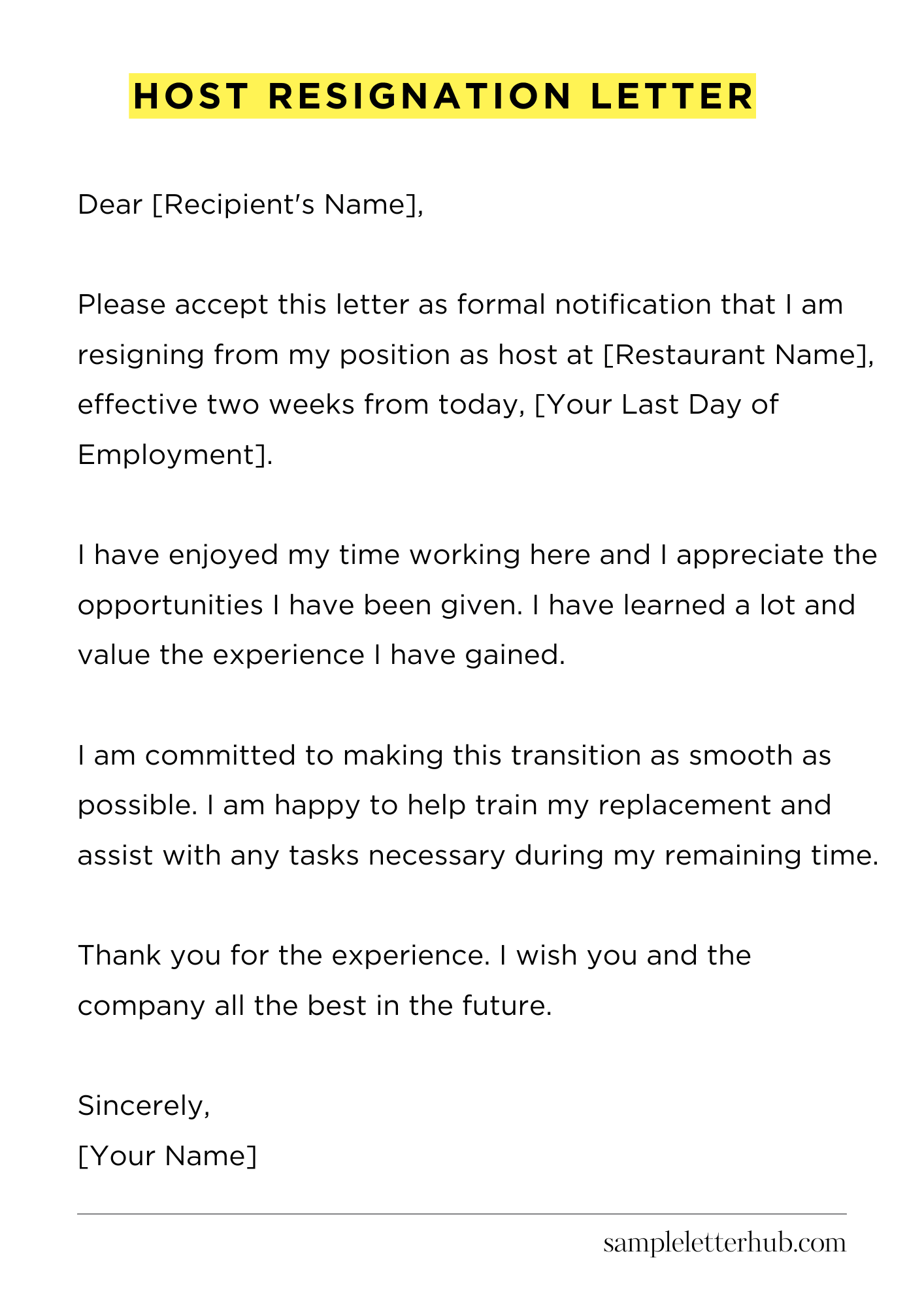
Dear [Recipient’s Name],
Please accept this letter as formal notification that I am resigning from my position as host at [Restaurant Name], effective two weeks from today, [Your Last Day of Employment].
I have enjoyed my time working here and I appreciate the opportunities I have been given. I have learned a lot and value the experience I have gained.
I am committed to making this transition as smooth as possible. I am happy to help train my replacement and assist with any tasks necessary during my remaining time.
Thank you for the experience. I wish you and the company all the best in the future.
Sincerely,
[Your Name]
How to Write a Host Resignation Letter
Know Your Audience (and Yourself!)
So, you’re ready to move on. That’s a big step! Before you even think about the words, consider who you’re writing to. Is it your direct manager? The entire team? This will influence your tone and level of formality. Understand your company culture. Is it a casual place, or do they prefer a more formal approach?
This will shape everything, from the opening greeting to the closing salutation. Take a moment to reflect on your time there. What did you enjoy? What are you grateful for? Knowing these things can also help guide your message. Think about the relationship you have with your boss and colleagues.
Crafting the Core Message: What to Say
Now, let’s get down to the basics. The purpose of this letter is clear: to officially resign. Begin by stating this directly. Something like, “Please accept this letter as formal notification that I am resigning from my position as [Your Position] at [Company Name].” Keep it concise and straightforward.
Then, state your last day of employment. This is critical. Make sure it aligns with your contract or any company policies regarding notice periods.
The most important part is to express gratitude. Briefly thank the company for the opportunity. Acknowledge any specific experiences or learning that you gained. It’s a nice touch and shows professionalism.
Lastly, consider offering your assistance with the transition. Offer to help train your replacement, complete any outstanding tasks, or answer any questions.
Formatting for Success: The Structure Matters
A well-formatted letter looks professional and shows respect. Keep it clean and easy to read. Use a standard business letter format. Include your name, address, and the date at the top. Address the letter to your direct supervisor or the appropriate person in HR.
Use a professional salutation like “Dear [Manager’s Name],” or “Dear [HR Department],” Then, write a body paragraph. Keep the whole letter to one page. Use a clear font like Times New Roman or Arial, size 12. Leave space between paragraphs.
Always proofread for any spelling and grammar errors. The closing should be a courteous sign-off such as “Sincerely,” or “Best regards,” followed by your name. Ensure it has your signature after printing it.
What to Avoid: Landmines to Dodge
There are some things you should absolutely avoid in your resignation letter. Don’t be negative or critical about the company or its employees. This is not the place to air grievances. Avoid burning bridges. Remember, you might need a reference or want to work in the industry again. Refrain from getting into a lot of detail about your reasons for leaving, unless explicitly asked.
Keep the focus on the basics of your resignation. Avoid going into a lot of personal detail, like your future plans, etc. Also, do not include threats or ultimatums.
Delivering the Letter: Timing and Method
Once your letter is ready, decide how you will deliver it. Typically, submitting the letter in person is the most professional approach. Schedule a meeting with your manager. If that’s not possible, email is usually acceptable. Always keep a copy for yourself. If submitting electronically, a PDF format is recommended.
This keeps the formatting from changing. Be prepared to discuss your resignation in more detail during your meeting. Follow the company’s established procedures regarding the exit process, and most of all, remain professional throughout. Now, it’s time for new beginnings!
FAQs about Host Resignation Letter
What is the purpose of a host resignation letter?
The primary purpose of a host resignation letter is to formally notify your employer of your intention to leave your position. It serves as a written record of your departure, enabling a clear and professional handover process. It also helps to maintain a positive relationship with your employer.
What essential elements should be included in a host resignation letter?
A host resignation letter should contain: Your formal notification of resignation, the date of your last day of employment, a statement of gratitude (optional, but recommended), and your contact information. You may also include a brief explanation for leaving (optional), and an offer to assist with the transition of your duties.
How far in advance should I submit my host resignation letter?
The notice period is typically specified in your employment contract or company policy. Common notice periods are two weeks, however, some roles require a longer period of notice. Always refer to your contract or company policy. If there is no specific policy, two weeks’ notice is generally considered a professional standard.
What should I avoid including in my host resignation letter?
Avoid including overly negative comments, criticisms of your employer or colleagues, or any unprofessional language. Keep the tone of the letter professional, respectful, and focused on your departure rather than complaints. Do not share confidential company information.
Can I provide a reason for leaving in my host resignation letter, and should I?
Providing a reason for leaving is optional. You can include a brief, positive statement about your reasons, such as pursuing a new opportunity or personal growth. However, you are not obligated to provide a detailed explanation. Keeping the reason concise and positive is generally advisable to maintain a professional tone.
Related:
Resignation letter due to rude boss
Resignation letter moving to another state
Resignation letter due to illness of family member
Resignation letter due to study