

Dealing with hospital bills can be overwhelming. A hospital bill claim letter is a formal way to address these bills. Its primary purpose is to dispute charges, request itemized bills, or seek financial assistance. This crucial document helps ensure accuracy and fairness in medical billing.
We understand the complexities of medical bills. That’s why we’re here to help. We’ll provide you with various hospital bill claim letter samples. These examples cover different scenarios. Use these letter templates to easily draft your own claim letter.
This article simplifies the process. We aim to empower you. Our goal is to make managing your hospital bills easier. Explore our user-friendly samples. Write your hospital bill claim letter with confidence.
[Your Name]
[Your Address]
[Your Phone Number]
[Your Email Address]
[Date]
[Hospital Billing Department Name/Address]
Subject: Hospital Bill Claim – Account Number [Your Account Number]
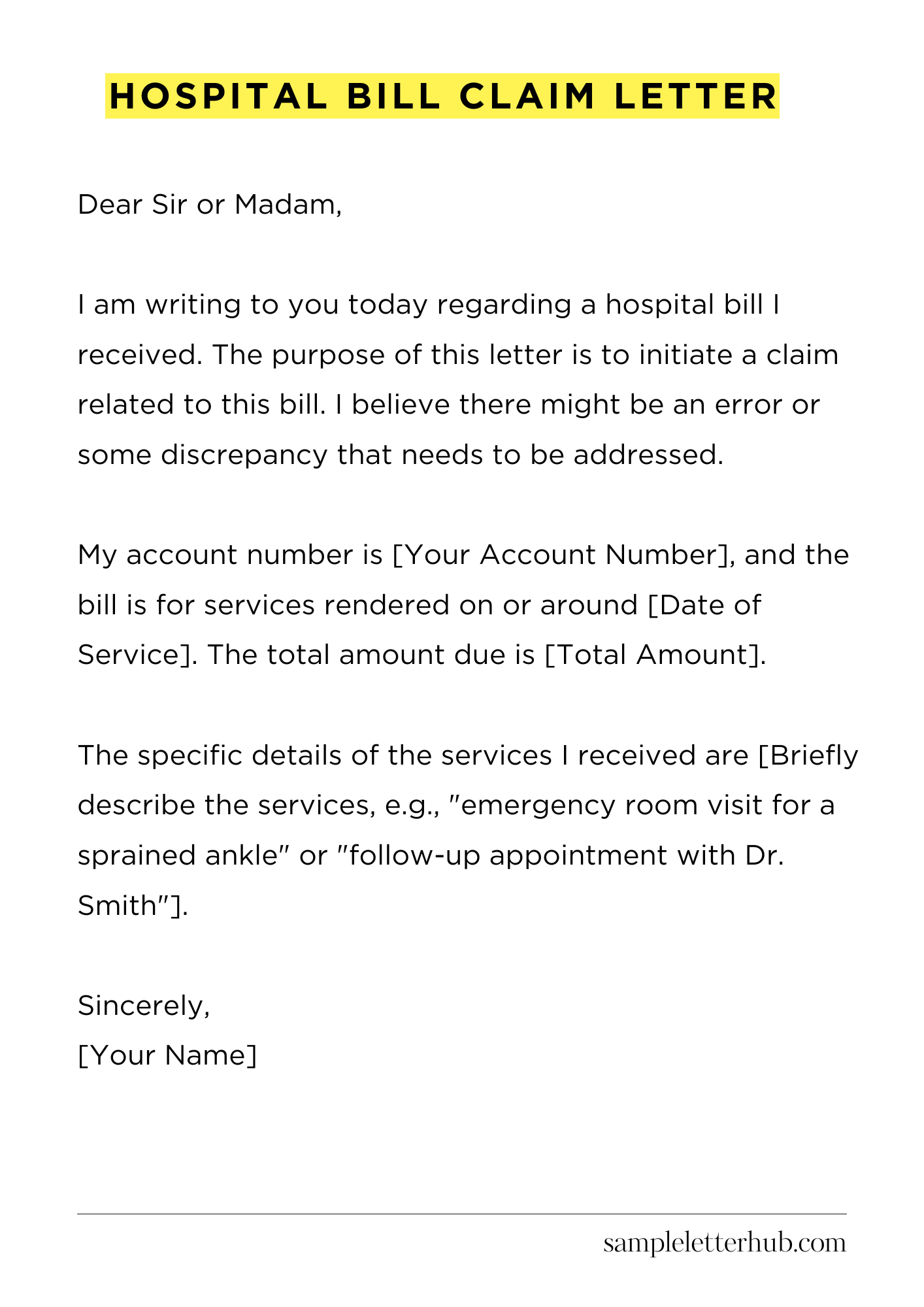
Dear Sir or Madam,
I am writing to you today regarding a hospital bill I received. The purpose of this letter is to initiate a claim related to this bill. I believe there might be an error or some discrepancy that needs to be addressed.
My account number is [Your Account Number], and the bill is for services rendered on or around [Date of Service]. The total amount due is [Total Amount]. The specific details of the services I received are [Briefly describe the services, e.g., “emergency room visit for a sprained ankle” or “follow-up appointment with Dr. Smith”].
I have reviewed the bill carefully. I noticed [Clearly and concisely explain the issue. Be specific. For example: “a charge for a service I did not receive,” “a coding error,” “a misunderstanding of my insurance coverage,” or “I believe I have already paid a portion of this bill.”]. These concerns make me question the accuracy of the final bill.
To support my claim, I am including [List any supporting documentation, e.g., “a copy of my insurance card,” “a copy of the Explanation of Benefits (EOB) from my insurance company,” or “a receipt showing a payment I made.”]. The attached documents should help clarify my situation further.
I would appreciate it if you could investigate this matter thoroughly. Please review the bill and any supporting documentation I have provided. Kindly make any necessary adjustments to the account. I would like to get this resolved as quickly as possible.
Could you please let me know the status of my claim within [Number] business days? You can reach me by phone at the number above or by email. I look forward to your prompt response and resolution of this issue.
Thank you for your time and attention to this important matter.
Sincerely,
[Your Name]
How to Write Hospital Bill Claim Letter
Navigating the labyrinthine world of hospital bills can feel overwhelming. You might think, where do I even start? Rest assured, a well-crafted hospital bill claim letter is your first line of defense.
It is an instrument you wield to challenge inaccuracies and recover what is rightfully yours. This guide provides an efficacious roadmap to successfully compose a compelling claim letter.
1. Initiate with Precision: The Salutation and Dateline
Begin your letter with a formal salutation. Address it to the appropriate department, usually the “Patient Accounts Department” or a specific claims administrator. Research this carefully. Include the date in the upper right-hand corner. A precise dateline is crucial for establishing a record and helps in future reference. A formal and direct approach is important.
2. The Subject Line: Clarity is Paramount
The subject line is your letter’s headline. Make it succinct and unequivocally clear. It must immediately communicate the purpose of your missive.
Consider options such as: “Claim for Hospital Bill Discrepancy – Account Number: [Your Account Number]” or “Request for Bill Review – Patient Name: [Your Name]”. This instantly tells the recipient the letter’s purpose.
3. Patient Demographics and Account Details: Furnishing the Foundation
Provide all essential patient information. Include your full name, address, phone number, and date of birth. Crucially, cite your hospital account number.
This allows the receiver to promptly access your records. Ensure these details are accurate, as any error can create impediments in processing your claim. Omitting these basic data points will delay the process.
4. Delimiting the Issue: Articulating Your Grievance
This is where you clearly delineate the discrepancies you found in your bill. Be specific. Instead of saying “The bill is wrong,” state, “I am disputing charge X on [Date] for [Service].”
Offer supporting evidence. Attach copies of any documentation. This includes appointment schedules, insurance statements, or itemized bills that substantiate your case. Detail any discrepancies or overcharges with meticulous care.
5. Substantiating Your Claim: The Proof is in the Pudding
This section is for substantiating your claims. Cite facts and details that underscore your claim’s merit. Reference specific codes or procedures if you have them. If a charge seems incongruous, explain why you believe it is inappropriate, perhaps due to pre-authorization requirements or a misdiagnosis. Provide context and facts. Remember, evidence-based reasoning fortifies your stance.
6. The Formal Plea: Requesting Resolution
Explicitly request a resolution to your claim. Formulate a polite but unambiguous demand for the bill’s correction. State precisely what action you desire.
For example, “I request that charge X be removed from my bill” or “I request a revised bill reflecting the correct charges.” Also, include a reasonable timeframe for a response, such as “I request a response within 30 days.” Be explicit with your demands.
7. The Culmination: Closing and Enclosure
Conclude your letter with a professional closing, such as “Sincerely,” or “Respectfully,” followed by your full name and signature. Below your signature, clearly indicate what documentation you are including with the letter. This is what’s known as the ‘enclosure’ or ‘attachment’ section.
For instance, “Enclosures: Copy of insurance statement, Itemized bill, Appointment schedule.” Proper execution is important. A carefully crafted letter significantly increases the probability of a favorable outcome. This final step is essential for record-keeping and processing of your claim.
FAQs about Hospital Bill Claim Letter
What is a hospital bill claim letter, and when is it necessary?
A hospital bill claim letter is a formal written document used to dispute or seek clarification on charges appearing on a hospital bill. It becomes necessary when a patient or their representative believes there are errors, discrepancies, or unfair charges on the bill.
This could include incorrect coding, charges for services not rendered, or charges exceeding agreed-upon rates. Additionally, it might be used to claim for services covered by insurance but not applied correctly.
What information should be included in a hospital bill claim letter?
A comprehensive hospital bill claim letter should include: the patient’s full name, address, and contact information; the hospital’s name and address; the date of service; the patient’s account number; a clear and concise explanation of the reason for the claim, including specific disputed charges and their corresponding dates.
How do I obtain supporting documentation needed for my claim letter?
Supporting documentation is crucial. Gather the following: the itemized hospital bill (often a detailed breakdown of all charges); your insurance explanation of benefits (EOB), which details what your insurance covered and what you’re responsible for; any medical records or reports related to the services; and any previous correspondence with the hospital or insurance company.
You can request itemized bills and medical records directly from the hospital’s billing department or medical records department. Contact your insurance provider for EOBs and any relevant policy documents.
Where do I send the hospital bill claim letter?
The hospital bill claim letter should be sent to the address specified by the hospital for billing inquiries or disputes.
This information is usually found on the hospital bill itself. If not, it can often be found on the hospital’s website or by contacting their billing department directly.
It is advisable to send the letter via certified mail with return receipt requested to ensure proof of delivery and acknowledgment of receipt. Also, keep a copy of the letter and all supporting documentation for your records.
What are my rights if the hospital denies my claim or doesn’t respond?
If the hospital denies your claim, you have several options.
First, review the denial carefully to understand the reasons. You can then appeal the decision by providing additional information or evidence. If the hospital doesn’t respond within a reasonable timeframe (as specified in your letter or by local regulations), follow up with a phone call, email, or a second letter (sent certified mail).
If these actions don’t result in resolution, consider contacting your insurance company or the hospital’s patient advocacy department. Depending on the situation and location, you may also have the option to file a complaint with the state’s insurance commissioner or seek legal advice.
Related:
Resignation letter due to rude boss
Resignation letter moving to another state
Resignation letter due to illness of family member
Resignation letter due to study