

A home insurance cancellation letter is a formal document. Its purpose is simple. You use it to cancel your home insurance policy. It officially notifies your insurance company. This letter stops your coverage.
Sometimes, you must cancel your home insurance. Maybe you found a better deal. Perhaps you sold your home. Writing the letter feels like a chore. Don’t worry! We’ve got you covered.
This article offers home insurance cancellation letter examples. We provide templates. These make writing easy. You can adapt them to your specific needs. Get ready to write!
[Your Name/Company Name]
[Your Address]
[Your Phone Number]
[Your Email Address]
[Date]
[Insurance Company Name]
[Insurance Company Address]
Subject: Cancellation of Home Insurance Policy – Policy Number [Your Policy Number]
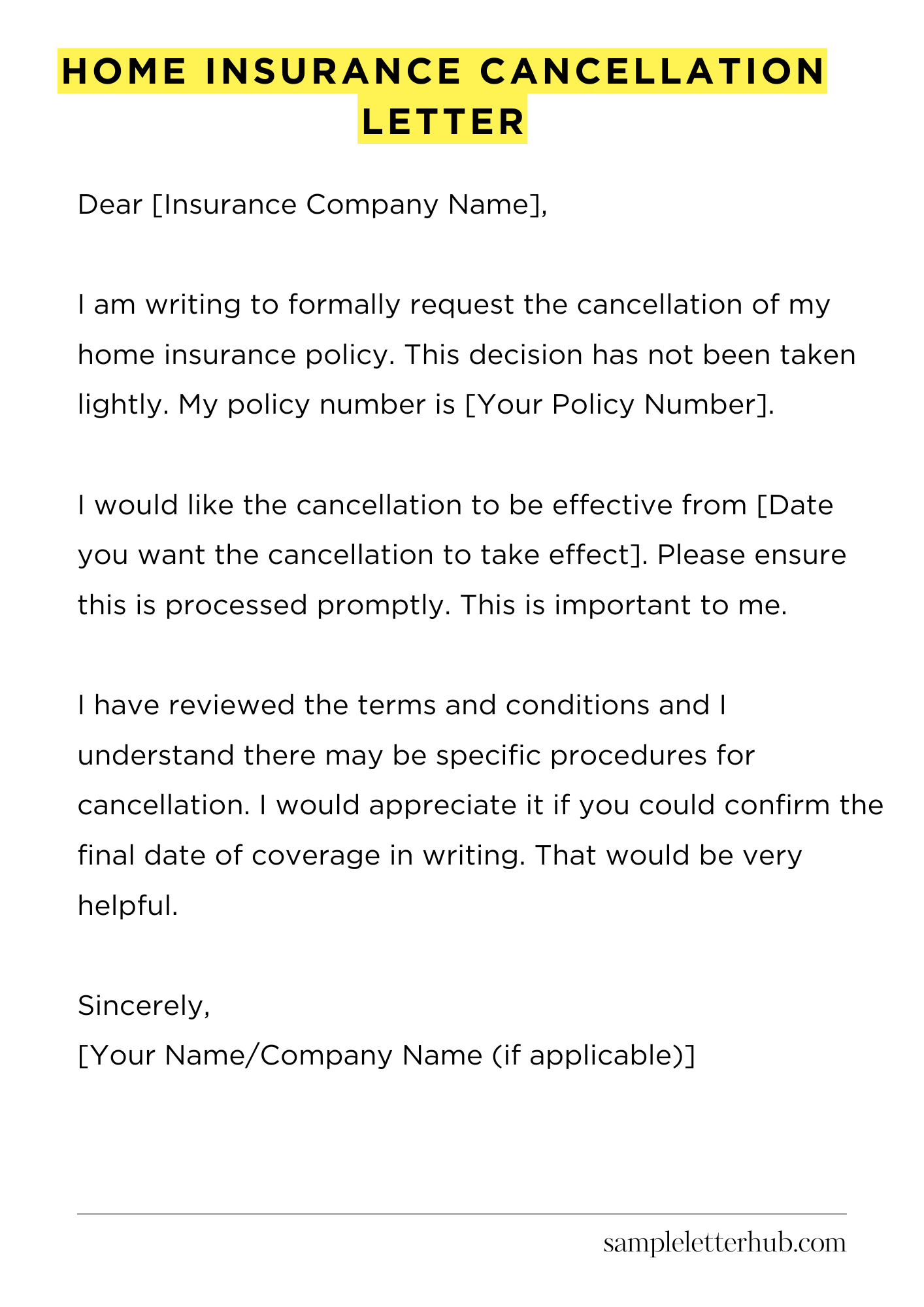
Dear [Insurance Company Name],
I am writing to formally request the cancellation of my home insurance policy. This decision has not been taken lightly. My policy number is [Your Policy Number].
I would like the cancellation to be effective from [Date you want the cancellation to take effect]. Please ensure this is processed promptly. This is important to me.
I have reviewed the terms and conditions and I understand there may be specific procedures for cancellation. I would appreciate it if you could confirm the final date of coverage in writing. That would be very helpful.
Also, please let me know if there are any outstanding premiums or if a refund is due. I want to make sure everything is properly settled. Kindly provide details regarding the return of any unearned premiums, if applicable.
I would appreciate receiving confirmation of the cancellation, along with a final statement, at my address. I am looking forward to hearing from you soon. This will help with my records.
Thank you for your time and assistance in this matter.
Sincerely,
[Your Name/Company Name (if applicable)]
How to Write Home Insurance Cancellation Letter
Canceling your home insurance policy might seem daunting, but with a structured approach, it becomes a navigable process. This guide provides a comprehensive framework for crafting a home insurance cancellation letter that is both effective and professional. Accuracy and clarity are paramount when dealing with insurance providers. Follow these steps to ensure a smooth transition.
1. Identify the Essential Information
Before you even begin to compose the letter, gather the necessary documentation. This is crucial. You’ll need your policy number, the full name of the policyholder(s), the address of the insured property, and the desired effective date of cancellation. Don’t overlook the policy’s start and end dates.
Be meticulous. This granular detail ensures the insurer can easily locate your policy in their system. Failing to provide complete information can lead to delays or complications.
2. The Salutation and Recipient
Address your letter with the utmost professionalism. Determine the correct recipient. Typically, this is the insurance company’s cancellation department or the underwriting department.
If you can’t find the contact information on your policy documentation, research the company’s website or call customer service. Use a formal salutation, such as “Dear [Insurance Company Name] Cancellation Department”. Maintain a professional tone from the outset; this sets a formal stage.
3. Clearly State Your Intent to Cancel
The core of your letter should unequivocally state your intention. Clearly articulate that you wish to cancel your home insurance policy. The language should be direct and unambiguous.
For example, begin the body of your letter with a statement like, “This letter serves as formal notification that I, [Your Name], wish to cancel my home insurance policy, policy number [Your Policy Number], effective [Desired Cancellation Date].” This straightforward approach minimizes the possibility of any misinterpretation.
4. Provide Specific Details Regarding Cancellation
Include the precise reasons for your cancellation, if applicable. Are you switching providers? Have you sold the property? Providing this context, while not strictly mandatory, can expedite the process and prevent follow-up requests. Note the details. Be as specific as you can.
Mention the new insurance policy details if transferring coverage to another company. If you’ve sold the property, provide the date of the sale. This gives additional clarity and will help the cancellation process.
5. Instructions on Refund and Confirmation
If you’re entitled to a refund, provide explicit instructions on how you’d like to receive it. State your preference. Request that the refund be issued to you by check, direct deposit, or other acceptable methods. Include your forwarding address if it differs from the property address.
Always ask for written confirmation of the cancellation. This confirmation serves as irrefutable proof of the cancellation and the date it took effect. This is the keystone. Be sure that you get confirmation.
6. The Formal Closing
Conclude your letter with a professional closing. Use a formal closing such as “Sincerely,” or “Respectfully,” followed by your full name and signature. This final step formalizes the document. Print your name clearly beneath your signature. This will enhance legibility and prevent any ambiguity regarding your identity.
7. Proofreading, Delivery, and Record Keeping
Before mailing the letter, meticulously proofread it for any grammatical errors or typos. Ensure all information is accurate and complete. Send the letter via certified mail with return receipt requested. This provides you with proof of delivery and the date it was received by the insurance company.
Keep a copy of the letter, the return receipt, and any other relevant documentation for your records. This is invaluable. These documents serve as an audit trail should any disputes arise in the future. Proper record-keeping is critical for your protection.
FAQs about Home Insurance Cancellation Letter
What information should I include in my home insurance cancellation letter?
Your cancellation letter should include your full name, address, policy number, the effective date of cancellation, and a clear statement requesting cancellation of your home insurance policy. You may also include a brief reason for cancellation, although this is usually not required. Make sure to sign and date the letter.
How do I know the effective date of my home insurance cancellation?
The effective date is the day your home insurance coverage officially ends. This date is usually specified by your insurance provider. You might find it in your policy documents or a prior communication. It’s crucial to specify the date in your cancellation letter to avoid any confusion.
How should I submit my home insurance cancellation letter?
Most insurance companies allow you to submit a cancellation letter via mail, email, or fax. Always retain a copy of the letter and proof of submission (e.g., a certified mail receipt or an email confirmation) for your records. Check your policy documents or contact your insurer to find out their preferred method.
Will I receive a refund after canceling my home insurance?
If you cancel your policy mid-term, you may be entitled to a refund for the unused portion of your premium. The amount of the refund depends on your policy terms and the timing of your cancellation. The insurer will typically calculate the refund based on a pro-rata basis. However, some policies may have cancellation fees.
What happens if I cancel my home insurance and don’t replace it?
Canceling your home insurance without having a new policy in place leaves you vulnerable. Without home insurance, you will not have financial protection if your home is damaged by covered perils such as fire, theft, or weather-related events.
Moreover, having no home insurance could violate the terms of your mortgage. Always ensure you have continuous coverage to protect your financial well-being.
Related:
Resignation letter due to rude boss
Resignation letter moving to another state
Resignation letter due to illness of family member
Resignation letter due to study