


A health insurance reconsideration request is your formal appeal. You are asking your health insurance company to re-evaluate a denied claim. It’s the process of fighting for coverage. The goal is to get your medical bills paid.
Dealing with denials can be confusing. We want to help you navigate it. We will share health insurance reconsideration request templates. You’ll find different examples. These samples cover various situations.
Our focus is simplicity. We provide sample letters. You can easily adapt them. Write your health insurance appeal with confidence. This will make your life easier. Let’s make this process a little less painful.
[Your Name/Address]
[Your Phone Number]
[Your Email Address]
[Date]
[Insurance Company Name]
[Insurance Company Address]
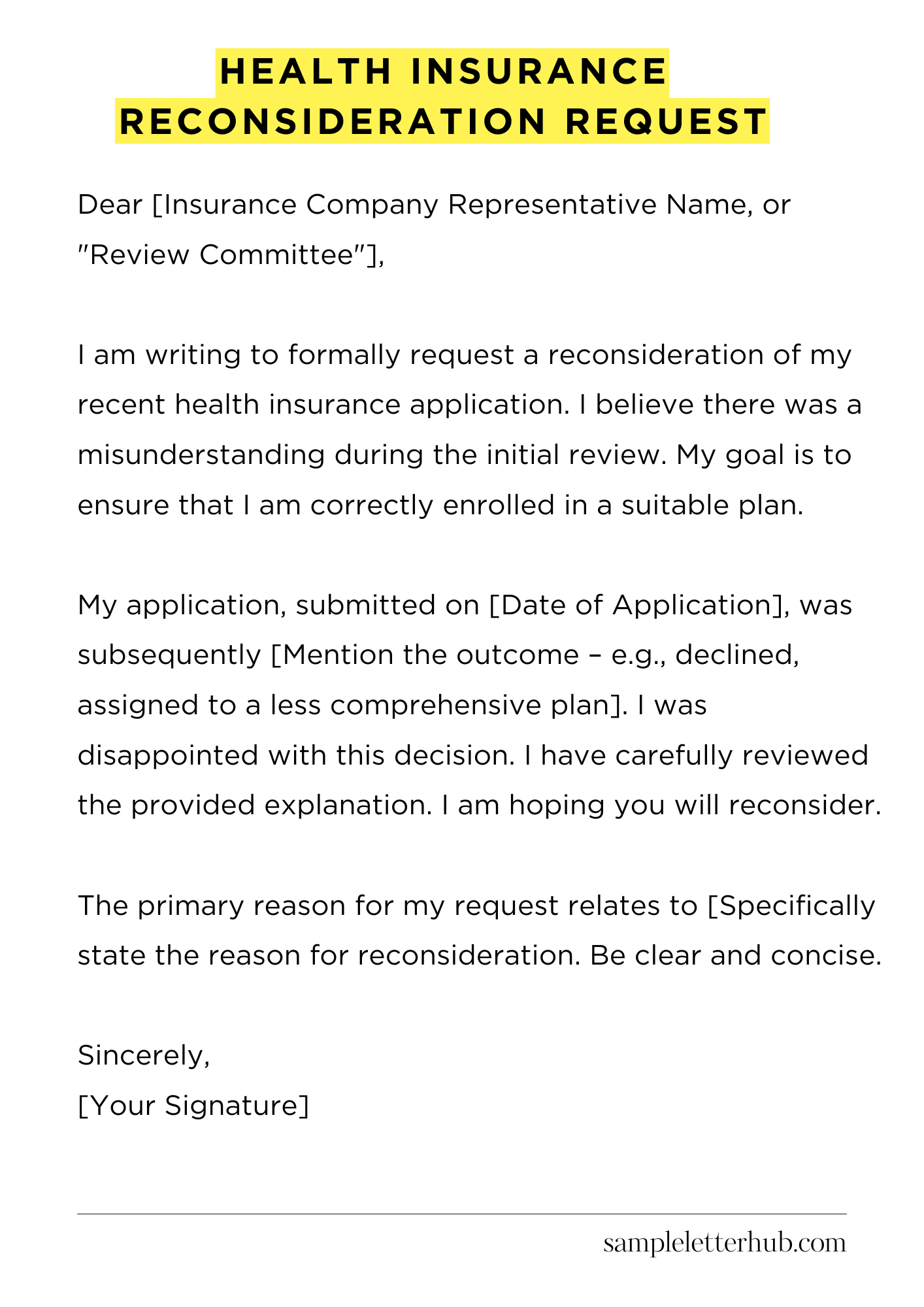
Dear [Insurance Company Representative Name, or “Review Committee”],
I am writing to formally request a reconsideration of my recent health insurance application. I believe there was a misunderstanding during the initial review. My goal is to ensure that I am correctly enrolled in a suitable plan.
My application, submitted on [Date of Application], was subsequently [Mention the outcome – e.g., declined, assigned to a less comprehensive plan]. I was disappointed with this decision. I have carefully reviewed the provided explanation. I am hoping you will reconsider.
The primary reason for my request relates to [Specifically state the reason for reconsideration. Be clear and concise. Examples: a pre-existing condition that is now well-managed; new information about my health; a change in my income that impacts my eligibility]. I would like to clarify some of the points made in the initial assessment.
[Provide specific details to support your request. Be factual and avoid emotional language. For example: “Regarding the reported diagnosis of [Condition], I have been receiving regular treatment from Dr. [Doctor’s Name] and my condition has stabilized. Attached is a letter from Dr. [Doctor’s Name] detailing my improved health.”]
I am also enclosing [List any supporting documentation, e.g., doctor’s notes, medical records, proof of income]. These documents should provide additional clarity and support my request for reconsideration. This is important to me.
I understand the importance of providing accurate information. I am committed to maintaining my good health. I am available to answer any further questions you may have.
Thank you for your time and consideration of this important matter. I look forward to a positive response.
Sincerely,
[Your Signature]
How to Write Health Insurance Reconsideration Request
1. Understanding the Denial – The Precipitating Factor
Before you even think about penning your reconsideration request, you must thoroughly grasp the rationale behind the denial. Scrutinize the rejection letter meticulously. It will serve as your lodestar.
Scrutinize the specific codes and stipulations cited. These are the building blocks of your rebuttal, the precise points you must address. Failure to thoroughly interpret the initial denial is akin to entering a labyrinth blindfolded.
2. Gather the Relevant Ammunition – Assembling the Arsenal
Compile an irrefutable portfolio of documentation. This is your arsenal. Gather all pertinent medical records: physician notes, lab results, imaging reports, and any other evidence that supports your claim.
Dig for policy documentation detailing the insurance provider’s coverage parameters. Any supplementary materials that can substantiate your case – expert opinions, published research, prior authorizations – should be included. Omitting key evidence will significantly weaken your appeal.
3. Structuring Your Request – The Architecture of Persuasion
Your reconsideration request must be a paragon of clarity and conciseness. Begin with a formal salutation and clearly identify the denied service or procedure. State your policy number and the denial reference number.
Then, provide a succinct overview of the medical necessity for the treatment. This serves as the prologue to your central argument. Ensure your tone is professional, yet emphatic; this isn’t merely a request; it’s a plea for just compensation.
4. Addressing the Denial – The Core of Your Argument
Here is where you directly counter the insurance company’s reasoning. Systematically address each reason for denial cited in their letter. Provide specific evidence from your medical records to refute their assertions.
If the denial hinges on the “medical necessity” of a treatment, emphatically explain why it is essential. Support your arguments with specific examples from your medical condition. Use clinical terminology if appropriate, demonstrating your comprehension. Avoid being equivocal; be definitive in your responses.
5. Presenting Your Supporting Evidence – The Evidentiary Narrative
Meticulously organize your supporting evidence. Reference each document you include by its title or date, and briefly explain its relevance to your case. If submitting voluminous records, consider creating an appendix or an exhibit list.
Avoid simply dumping a pile of documents; instead, weave them into a coherent narrative that validates your claim. Ensure your evidence demonstrably supports your assertions, building an undeniable case.
6. Reinforcing Your Position and the Call to Action – The Closing Gambit
Conclude your request by reiterating the necessity of the denied treatment and its impact on your health. This is your persuasive denouement. Restate your policy number and any relevant claim numbers. Include a clear and direct “ask,” requesting that the denial be overturned and the treatment approved.
Provide your contact information, along with any necessary instructions for correspondence. Always thank the reviewer for their consideration. This adds a degree of civility to your rebuttal.
7. Submission and Follow-Up – The Final Act
Before submission, proofread your entire letter meticulously. Check for grammar, spelling, and clarity. Make a copy of everything for your records. Send the request via certified mail with return receipt requested.
This provides definitive proof of delivery and receipt. If you do not receive a response within the allotted timeframe, follow up promptly by contacting the insurance company by phone and making a written inquiry. Keep detailed records of all communication. This follow up can sometimes push the insurance provider to speed up the process.
FAQs about Health Insurance Reconsideration Request
What is a health insurance reconsideration request?
A health insurance reconsideration request is a formal appeal you submit to your insurance company when a claim for medical services or prescription drugs has been denied, or if you disagree with the amount the insurer has paid. It allows you to present additional information or argue why the initial decision should be overturned.
When should I submit a reconsideration request?
You should submit a reconsideration request if your health insurance claim has been denied, or if you believe the insurer has not paid the correct amount for a covered service. This is particularly important if you received necessary medical care and face significant out-of-pocket costs due to the denial or underpayment.
What information do I need to include in a reconsideration request?
A strong reconsideration request typically includes your policy number, the claim in question, the reason for the initial denial, any supporting documentation (e.g., medical records, doctor’s notes, itemized bills), and a clear explanation of why you believe the denial should be reversed or the payment should be adjusted.
Always check your insurance plan’s specific requirements, as they may require specific forms or formats.
What is the process for submitting a reconsideration request?
The process usually involves obtaining the denial notice, gathering all necessary supporting documentation, and then submitting the request to your insurance company. Often, this is done via mail, fax, or an online portal. Be sure to adhere to any deadlines stated in the denial notice or your plan documents, and keep records of all correspondence.
How long does it take to receive a response to a reconsideration request?
The timeframe for receiving a response varies depending on the insurance company and the complexity of the claim. Generally, insurers have a set amount of time, often dictated by state or federal regulations, to review and respond to a reconsideration request.
Check your plan documents or the denial notice for the specific timeframe. If you don’t receive a response within the allotted time, follow up with your insurer.
Related:
Resignation letter due to rude boss
Resignation letter moving to another state
Resignation letter due to illness of family member
Resignation letter due to study